
Decoding Influence: Exact Topology Inference in Networks with Confirmation Bias
On Network Topology Inference of Social Networks
The paper introduces a novel framework for the exact inference of directed social network topologies and confirmation bias parameters from observed agent opinion states. By leveraging a piece-wise linear confirmation bias model within a cyber-social network structure, the authors propose an algebraic method to reconstruct hidden influence weights and bias coefficients without requiring external stimulation for every node.
TL;DR
Researchers Yanbing Mao and Emrah Akyol have developed a mathematical "X-ray" for social networks. By observing how opinions shift over time, their method can exactly reconstruct who influences whom and quantify the "confirmation bias" of individual users—even in directed networks where previous methods failed.
Context: The Limits of Visibility
Understanding the hidden architecture of social networks is critical for everything from public health messaging to fighting "fake news." However, we rarely see the underlying "edges" (who listens to whom); we only see the "states" (the opinions posted).
Previous attempts at "Exact Inference" generally fell into two traps:
- Intrusiveness: Requiring "node knockout" (forcing specific people to stay silent), which is impossible in free societies.
- Symmetry Bias: Relying on undirected graph assumptions. As the authors prove, once a network grows beyond 4 agents, standard Lyapunov-based methods cannot solve for directed (asymmetric) influence because the number of unknowns outpaces the available equations.
The Core Insight: Exploiting Bias
The authors leverage a specific model of Confirmation Bias. In this model, agents don't just listen to information sources; they listen more to sources that already align with their views.
Mathematically, this introduces a state-dependent weight into the system:
While state-dependence usually makes systems harder to analyze, here it provides a unique "fingerprint." By controlling information sources (e.g., setting them to a baseline opinion), the researchers transform a chaotic social evolution into a structured linear problem.
Methodology: The P and Q of Networks
The heart of the paper is a transition toward using difference-based matrices. Instead of just looking at raw opinion states, the authors construct two matrices, and :
- : Captures the energy of opinion changes over time.
- : Captures how those changes propagate to the next time step.
Model Architecture
The interaction occurs at two layers: the Social Layer (agent-to-agent) and the Cyber Layer (information source-to-agent).
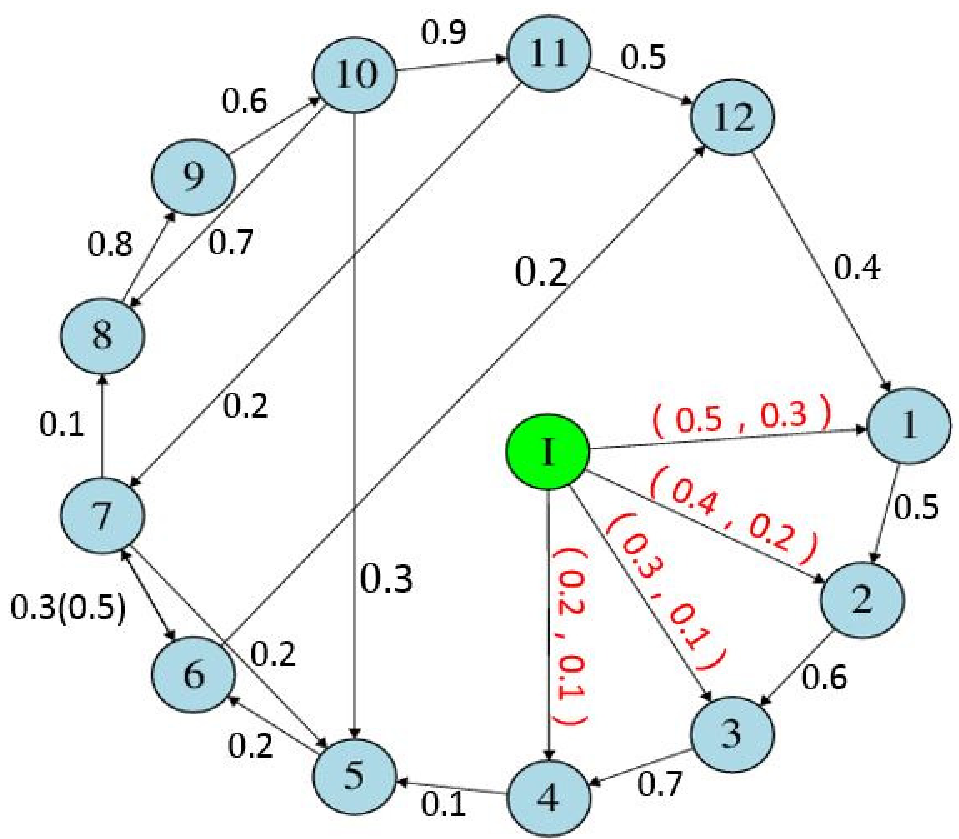 Fig 1. The Real Social Network: Influence weights () and confirmation bias parameters () are coupled with directed links.
By solving the equation , where is the matrix containing both hidden social weights and bias-related parameters, the topology is revealed.
Experiments & Results
In a simulation of 12 agents with a complex directed topology, the authors demonstrated that if the matrix is full rank (meaning the opinions have evolved with enough "diversity"), the reconstruction is perfect.
Performance Evidence
The algorithm was able to extract specific weighted links that are invisible to the naked eye:
- It correctly identified social weights like .
- It decoupled the Innate Opinion (what a person naturally believes) from the Confirmation Bias (how much they filter new info).
| Parameter | Ground Truth | Inferred Value | Result |
|---|---|---|---|
| Link (2,1) | 0.5 | 0.5000 | Exact |
| Bias | 0.3 | 0.3000 | Exact |
| Resistance | 0.5 | 0.5000 | Exact |
Critical Analysis & Conclusion
This work moves beyond "guessing" network structures using correlations. It provides a rigorous algebraic solution for directed graphs, filling a major gap in Network Science.
Limitations: The method assumes a global capability—it needs to see everyone's opinions at every time step. In the real world, "lurkers" or private accounts create "latent nodes" that would break the full-rank requirement of matrix .
Future Outlook: The next frontier is Adversarial Inference. If an actor knows they are being monitored, can they adjust their opinions to "mask" the network topology? The authors hint at a future where we study the trade-off between controlling a network's opinion and hiding its structure.