
NCP Framework: Why "Simple" Networks Lead to Better Patient Responsibility
Towards a networks-enabled complexity profile for examining responsibility for decision-making by healthcare professionals
This paper introduces a "Networks-enabled Complexity Profile" (NCP) to quantify the complexity of general practitioners' (GPs) work environments. By analyzing 107 rural GPs, it demonstrates that those in "simple" network structures exhibit higher accountability and more positive attitudes toward collaborative patient decision-making.
TL;DR
Is a doctor with more professional connections necessarily a better doctor? This research challenges the "more is better" dogma in healthcare networking. By applying social network analysis (SNA) to 107 rural GPs, the authors found that clinicians embedded in "simpler" professional structures—fewer components and lower interrelatedness—are more likely to take responsibility for treatment decisions and involve patients in the process.
Academic Positioning: This paper moves complexity science from a descriptive metaphor to a quantitative diagnostic tool, providing an empirical bridge between social network topology and clinical attitudes.
The Motivation: Moving Beyond Descriptive Complexity
In medical literature, "complexity" is often used as a vague buzzword for "difficult." While complexity thinking suggests that the relationships between parts are more vital than the parts themselves, there has been a lack of a robust, empirical way to profile individual clinicians.
The authors argue that a GP's professional environment (colleagues, specialists, nurses) acts as a Complex Adaptive System. If this system becomes too "interrelated," the resulting cognitive and task load might actually degrade the quality of care—specifically, the GP's willingness to engage in shared decision-making with the patient.
Methodology: Quantifying the "Unquantifiable"
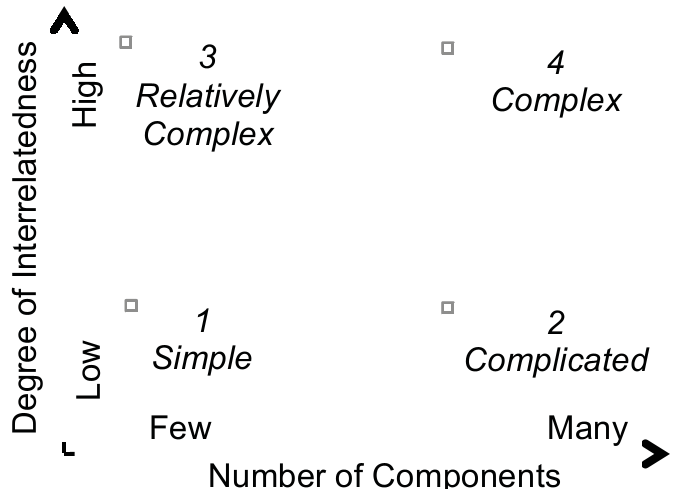
The core contribution is the Complexity Profile, which plots clinicians across two dimensions:
- Number of Components (NoC): The size of the professional network.
- Degree of Interrelatedness (DoI): A value derived from:
- Inclusiveness: Proportion of actors who are connected.
- Density: The ratio of actual ties to maximum possible ties.
By combining these, the researchers identified four distinct profiles:
- Simple: Low NoC, Low DoI (e.g., a solo practitioner with a streamlined workflow).
- Complicated: High NoC, Low DoI (e.g., a receptionist handling many disparate but independent calls).
- Relatively Complex: Low NoC, High DoI (e.g., a small, intense Emergency Department team).
- Complex: High NoC, High DoI (e.g., multi-disciplinary teams in a disaster zone).
Key Findings: The Paradox of Connection
The study used t-tests to compare these profiles against "Responsibility for Decision-Making" scores.
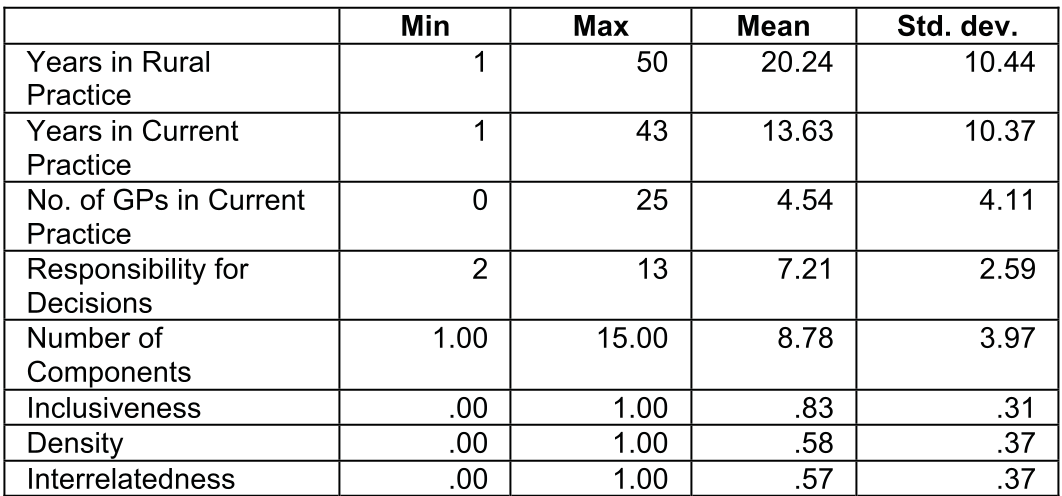
- The "Simple" Advantage: GPs in the "Simple" quadrant scored significantly higher (M=8.37) than those in "Complex" (M=6.31) or "Complicated" (M=6.22) quadrants.
- Cognitive Load & Redundancy: The authors hypothesize that in high-complexity networks, GPs suffer from "information redundancy" and excessive interaction costs. When a GP is overwhelmed by the "noise" of their professional network, they are less likely to invest the extra time needed for patient-centered consultation.
Critical Insight: Quality Over Quantity
The research suggests that professional networks have a "saturation point." While a doctor needs connections to provide care, a network that is too dense creates a clique structure where information travels fast but adds little new value, merely increasing the coordination burden.
Limitations & Future Outlook
- Context Sensitivity: The study focuses on rural Australian GPs. Complexity might be perceived differently in urban, high-resource settings.
- Relational Intensity: The model focuses on the structure of ties but not yet the content or quality of the information being exchanged.
Conclusion
This paper provides a wake-up call for healthcare administrators. Instead of simply encouraging "more collaboration," we must design efficient networks. By reducing unnecessary interrelatedness (the "Complex" to "Simple" transition), we can free up a clinician's cognitive resources, indirectly improving their professional responsibility and patient engagement.
Takeaway for Practitioners: A lean, non-redundant professional network is often more conducive to high-quality, patient-centric care than a sprawling, interconnected one.