
Beyond Content: Leveraging Emotion Dynamics for Neural Gender Prediction
Neural Gender Prediction in Microblogging with Emotion-aware User Representation
The paper introduces a Neural Gender Prediction (NGP) approach for social media users by leveraging an emotion-aware hierarchical user representation. It utilizes hierarchical attention networks to weigh the importance of specific words and messages, achieving state-of-the-art results on NLPCC and Weibo datasets.
TL;DR
In the world of social media analytics, "what" you say is important, but "how" you feel while saying it might be the key to identifying who you are. This paper presents an Emotion-aware Hierarchical User Representation model that treats a user's social media history not as a flat text block, but as a structured hierarchy of affective expressions. By integrating emotion signals via multi-task learning and dual-level attention, the researchers achieved significant performance gains in gender prediction on platforms like Weibo and Twitter.
Problem & Motivation: The Noise in the Crowd
Most existing gender prediction pipelines suffer from two major flaws:
- Structural Oversimplification: They merge all user posts into one giant string, effectively washing out the high-signal "nuggets" (like a post about a specific hobby) with mundane noise (like "Good morning").
- Emotional Blindness: Men and women often exhibit different linguistic patterns in emotional expression. For instance, research suggests female users may use specific adjectives like "cute" or "wonderful" more frequently or in different contexts than male users.
The authors argue that a model must be both selective (using attention to find key messages) and emotionally intelligent (capturing the underlying sentiment) to be truly effective.
Methodology: The Hierarchical Affective Engine
The proposed Neural Gender Prediction (NGP) framework operates on a hierarchy that mirrors how we naturally read a social media profile.
1. The Hierarchical Architecture
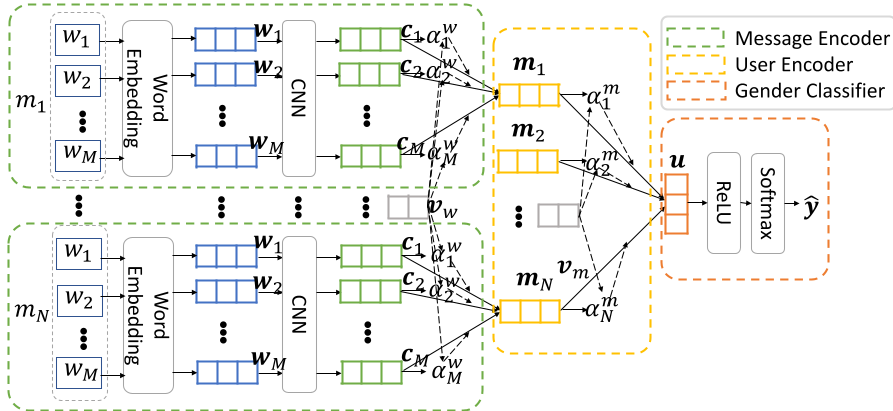
The model consists of a Message Encoder (Word -> Message) and a User Encoder (Message -> User).
- Word-Level Attention: Not every word is equal. In "I love this lipstick," the word "lipstick" carries a much higher gender-predictive weight than "this."
- Message-Level Attention: A user who posts 100 times might only have 5 posts that clearly signal their gender. The model uses attention to "focus" on those 5 posts while ignoring the 95 generic ones.
2. Injecting Emotion
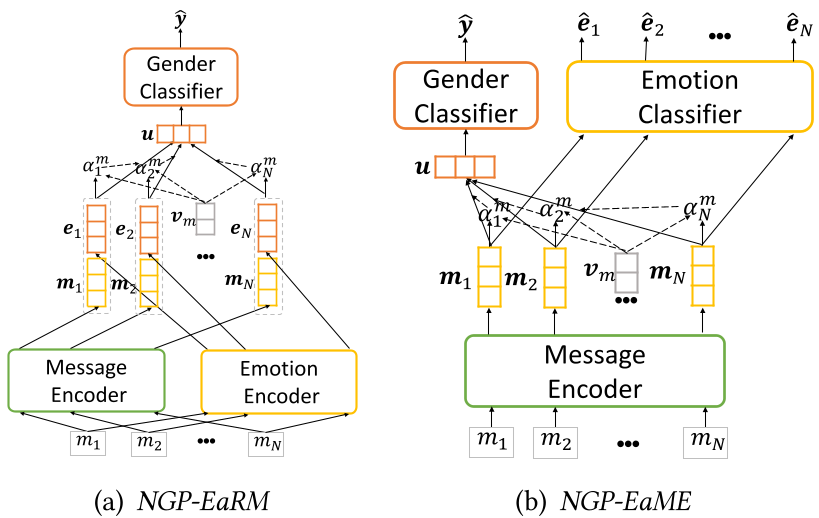
The brilliance of this paper lies in how it forces the model to care about feelings. They tested two specific approaches:
- NGP-EaRM (Emotion-aware Representation): Uses a pre-trained emotion model to extract a "sentiment vector" for each post, which is then fused with the content vector.
- NGP-EaME (Emotion-aware Message Encoder): A multi-task learning setup where the model is simultaneous trained to predict gender and classify emotion. This forces the internal CNN layers to learn features that represent both "topic" and "affect."
Experiments & Key Results
The researchers evaluated their model on the NLPCC and Weibo datasets.
- Beating the Baselines: The NGP-EaME and NGP-EaRM models consistently outperformed traditional LSTM and CNN approaches.
- Attention Matters: As shown in the ablation studies, the combination of word-level and message-level attention provides a compounding benefit. Without message-level attention, the model gets "lost" in the user's generic posts.
- The Multi-Task Sweet Spot: The weight of the auxiliary emotion task () is crucial. A value of 0.3 proved optimal—enough to influence the features, but not so much that it distracted from the primary goal of gender classification.
Critical Analysis & Conclusion
This work represents a step forward in User Modeling by successfully marrying structural hierarchy with affective computing.
Takeaway: If you want to understand the demographics of a user base, don't just look for keywords—look for the emotional fingerprints left behind across their history.
Limitations: While effective, the model relies on a fixed emotion classifier or labeled emotion data. In environments where emotional language is highly sarcastic or evolving (like internet slang), the "emotion-aware" component might require frequent retraining. Future work could look into unsupervised emotion discovery to make the system more robust to shifting social media dialects.