
JNTM: Bridging the Gap Between Social Circles and Spatial Footprints
A Neural Network Approach to Jointly Modeling Social Networks and Mobile Trajectories
This paper presents JNTM (Joint Network and Trajectory Model), a neural network framework that simultaneously models social network structures and mobile trajectories. It leverages network embeddings and dual-level sequential modeling (RNN and GRU) to achieve SOTA performance in location and friend recommendations.
Executive Summary
TL;DR: The "Joint Network and Trajectory Model" (JNTM) is a pioneering deep learning framework that treats social connections and geographical movements not as separate entities, but as two sides of the same coin. By combining network embedding with a hierarchical sequential architecture (RNN + GRU), it captures everything from immediate travel intent to long-term habits, significantly outperforming traditional Markov-based models in both location and friend recommendation tasks.
In the academic landscape, this work moves beyond simple collaborative filtering, establishing a sophisticated neural pipeline for Location-Based Social Networks (LBSNs) that excels even when data is critically sparse.
Problem & Motivation: The Heterogeneity Challenge
Why is predicting your next check-in so difficult? Existing methods usually fall into two traps:
- The Markov Trap: They assume your next move depends only on your current location, ignoring the rich context of your past week or month.
- The Isolation Trap: They treat your social graph (who you know) and your trajectory (where you go) as independent datasets.
The authors' key insight is the Homophily Principle in a spatial context: people who visit the same places are likely to be friends, and friends influence each other's future destinations. Modeling these as a single, joint generative process allows the "dense" signals of a social graph to rescue the "sparse" signals of a new user's trajectory.
Methodology: The Four Pillars of Human Movement
The JNTM architecture is built on four core factors that drive mobile trajectories:
- General Visit Preference: Represented by a stable "Interest Embedding" for each user.
- Influence of Friends: Encoded via shared "Network Embeddings" learned from social links.
- Short-term Context (The RNN Layer): Captures immediate transitions (e.g., "Gym → Coffee Shop") within a 6-hour window.
- Long-term Context (The GRU Layer): Uses a Gated Recurrent Unit to remember significant patterns across months, avoiding the "vanishing gradient" problem of standard RNNs.
Architecture Overview
The model ties these factors together by concatenating the embeddings into a single context vector used to predict the next location via a softmax layer (optimized with negative sampling).
The JNTM architecture demonstrates how user interest, social ties, and sequential contexts are fused.
Experiments & Results: Dominance in Data Sparsity
The researchers evaluated JNTM on two massive datasets: Gowalla and Brightkite.
1. Next-Location Prediction
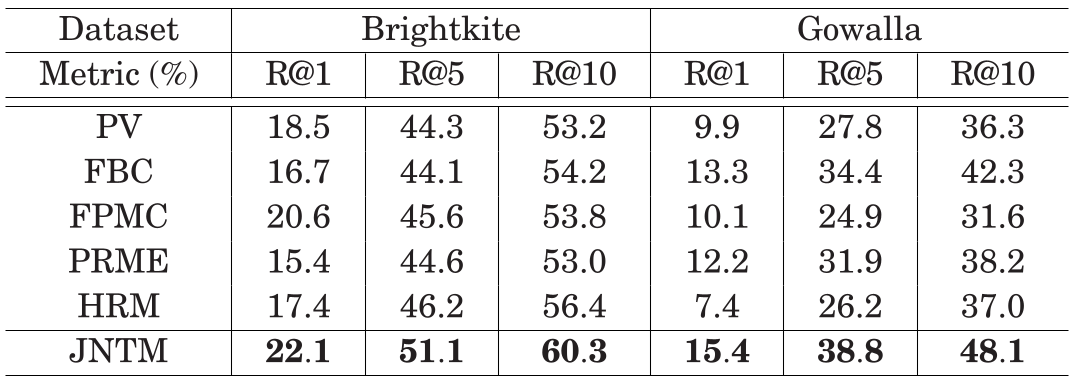
JNTM consistently outperformed SOTA baselines like FPMC and PRME. The most striking results appeared in the cold-start analysis. For users with fewer than 5 subtrajectories, JNTM's ability to "borrow" information from the social graph led to a massive performance advantage.
2. Friend Recommendation
Does your movement predict your friends? Absolutely. JNTM outperformed DeepWalk in scenarios where the social network was sparse, proving that trajectory similarity is a high-fidelity proxy for social strength.
3. Ablation: Why use both RNN and GRU?
The study shows that while RNNs are great for "immediate" next-step prediction, the addition of the GRU (Long-term) layer is vital for discovering "New" locations that a user hasn't visited before, capturing the latent curiosity or periodic habits of the user.
Critical Analysis & Future Outlook
JNTM is a robust solution for LBSNs, but it does have its limitations:
- Computational Overhead: Training a joint RNN-GRU-Network model is significantly more expensive than simple Matrix Factorization (approx. 50x slower in training time).
- Physical Dynamics: The current model treats locations as discrete IDs, ignoring the actual physical distance (longitude/latitude) which could provide even stronger priors (e.g., the Power Law of human mobility).
Conclusion: This paper marks a transition from "feature engineering" for LBSNs to "representation learning." By proving that social and spatial data are deeply intertwined through shared neural embeddings, it sets a new standard for how we build recommendation engines in an increasingly mobile world.