
NeuralWalk: Moving from Deductive Assumptions to Inductive Learning in Trust Social Networks
NeuralWalk: Trust Assessment in Online Social Networks with Neural Networks
This paper introduces NeuralWalk, an inductive trust assessment algorithm that utilizes a specialized neural network architecture called WalkNet to model trust propagation and fusion in social networks. It successfully maps categorical trust ratings to vector-based trust opinions, achieving SOTA performance on Advogato and PGP datasets.
TL;DR
Assessing trust in Online Social Networks (OSNs) is a balance between mathematical theory and messy real-world data. NeuralWalk breaks the tradition of using hard-coded "logic rules" for trust. By introducing WalkNet, it learns how trust propagates and fuses directly from data, effectively bridging the gap between simple user ratings and complex trust opinions.
The Problem: The "Assumption Trap"
Most existing trust inference models like TidalTrust or OpinionWalk are deductive. They assume rules like "the friend of my friend is my friend" are universal truths. However, human sociology is rarely that simple.
Furthermore, sophisticated models often require "Trust Opinions" (Belief, Distrust, Uncertainty), but real-world datasets like Advogato only provide "Trust Ratings" (Levels 1-4). This mismatch forces researchers to use heuristic "hacks" that introduce significant errors.
Methodology: The WalkNet Architecture
The core of the NeuralWalk algorithm is WalkNet, a neural network designed to simulate single-hop trust behavior.
1. Rating to Opinion Transformation
NeuralWalk doesn't just treat "Level 4 Trust" as a number. It uses a non-linear transformation: This converts a one-hot rating vector into a multi-dimensional opinion vector, allowing the model to capture latent evidence features.
2. Learning the Operators
Instead of manually defining the Discounting (propagation) and Combining (fusion) operators, WalkNet uses neural layers:
- Discounting: Modeled via pairwise multiplications of opinion components to capture non-linear interactions between trustors and intermediaries.
- Combining: Uses matrix multiplication to fuse multiple recommendations into a single consensus opinion.
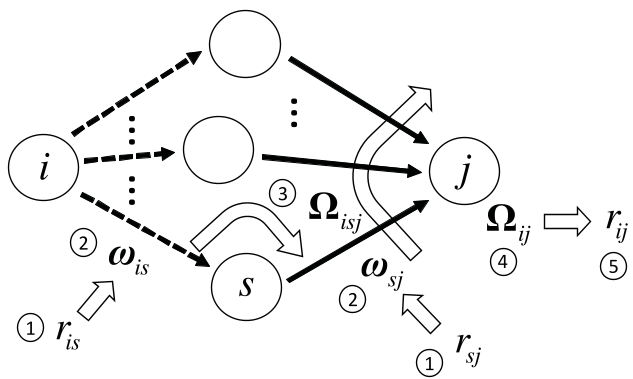 Fig 1: The 5-step process of WalkNet, from raw ratings to fused potential trust.
3. The "Walking" Process
To handle multi-hop trust (e.g., trusting a stranger through a chain of friends), the algorithm uses a Breadth-First Search (BFS) approach. It iteratively "walks" through the network, using the trained WalkNet to reveal unknown relations and adding them back into the graph for the next iteration.
Experimental Performance
The researchers tested NeuralWalk on Advogato and PGP datasets against strong baselines like Matri and OpinionWalk.
- Accuracy Boost: On the PGP dataset, NeuralWalk achieved an F1 score of 0.916, outperforming the second-best model (Matri) by a significant margin.
- MAE Reduction: The Mean Absolute Error (MAE) was slashed, showing that the model's predictions are much closer to actual human ratings than previous algebraic models.
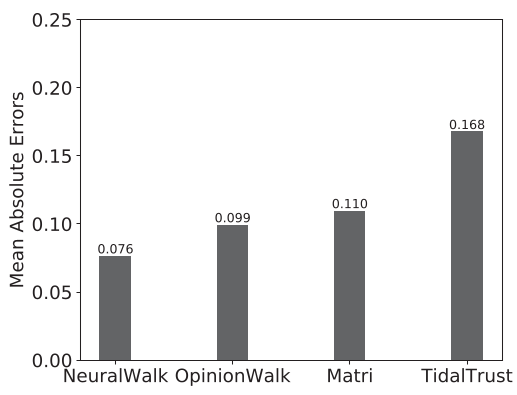 Fig 2: Comparison of F1 scores across different datasets. NeuralWalk (NW) consistently takes the lead.
Critical Insight: Why Inductive Wins
The primary reason for NeuralWalk's success is its Inductive Bias. By training on original trust relations (ground truths) and using Cross-Entropy Loss, the model adapts its internal representation of "trust" to the specific nuances of the specific community it is analyzing.
Moreover, the Boolean Matrix Implementation ensures that even though the process is iterative, it remains computationally efficient enough for large-scale OSNs ( complexity, but highly parallelizable).
Conclusion & Future Work
NeuralWalk represents a significant shift from "defining" trust to "learning" trust.
- Takeaway: The mapping mechanism between ratings and opinions is a masterstroke for making theoretical trust models practical.
- Limitations: While powerful, the BFS approach might face scalability issues on massive graphs with billions of edges without further optimization.
- Prospects: Future iterations could integrate Graph Convolutional Networks (GCNs) or Attention Mechanisms to replace the BFS "walking" with a more global contextual understanding.
Author: Senior Academic Tech Editor