
Refining Dementia Screening: How ML Makes Cross-Cultural Diagnostics Faster and Smarter
Refinement of Neuro-psychological Tests for Dementia Screening in a Cross Cultural Population Using Machine Learning
The paper presents a machine learning-based approach to refine the Cross-Cultural Neuropsychological Test Battery (CCNB) for dementia screening. By employing algorithms like C4.5 and CART, the authors developed a shortened screening tool (CASI-MMSE-M) that maintains high diagnostic accuracy while significantly reducing clinical administration time.
TL;DR
Researchers have successfully used Machine Learning (ML) to "prune" a complex 90-minute dementia screening battery into a concise, clinically interpretable 4-to-6 question set. By focusing on the CASI-MMSE-M subset, the study achieved an accuracy of 84.21%, proving that automated feature selection can improve both the speed and cultural fairness of neuro-psychological assessments.
The Problem: The High Cost of Knowing
As the global population ages, early detection of dementia is critical. However, clinicians face two major hurdles:
- Time Constraints: Standard batteries like the CCNB are exhaustive, often taking over an hour and a half to administer.
- Cultural Bias: Many diagnostic tools are designed for Western, English-speaking populations, failing to account for education levels and cultural nuances in minority elders.
The authors recognized that to be effective, a screening tool must be fast, reliable, and interpretable for healthcare providers.
Methodology: Pruning the Cognitive Tree
The study utilized a dataset of 114 individuals (57 cases, 57 controls) from diverse backgrounds (African-American, Chinese, Hispanic, and Vietnamese). They compared the performance of several ML algorithms on various subsets of the Cognitive Abilities Screening Instrument (CASI).
Why Decision Trees?
Unlike "black-box" models (like Neural Networks), the researchers prioritized C4.5 and CART. In medicine, the why matters as much as the what. A decision tree provides a visible path: if a patient fails the "Day-of-week" question and a "Short-term memory" task, the risk of dementia is quantitatively assessed.
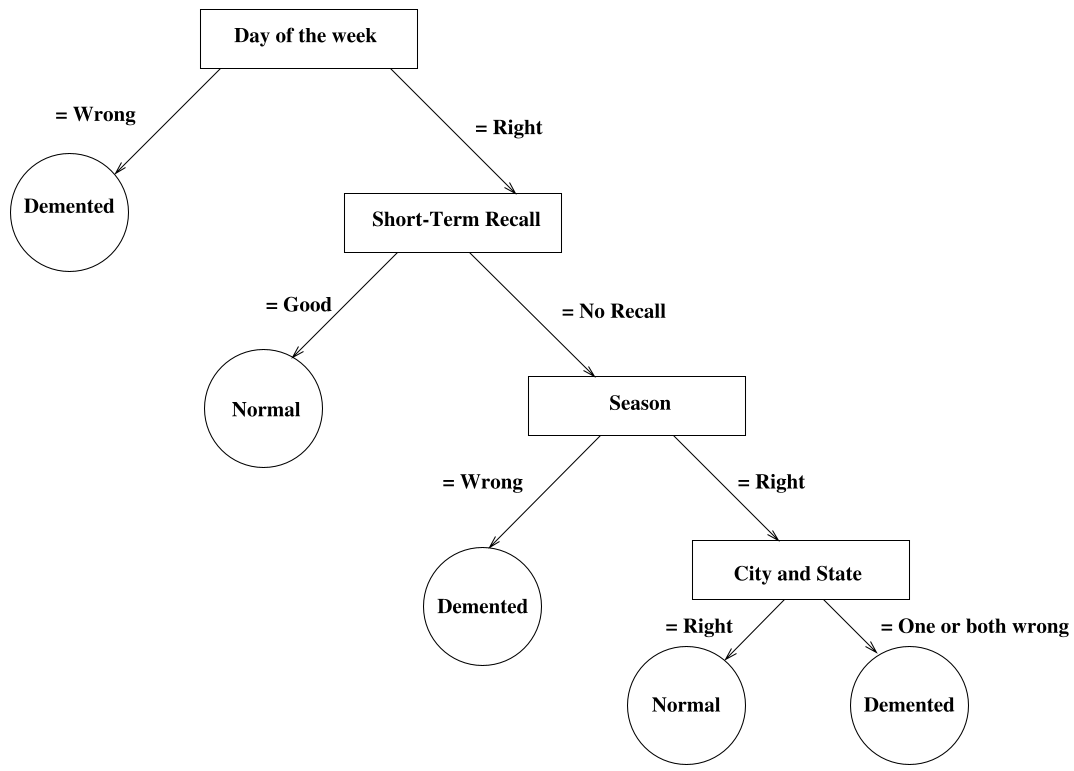 Figure 1: A sample decision tree illustrating the logical flow from basic orientation to memory recall.
Experimental Results: Less is More
The most striking finding was that the CASI-MMSE-M (a subset based on Mini-Mental State Exam items) actually yielded better accuracy than the full, laborious battery.
| Algorithm | Full Battery Accuracy | Optimized Subset Accuracy |
|---|---|---|
| C4.5 | 82.46% | 84.21% |
| Naive Bayes | 85.96% | 82.46% |
| FOCL | 84.20% | 78.10% |
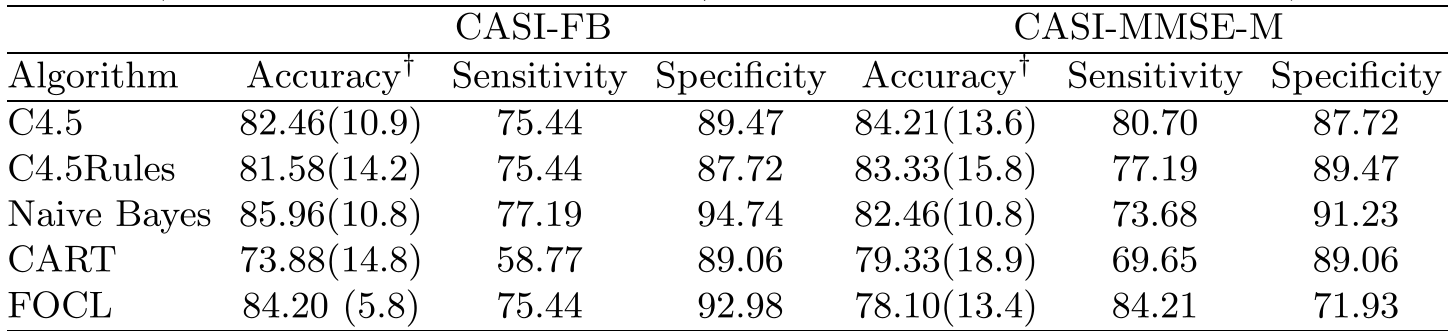
The C4.5 algorithm stood out by increasing sensitivity to 80.70% on the subset, which is vital for a screening tool where missing a positive case (False Negative) is the costliest error.
The "Day-of-Week" Insight
The ML models consistently highlighted specific attributes as high-value predictors:
- Orientation: Knowing the day of the week or the season.
- Recall: Short-term memory tasks.
By ranking these features, the researchers showed that the majority of the 100-point CASI scale was redundant for the specific task of initial screening.
Critical Analysis & Conclusion
Takeaway
This work acts as a bridge between high-level data mining and frontline clinical practice. It demonstrates that KDD (Knowledge Discovery in Databases) can strip away the noise in clinical datasets to find the "signal" that defines cognitive impairment across cultures.
Limitations
- Sample Size: With only 114 participants, the models need validation on larger, more diverse cohorts.
- Prevalence Bias: The study used a 50/50 split of cases and controls, which does not reflect the lower prevalence of dementia in the general population.
Future Outlook
The move toward "Intelligible ML" in healthcare is accelerating. This paper provided an early blueprint for how we can use algorithms not just to replace doctors, but to provide them with sharper, leaner, and more culturally equitable tools.