
NeuroGlasses: Decoding the Neural Impact of 3-D Vision via Wearable Sensing
12167_NeuroGlasses A Neural Sensing Healthcare System for 3-D Vision Technology.
Summary
Problem
Method
Results
Takeaways
Abstract
NeuroGlasses is a non-intrusive wearable physiological sensing system designed specifically for monitoring 3-D video watchers. It integrates EEG, ECG, and EOG sensors into a mobile healthcare framework to analyze the potential neural and physical side effects of 3-D vision technology.
## TL;DR
While 3-D movies and displays have become consumer staples, they carry hidden health risks like dizziness and neural strain. **NeuroGlasses** is a wearable physiological monitoring system that uses low-cost sensors and advanced signal reconstruction algorithms to track brain (EEG), heart (ECG), and eye (EOG) activity in real-time, revealing that 3-D content triggers significantly higher neural stress than 2-D content.
## Problem & Motivation: The Laboratory Gap
Despite warnings from manufacturers like Samsung about the hazards of 3-D technology (nausea, seizures, or dizziness), most empirical research has been confined to professional labs with bulky, expensive equipment.
The challenge of moving this to a "daily life" wearable is two-fold:
1. **Sensor Placement Sensitivity**: Slight shifts in a headband's position (left vs. right) drastically change signal morphology.
2. **Signal Contamination**: Low-cost sensors used in non-laboratory settings are plagued by Co-Channel Noise (CCN) and In-Band Distortion (IBD).
## Methodology: Signal Reconstruction & Architecture
The core innovation of NeuroGlasses lies in its ability to transform "dirty" data into clinical insights through a three-layer software architecture: **Sensor, Signal, and Application Layers**.
### 1. The NeuroGlasses Infrastructure
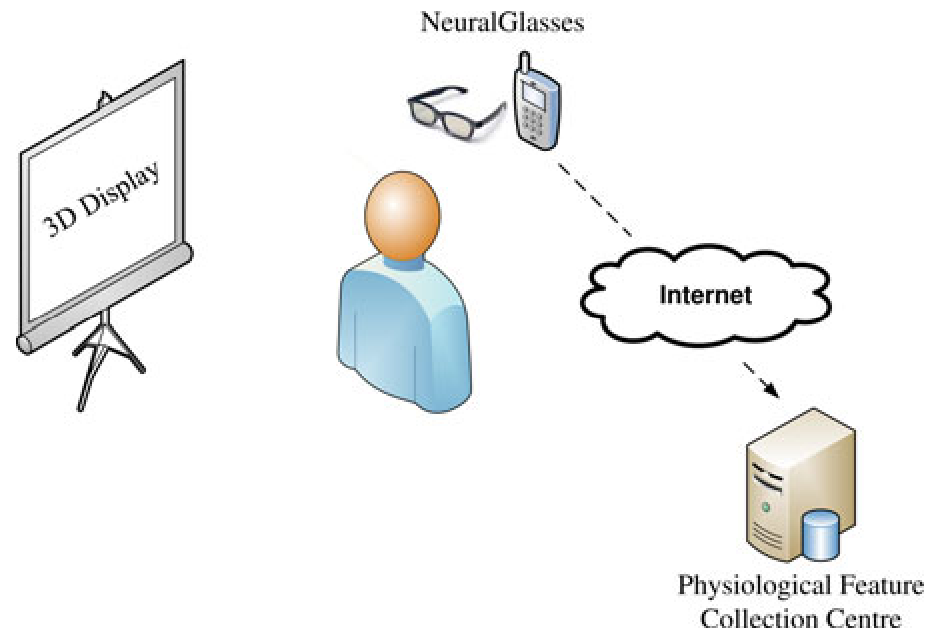
The system utilizes a 24-bit ADC front-end (OCZ NIA) that communicates with a central control unit (smartphone) which relays data to a server for long-term health analysis.
### 2. Feature-Based Reconstruction
To combat noise, the authors proposed a **moving-window algorithm**. It calculates a segmentation factor:
$$s\gamma = \frac{\partial f(t)}{\partial t}$$
When this factor hits a threshold, a "spike" or noise artifact is identified. For positive interference, the peak is removed; for negative, the peaks within the window are combined.
### 3. Location-Aware Correction
Since no user wears glasses the same way, the system models three forehead positions (left, center, right) and uses PCA-based feature adjustment to ensure the signals remain consistent regardless of the headset's fit.
## Experiments: 2-D vs. 3-D Reality Check
The team conducted a pilot study with 20 volunteers (10 male, 10 female) comparing their physiological responses to the same video content in 2-D and 3-D formats.
### Heart Rate Accuracy
Using the reconstructed ECG signals, the system calculated a heart rate of ~67 BPM, which was validated against commercial medical-grade heart rate meters, proving that the signal reconstruction was effective.
*Fig: (a) Raw noisy signal vs (b) Reconstructed ECG signal.*
### The "3-D Effect" on the Brain
The most striking result was the discrepancy in EEG and ECG activity. While 2-D viewing showed a constant, low-fluctuation mean value, 3-D viewing resulted in large variations and higher amplitudes in physiological signals. This suggests that the brain is significantly more "active" (and potentially stressed) when processing the binocular disparities required for 3-D vision.
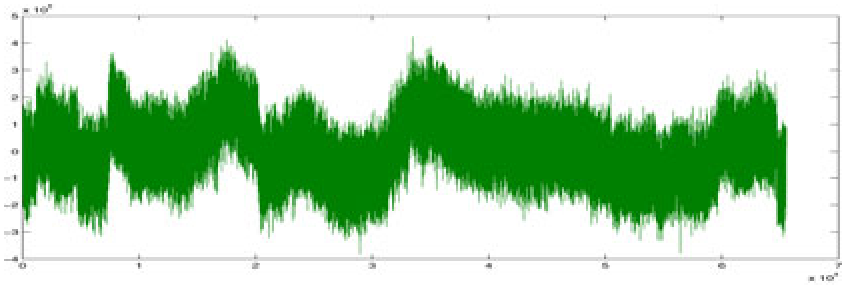
*Fig: EOG signals being corrected for different forehead positions.*
## Critical Analysis & Future Outlook
**Takeaway**: NeuroGlasses represents a critical shift from "reactive" healthcare (treating a seizure after it happens) to "preventative" monitoring. By embedding sensors into an object users already wear (3-D glasses), the system achieves high compliance.
**Limitations**: The current study uses a front-end (OCZ NIA) that is somewhat dated and has a high retail price relative to modern PCB-on-chip solutions. Furthermore, while it identifies *increased* activity, it doesn't yet categorize specific neural diseases.
**Future Work**: The authors aim to expand the feature extraction library to specifically identify the "pathogen" of 3-D sickness, potentially leading to "smart" 3-D glasses that can dim or switch to 2-D mode if the user's neural fatigue exceeds a safety threshold.