
Beyond Discrete States: A Neuro-Inspired Framework for Blended Agent Emotions
A Neuroscientific Approach to Emotion System for Intelligent Agents
The paper introduces a dynamic affective system for intelligent agents, rooted in neuroscientific models of the primate brain. It utilizes a four-module architecture (appraisal, emotion-generation, emotional expression, and long-term memory) to enable agents like the Philips iCat to process rewards/punishers and manifest simultaneous, blended emotional states.
TL;DR
Researchers have developed a dynamic affective system that moves away from the "one-emotion-at-a-time" limitation of traditional robots. By mimicking the reward/punishment processing of the primate brain, this system allows intelligent agents to feel and express multiple emotions simultaneously through a continuous blending mechanism.
Background: The Limits of Affect Space
For an agent to be truly "believable," it must mirror human emotional complexity. Most prior works, such as Sony’s Aibo, use an affect space where emotions are competitive. In these systems, if an agent is "Happy," it cannot be "Sad" or "Surprised" at the same moment. However, neuroscience shows that the human prefrontal cortex and amygdala allow for a much more nuanced orchestration of feelings.
Problem & Motivation
The core issue with existing models is their Winner-Take-All (WTA) nature. Humans rarely experience pure, isolated emotions; we experience transitions and mixtures. The authors argue that agents should not just "switch" states but "evolve" through them. Their motivation was to bridge the gap between ethological observation and neurobiological reality, specifically focusing on how the brain evaluates reinforcers (rewards and punishers).
Methodology: The Four-Pillar Architecture
The proposed system replaces simple state-switching with a biological pipeline:
- Appraisal Module: Acting like the orbitofrontal cortex, it evaluates if a stimulus is a "reward" or a "punisher" based on Long-Term Memory (LTM) and internal goals.
- Emotion Generation Module: This is the heart of the system. It contains Primary Emotion Units (innate reactions to loud noises, etc.) and Secondary Emotion Units (learned associations). Crucially, activation levels are calculated cumulatively: This allows multiple emotions to stay above the activation threshold at once.
- Emotional Expression Module: Instead of selecting one animation, it blends "basis facial postures."
- Long-Term Memory (LTM): Stores the "standards" for what is praiseworthy or desirable.
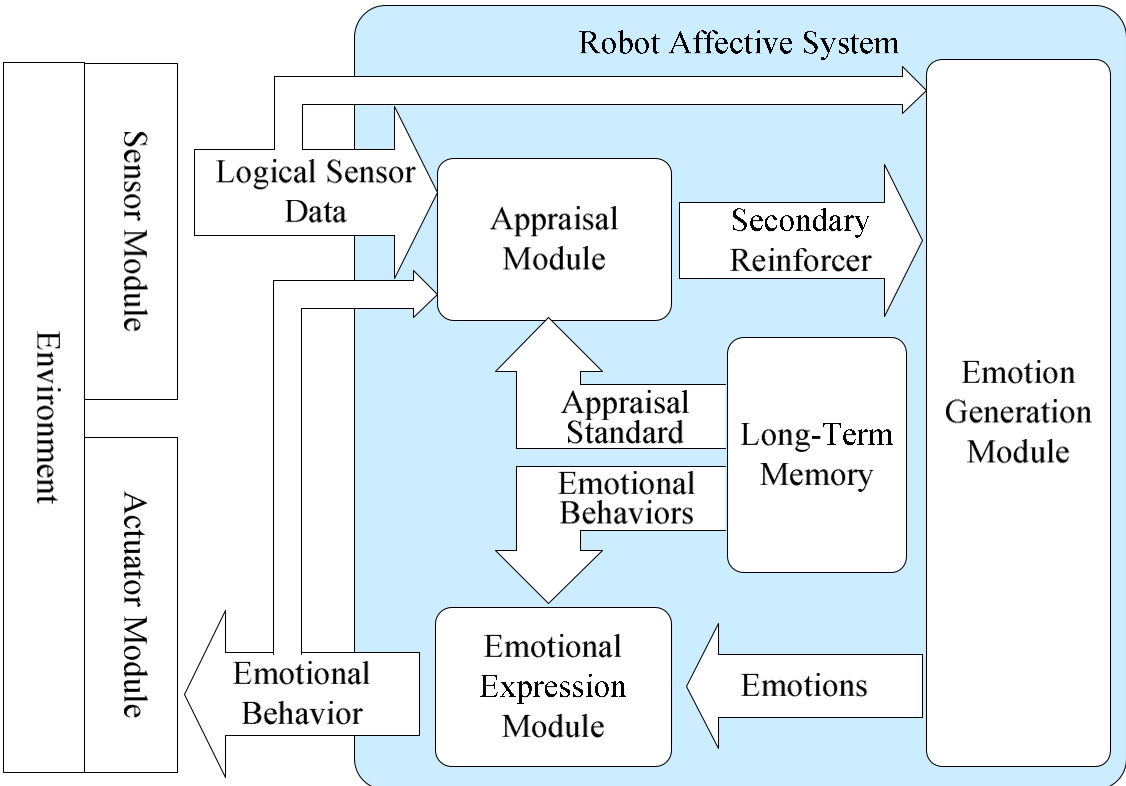 Figure 1: The overarching framework connecting sensors to neuro-inspired emotional processing.
Experiments & Results: The iCat Prototype
The system was tested on the Philips iCat, a robotic head with 13 servos for facial expressions. Unlike previous models that might abruptly snap from "Joy" to "Fear," the iCat demonstrated fluid transitions.
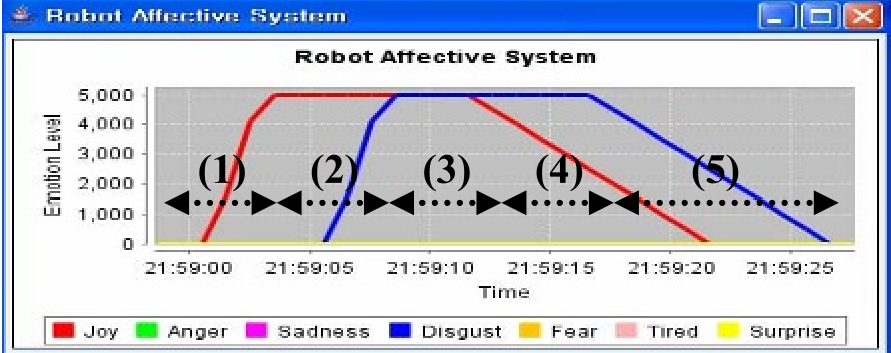 Figure 2: Real-time activation levels. Note how Joy (red) and Disgust (blue) coexist, leading to a complex blended expression rather than a binary state change.
The results showed that by using a decay factor () and mood gain parameters, the agent could exhibit "mood-congruent" behavior—recovering faster from negative stimuli when in a generally good mood.
Critical Analysis & Conclusion
Takeaway
The shift from discrete emotional states to continuous activation levels is a significant step toward agent believability. The inclusion of "Motivation" (homeostatic needs like 'tiredness') adds a layer of survival-driven realism that many cognitive models lack.
Limitations
While the system captures the "How" of emotional blending, the "What"—the stimulus-reinforcement learning—is still largely rule-based in this implementation. The authors acknowledge that true autonomous association learning (learning that a specific sound precedes a specific pain) is difficult to implement in current agents without more advanced cognitive architectures.
Future Work
The next frontier for this research involves adding Personality. A "Stingy" personality might evaluate a missing reward as a much higher punishment than a "Generous" one, further individualizing the AI's emotional profile.