
Never Alone in the Crowd: Driving Emergent Behaviors via Emotional Contagion
Never Alone in the Crowd: A Microscopic Crowd Model Based on Emotional Contagion
The paper introduces a microscopic crowd simulation model for crisis management training, focusing on the emergence of collective behaviors through "emotional contagion." It maps OCEAN personality traits to computational parameters that dictate how individuals influence and are influenced by the emotions of nearby agents.
TL;DR
In crisis management training, the difference between a controlled evacuation and a fatal riot often lies in the "mood" of the crowd. This paper presents a microscopic model that moves beyond simple path-finding to simulate how emotions spread like a virus. By mapping the OCEAN personality model to factors of Contagion Power and Susceptibility, the researchers have created a way for virtual agents to "catch" emotions from one another, leading to realistic, emergent crowd behaviors.
Problem & Motivation: The Gap in Crowd Intelligence
Most crowd simulations are "physically smart but emotionally hollow." They excel at navigating obstacles but fail to explain why a single panicked individual can trigger a stampede.
The authors identify a critical technical bottleneck:
- Complexity vs. Scale: High-level cognitive models (like Lazarus' theory) are too computationally expensive for thousands of agents.
- The Binary Fallacy: Traditional contagion models (SIR models) treat people as either "sick" or "healthy." In reality, humans are constantly influencing others while being influenced themselves.
The insight here is that emotional contagion is an unconscious, automatic process. If we model this "low-level" mechanism correctly, we can witness complex crowd dynamics without needing to simulate every agent's deep thoughts.
Methodology: From Personality to Contagion
The core of the system is the integration of the BDI (Beliefs, Desires, Intentions) framework with a personality-driven contagion module.
1. The Contagion Mapping
The authors translate the abstract OCEAN traits (Openness, Conscientiousness, Extroversion, Agreeableness, Neuroticism) into two operational parameters:
- Contagion Power (CP): How likely is this agent to infect others? (High Extroversion and low Conscientiousness/impulsivity boost this).
- Susceptibility to Contagion (SC): How likely is this agent to "catch" a mood? (High Agreeableness and Neuroticism increase vulnerability).
 The susceptibility of Agent A to Agent B (SC A/B) is a dynamic function of A's static traits, B's power, and their mutual relationship.
2. The Agent Cycle
Agents follow a refined loop: Perception → Appraisal (OCC Theory) → Emotional Contagion → Decision (Soar) → Action. This ensures that even before an agent "decides" to panic, their internal mood has already been altered by the surrounding atmosphere.
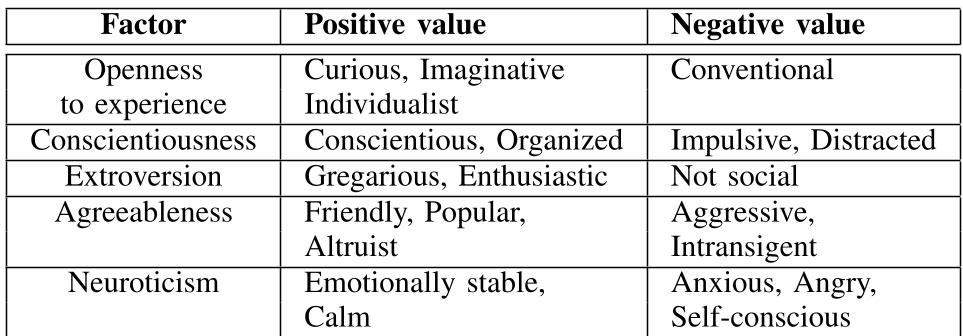 Mapping OCEAN traits to specific behavioral tendencies.
Experiments & Results: Mood Convergence
The researchers tested the model in environments without external events to isolate the effect of contagion.
- Mood Convergence: Even with diverse initial emotional states, the agents eventually gravitated toward a shared collective mood, validating the "crowd-mind" theories of social psychology.
- Social Influence: The simulation demonstrated that "appreciation relationships" act as a filter—agents are more likely to be contaminated by those they respect or like.
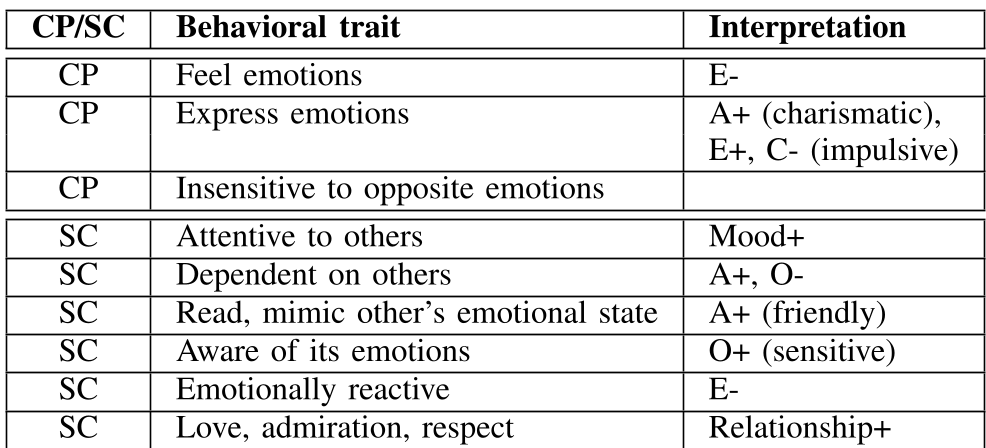 A breakdown of how behavioral traits are interpreted into CP and SC values.
Critical Insight & Future Outlook
The beauty of this model lies in its computational efficiency. By treating emotional spread as a mathematical function of personality and proximity, the researchers bypass the need for expensive social reasoning.
Limitations: The current work is a "computational mapping" that requires further validation by psychologists to calibrate the exact weights of the OCEAN traits. Additionally, it focuses on "unconscious" contagion; the "intentional" spread of panic (e.g., someone shouting "Fire!") requires further integration with the Soar architecture.
The Takeaway? In the future of crisis simulation, agents won't just move like a crowd—they will feel like a crowd. This work paves the way for more empathic and realistic training environments for first responders.