
Trust in the Digital Social Fabric: A New Mathematical Approach to Reputation
A New Approach for the Trust Calculation in Social Networks
This paper introduces a novel mathematical approach for trust calculation in decentralized social networks. By evaluating and modifying the widely cited Yu trust function, the authors propose a more nuanced mechanism that utilizes a quadratic regression model to categorize agents as "good," "bad," or "unknown," effectively supporting honest participants while aggressively penalizing malicious ones.
TL;DR
Calculating "trust" in a decentralized social network is notoriously difficult. This paper identifies fatal flaws in existing trust models—specifically the tendency to reward "bad" agents too much and "good" agents too little. The authors propose a modified trust function using a zone-based logic and a quadratic regression approximation, creating a system that is both fairer to newcomers and harsher on persistent bad actors.
Problem & Motivation: The Paradox of Current Trust Functions
In e-commerce and P2P networks, we rely on reputation. However, the existing "Yu Trust Function" (a pillar in the field) exhibits irrational behaviors.
The Critique:
- Irrational Rewards: In the Yu model, if a very untrustworthy agent (T=-0.8) cooperates once, it might see a larger trust jump than a highly trustworthy agent (T=0.8) who cooperates. This devalues long-term honesty.
- The "Stuck" Agent: Newcomers or those trying to redeem themselves often find it nearly impossible to climb out of the "negative" zone because the penalty for one mistake outweighs the reward of multiple honest acts.
The authors’ intuition is that trust should be asymmetric. We should reward the elite more than the "rehabilitating," and punish the malicious more than the "occasionally mistaken."
Methodology: The Three-Zone Strategy
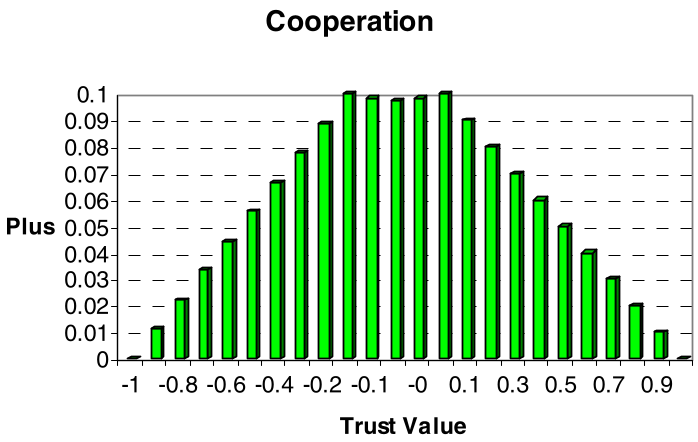
The core of the paper lies in dividing the trust interval [-1, 1] into three distinct functional segments governed by parameters (upper threshold) and (lower threshold).
| Zone | Status | Rule for Cooperation | Rule for Defection |
|---|---|---|---|
| (α, +1] | Good Agent | Large Reward () | Small Discouragement () |
| [β, α] | Candidate / Newcomer | Give Opportunity () | Take Opportunity () |
| [-1, β) | Bad Agent | Small Encouragement () | Large Penalty () |
Mathematical Optimization
To avoid complex, multi-case iterative calculations, the authors performed a Quadratic Regression. This provides a smooth curve that approximates the logical rules with high precision:
This formula allows a system to calculate the next state of trust with a single polynomial operation, which is critical for high-frequency trading or large-scale social nodes.
Experiments & Results
The authors validated the model by simulating agent behaviors across the trust spectrum.
Key Findings:
- Blocking Bad Agents: In the range , the penalty rate is significantly higher than the encouragement rate . This effectively traps malicious actors unless they show exceptional, sustained cooperation.
- Supporting Good Agents: Conversely, in the range , the reward rate is higher than the discouragement rate . This builds a "buffer" for reputable agents, preventing a single failure from destroying years of built reputation.
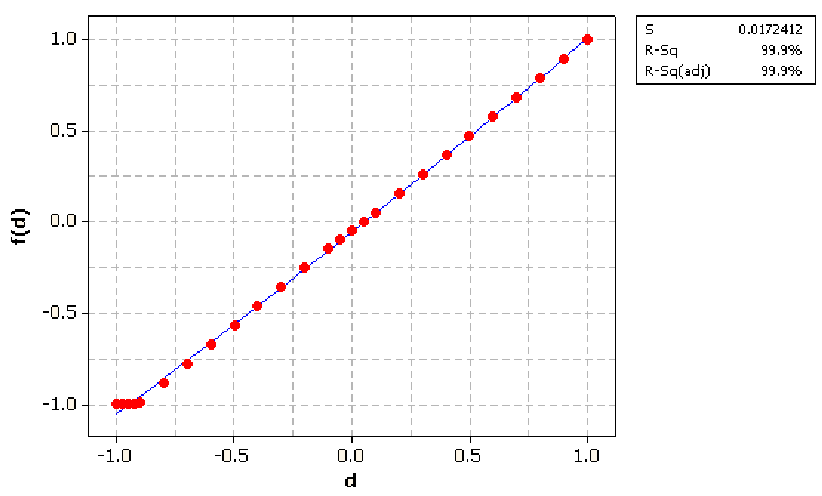 Fig: The quadratic regression provides a near-perfect fit for the intended trust curves.
Critical Analysis & Conclusion
Takeaways
The paper successfully transforms trust from a purely numerical value into a behavioral strategy. By introducing the "No Judgment" zone, it provides a safe sandbox for newcomers—a common failure point in eBay-style systems where 0-rated accounts are often viewed with the same suspicion as -10 rated accounts.
Limitations & Future Work
- Transaction Value: While the paper briefly mentions a coefficient () for transaction value (e.g., a 10 honesty helps), a formal mathematical integration into the quadratic model is left for future exploration.
- Sociability: The paper focuses on "Expertise" (doing the task correctly). The authors acknowledge that "Sociability" (providing accurate referrals) is a separate dimension that needs its own dedicated trust function.
Final Thought: This work provides the mathematical foundation for more resilient and "human-like" reputation systems in the next generation of social and economic networks.