
Multimedia Research in the Social Era: A Visionary Roadmap from 2007
New challenges in multimedia research for the increasingly connected and fast growing digital society
This paper synthesizes a high-level panel discussion from ACM Multimedia 2007, outlining the transition of multimedia research from isolated retrieval tasks to socially-connected ecosystems. It identifies five strategic pillars—Personal Management, Amateur Photography, Arts, Video Sharing, and Social Networks—to address the explosion of user-generated content (UGC).
TL;DR
Published during the explosive rise of Flickr and YouTube, this landmark panel paper identifies the shift from "processing files" to "understanding experiences." It argues that the future of multimedia lies in bridging the semantic gap through context-aware computing, social network dynamics, and automated aesthetics—setting the stage for the AI-driven media landscapes of the 2020s.
Problem & Motivation: The Deluge of Informal Data
By 2007, the digital world faced a crisis of abundance. Digital cameras and phones were no longer tools for professionals; they were appendages of the masses. The authors noted that YouTube was already adding 65,000 videos daily.
The core pain point was the Semantic Gap: the discrepancy between low-level visual features (pixels, color histograms) and the high-level concepts humans care about (e.g., "my daughter's birthday party"). Traditional algorithms trained on broadcast news (TRECVID) failed miserably when applied to messy, unconstrained consumer media. The community realized that "Content-Based Image Retrieval" (CBIR) needed to move beyond simple similarity to true understanding.
Methodology: The Interaction of Three Networks
The panel's strategic breakthrough was the conceptualization of the interaction between three distinct domains:
- Social Networks: The dynamic structure of human connections and sharing.
- Semantic/Visual Networks: The underlying relationships between objects, concepts, and labels (e.g., WordNet).
- Multimedia Technologies: The algorithmic tools used to process signals.
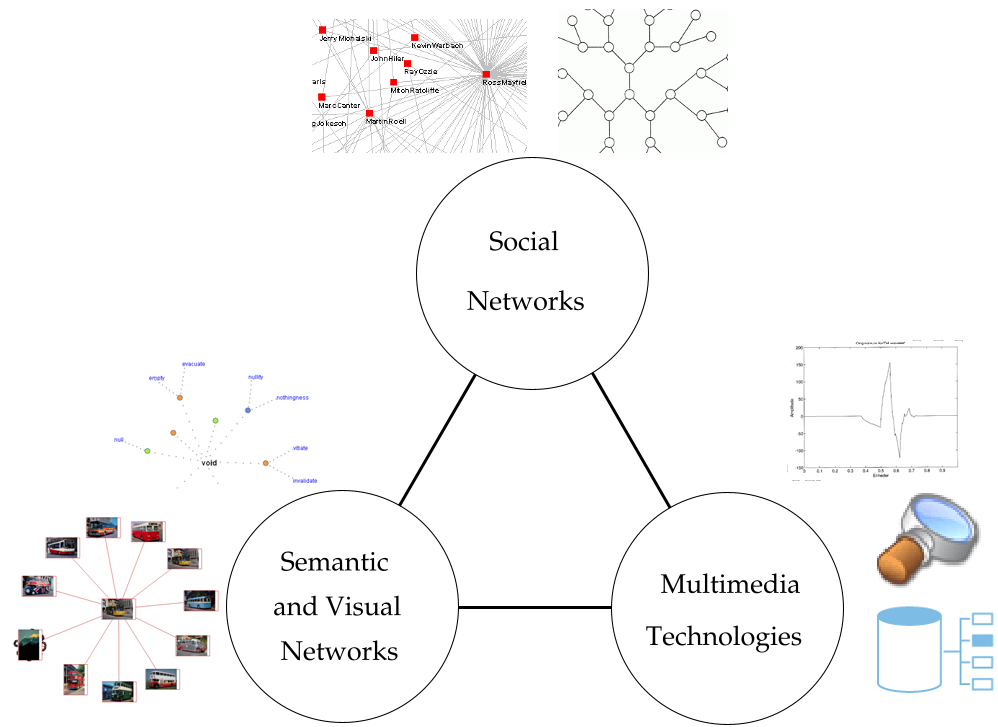
The authors proposed that rather than trying to solve vision in a vacuum, researchers should use Context:
- Temporal & Spatial Context: Using GPS and timestamps to group photos into "events."
- Social Context: Leveraging "folksonomy" (user tags) and community feedback to refine machine-generated labels.
- Human-in-the-loop: Designing systems where minimal user input (active learning) drastically improves retrieval accuracy.
Key Research Pillars & Insights
1. Personal Multimedia Management
The goal shifted from "storage" to "summarization." Instead of a user browsing 1,000 photos from a trip, the authors envisioned algorithms that automatically select the "best" representative images based on visual quality and event importance.
2. Computational Aesthetics
A controversial but pivotal topic discussed was whether a computer could judge "beauty." The panelists argued that "faking" or "enhancing" images (e.g., sharpening, color boosting) would become standard. This predicted the "AI-enhanced" photography we now see in Every iPhone and Pixel device.
3. Video Sharing and Retrieval
The panel correctly identified that for video, text-based search was a temporary crutch. They suggested "Divide and Conquer"—building specialized engines for sports, news, and music videos—as a path toward general-purpose video understanding.
Deep Insight: Beyond Metadata
The discussion on Social Networks was particularly prescient. The paper suggests using multimedia search not just to find content, but to find people. By recognizing common subjects or artistic styles, the system can act as a "social matchmaker," connecting users with similar tastes—a fundamental mechanic of modern recommendation engines like TikTok or Instagram.
Critical Analysis & Conclusion
While the paper predates the "Deep Learning Revolution" of 2012, its logic remains sound. It correctly identified that Context is King.
Limitations at the time:
- Compute Power: The authors noted that compute power was growing slower than storage—a bottleneck that was eventually shattered by GPU acceleration.
- Algorithmic Robustness: Their reliance on "standard statistical models" has since been replaced by Transformers and Large Multimodal Models (LMMs).
Takeaway: This paper reminds us that the technical "how" (pixels and features) is secondary to the "why" (social connection and memory archiving). As we move into the era of Generative AI, the challenge remains the same: how to make multimedia technology a seamless, transparent bridge for human experience.