
Breaking the Language Barrier: Elevating Sentiment Analysis via Universal Emoticon Vectors
A New Emotional Vector Representation for Sentiment Analysis
The paper introduces a novel Emotional Vector Representation for sentiment analysis that leverages emoticons as universal indicators of sentiment. By mapping text into an 8-dimensional "emotional state" space—based on Emotional TF-IDF weighting—the method achieves a state-of-the-art F-score of 81.08% using SVM, outperforming traditional Bag-of-Words and Word2Vec baselines on Facebook data.
TL;DR
In the chaotic world of Web 2.0 social media—where slang, dialects, and "SMS-speak" dominate—traditional text analysis often falls short. This paper introduces a specialized Emotional Vector Representation that treats emoticons not just as noise, but as universal anchors of human sentiment. By mapping words to 8 distinct emotional intensities using a novel Emotional TF-IDF metric, researchers achieved an 81.08% F-score, decisively beating standard baselines like Word2Vec.
Background: The Limits of Words
Sentiment analysis typically treats text as a "Bag-of-Words" (BoW). While effective for formal documents, this approach struggles with Facebook or Twitter comments where Tunisian dialect, French, and Arabic are often mixed. In these environments, emoticons are the true "lingua franca"—multilingual, universal, and highly dense with contextual meaning. The authors' insight is simple yet powerful: Use the emoticons to define the space in which words are measured.
Methodology: The 8-Dimensional Emotional Space
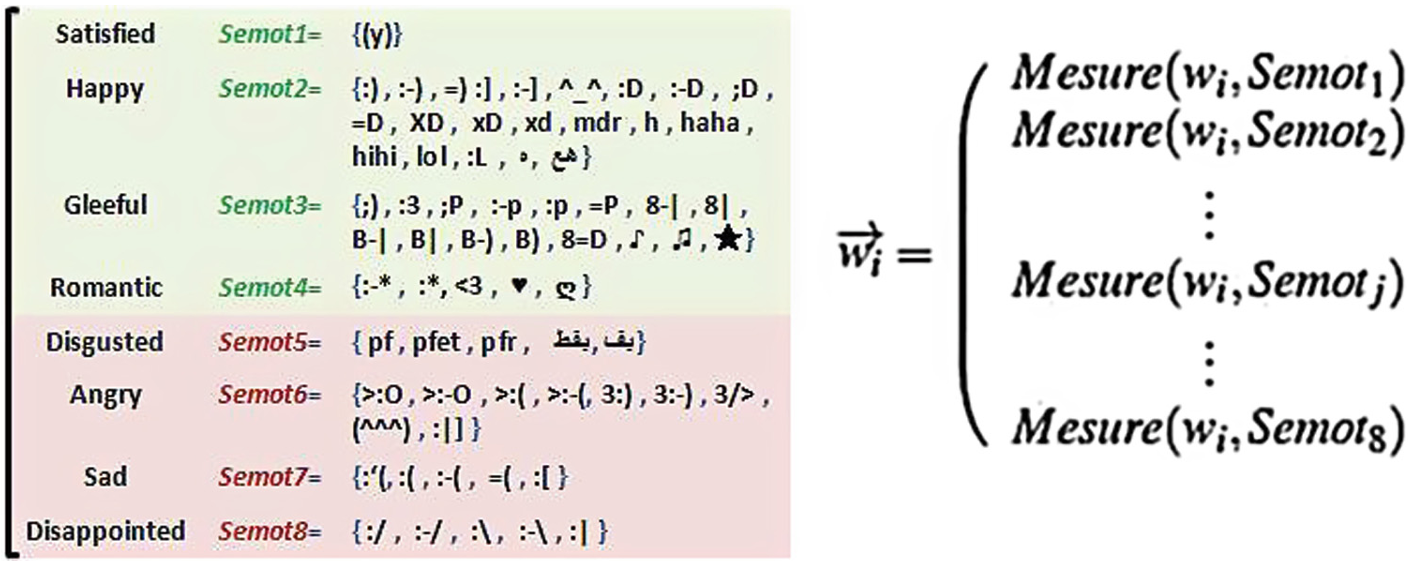
The core innovation lies in how words are transformed into numbers. Instead of high-dimensional sparse vectors, every word is mapped to an 8-dimensional vector based on its relationship with specific sets of emoticons ().
1. Defining Emotional States
The authors categorized common emoticons into 8 states:
- Positive: Satisfied, Happy, Gleeful, Romantic.
- Negative: Disappointed, Sad, Angry, Disgusted.
2. Emotional TF-IDF Weighting
To quantify the "emotional pull" of a word, the authors developed Emotional TF-IDF: This formula ensures that words appearing frequently with specific, rarer emotion symbols are given higher weight, allowing the model to distinguish between subtle nuances like "sadness" versus "disgust."
3. Negation Handling: The Game Changer
One of the most significant hurdles in sentiment analysis is negation (e.g., "not happy"). This paper implements a segment-based approach where the co-occurrence count is decremented if a word is preceded by a negation particle. This simple logical adjustment is the difference between a mediocre model and an industry-leading one.
Experimental Results: Outperforming the Giants
The researchers tested their method on a dataset of Tunisian political comments from Facebook. They compared their emotional vectors against heavyweights like Word2Vec and Latent Semantic Analysis (LSA).
| Method | F-score |
|---|---|
| Word2Vec + Average | 71.09% |
| TF-IDF Weighting | 69.65% |
| Our Emotional TF-IDF + Negation | 81.08% |
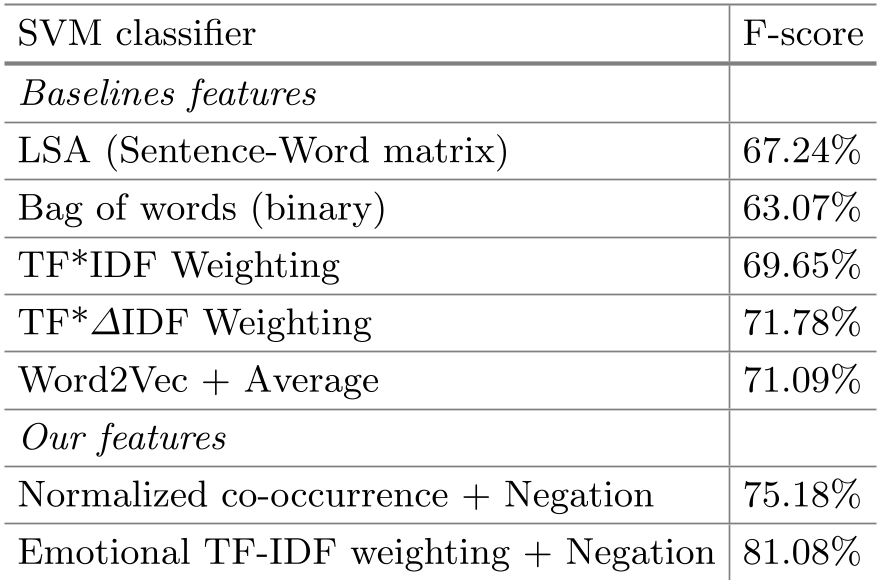
The results show that Emotional TF-IDF provides a nearly 10% improvement over neural-based Word2Vec embeddings. This highlights the effectiveness of using domain-specific features (emoticons) rather than general-purpose word embeddings for social media tasks.
Critical Analysis & Conclusion
The Takeaway
The success of this method proves that in informal settings, symbolic context (emoticons) is more reliable than lexical context. By reducing the dimensionality of the problem to 8 human-interpretable emotional axes, the model becomes more robust against spelling variations and multilingual code-switching.
Limitations & Future Work
While impressive, the reliance on emoticons means that comments without symbols are harder to categorize initially. The authors suggest a future "enrichment step," where the learned emotional signatures of words can be used to label comments that lack emoticons entirely—effectively propagating sentiment knowledge across the whole corpus.
In conclusion, this work provides a blueprint for building sentiment systems that are as dynamic and expressive as the social media users they aim to understand.