
From Raw Traces to Network Intelligence: A Rough Set Approach to GPRS Modeling
16617_New method for GPRS cellular network traces exploitation.
This paper introduces a novel data-driven framework for subscriber sampling and traffic/mobility modeling in GPRS networks using Data Mining. By applying Rough Set theory to real-world cellular traces from a Tunisian operator, the authors establish a method to extract highly significant subscriber populations, significantly improving over traditional manual or mean-based sampling.
TL;DR
To build realistic 3G and 4G networks, engineers need more than just math—they need real data. However, raw cellular traces are massive and messy. This paper proposes a Data Mining framework using Rough Set theory to automatically sample "significant" subscribers from millions of GPRS records, outperforming traditional statistical averages by nearly 100% in identifying high-value data points.
The Bottleneck: Data Wealth, Information Poverty
In network planning, we faces a paradox: we have access to "Rough Meters" at the Operation Maintenance Centers (OMC-R) that record every handover, traffic charge, and power level. Yet, a single day of measurements can exceed 10GB.
Prior work typically used:
- Mathematical Models: Too many assumptions/approximations.
- Simulations: Computationally expensive and often detached from local geography.
- Manual Trace Exploitation: Extremely slow and prone to human error.
The authors argue that the missing link is an automated Decision System capable of distinguishing between "noise" (low-activity users) and "signal" (users who define network stress and mobility patterns).
Methodology: The Power of Rough Sets
Instead of just looking at the "average" user, the authors apply Rough Set Method, a branch of Artificial Intelligence designed to handle uncertainty and granularity in data.
1. Attribute Extraction
The system extracts three core pillars from the raw .xl3 files:
- Traffic Charge (T): Download volume per subscriber.
- Area Density (D): Based on Cell Identity (CI) and Location Area Code (LAC).
- Service Rate (R): Usage of Internet, MMS, WAP, and Email.
2. The Decision Logic
By constructing a Discernibility Matrix, the researchers identify what makes one subscriber's behavior uniquely valuable for the model. They formulated logic rules like:
If Traffic is Medium (MT) AND Density is High (HD) AND Service Rate is High (HR), THEN recommendation is High (HRe).
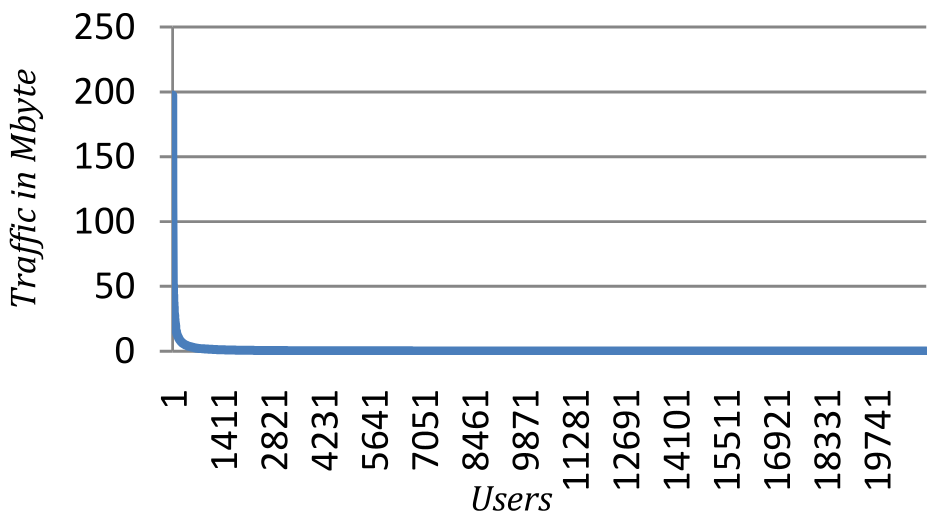 Fig 1: The power-law distribution of traffic, showing why simple averages fail to capture the heavy hitters.
Experimental Results: Precision Matters
The study utilized real-world data from the Tunisian operator Tunisiana. The contrast between the "simple average" method and the "Rough Set" method was stark:
- Simple Mean Method: Only identified 2,200 "significant" users. It essentially ignored users who were physically mobile but had low traffic at specific intervals.
- Rough Set Method: Identified 4,250 users. By considering area density (mobility), it captured subscribers who are critical for understanding "Network Congestion" risks, even if their individual traffic was moderate.
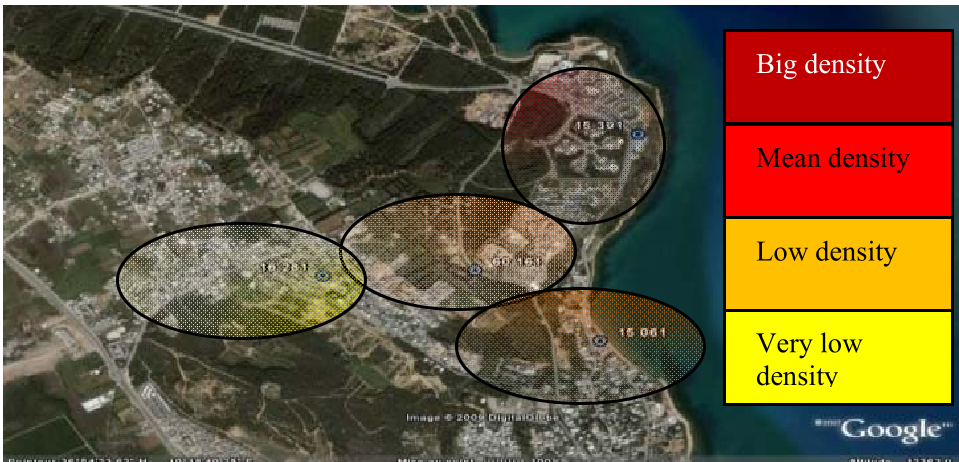 Fig 2: Geographic density variation across Tunis, used to weight user importance.
Critical Insight: Why This Works
The "magic" of this approach lies in the Case-Based Logic. In cellular networks, a user in a "Residential Zone" (Low Density) behaves differently than a user in an "Industrial Park" (High Density/High Mobility). Traditional sampling loses this context. The Rough Set approach preserves the relationship between location and behavior, ensuring that the final network model mimics the actual stressors of a live urban environment.
Conclusion & Future Outlook
This paper bridge the gap between Data Mining and Telecommunications. By automating the extraction of a "significant population," the authors provide a blueprint for more resilient 4G and 5G networks.
Limitations: The current study focuses on GPRS. Future iterations will need to account for the high-velocity data of LTE-A and 5G, where the number of attributes (like beamforming data or MIMO layers) increases exponentially, potentially requiring more advanced KDD (Knowledge Discovery in Data) pipelines.