
DOG: Redefining Chinese Knowledge Management through Domain Ontology Graphs
A New Method for Knowledge and Information Management Domain Ontology Graph Model
2012-05-29
Summary
Problem
Method
Results
Takeaways
Abstract
This paper proposes the Domain Ontology Graph (DOG), a novel ontology learning model designed for Chinese text data. It introduces a specialized framework, KnowledgeSeeker, which leverages Chi-square statistical measurements to semi-automatically extract concepts and relationships, achieving a state-of-the-art F-measure of 92.3% in text classification tasks.
## TL;DR
Knowledge management in Chinese text has long been hindered by the language's structural complexity and the inefficiency of manual ontology creation. This paper introduces the **Domain Ontology Graph (DOG)**, a semi-automatic framework that extracts semantic relationships using Chi-square statistics. By shifting from simple keyword vectors to a relational graph, the authors achieved a 92.3% F-measure in text classification, significantly outperforming traditional TF-IDF baselines.
## The Semantic Gap in Chinese Text Analysis
In the realm of Information Management, an ontology acts as the "DNA" of a domain, defining classes, properties, and relationships. However, two major hurdles persist:
1. **Manual Bottleneck**: Tools like Protégé require domain experts to manually define hierarchies, which is subjective and slow.
2. **Linguistic Barriers**: Unlike English, Chinese lacks clear word boundaries (spaces), making standard NLP pipelines incompatible.
The authors argue that existing systems fail to capture "uncertain information" and implicit relationships hidden within document warehouses. Their solution, **KnowledgeSeeker**, aims to bridge this gap via a semi-automatic, graph-based learning engine.
## Methodology: The Bottom-Up Graph Construction
The DOG model decomposes knowledge into four levels of **Conceptual Units (CU)**: Terms, Concepts, Concept Clusters, and the full Ontology Graph. The learning process follows a rigorous 5-step pipeline:
1. **Term Extraction**: Using the *HowNet* dictionary and maximal matching to identify meaningful sequences of characters.
2. **Term-to-Class Mapping**: Applying $\chi^2$ (Chi-square) statistics to measure the independence between a term and a specific domain (e.g., "Military" vs. "Sports").
3. **Term-to-Term Mapping**: A critical innovation where the co-occurrence of terms is measured within a class to build a directed, weighted graph.
4. **Concept Clustering**: Grouping similar terms into "semantic neighborhoods" without needing a pre-defined number of clusters.
5. **DOG Generation**: The final assembly of terms and relations into a machine-readable format.
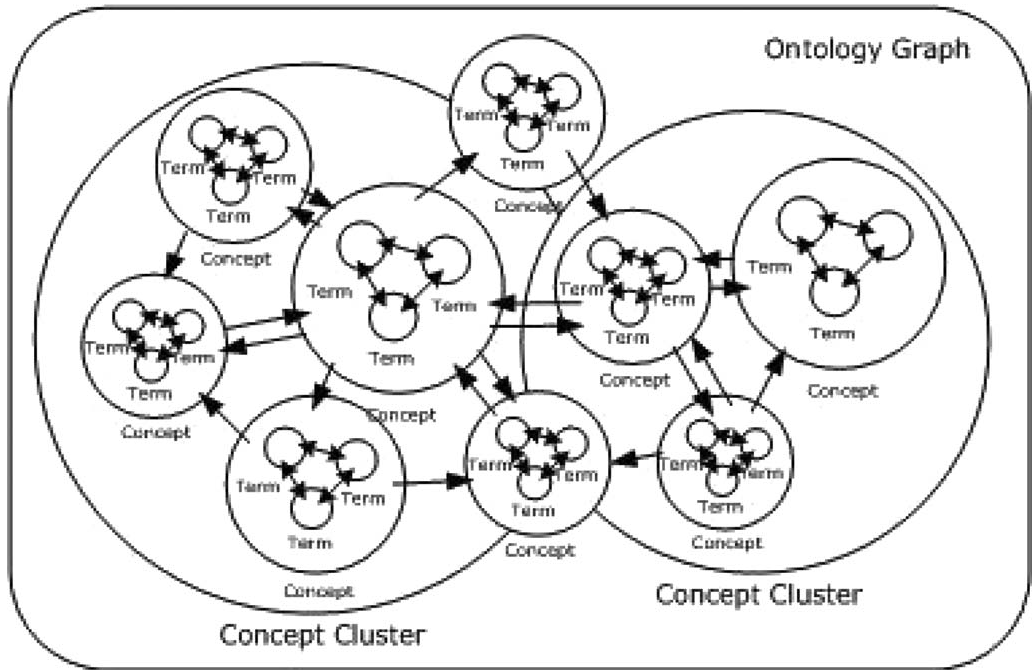
*Figure 1: The hierarchical workflow of the KnowledgeSeeker system, moving from raw text to structured ontology graphs.*
## Beyond Keywords: Document Ontology Graphs (DocOG)
A standout feature of this work is the **DocOG Operation**. Instead of representing a news article as a "bag of words," the system maps the document's terms onto the pre-built DOG. This allows the system to "infer" related knowledge that might not even be explicitly mentioned in the text, but exists within the domain graph.
## Experimental Evidence: Success in High Accuracy
The authors tested their model on a massive corpus of 57,218 Chinese documents. The results were clear:
* **Standard TF-IDF**: Peaked at an 86.8% F-measure.
* **Term-Dependence**: Reached 88.9%.
* **Ontology Graph (DOG)**: Reached a dominant **92.3%** using an 80-term size graph.
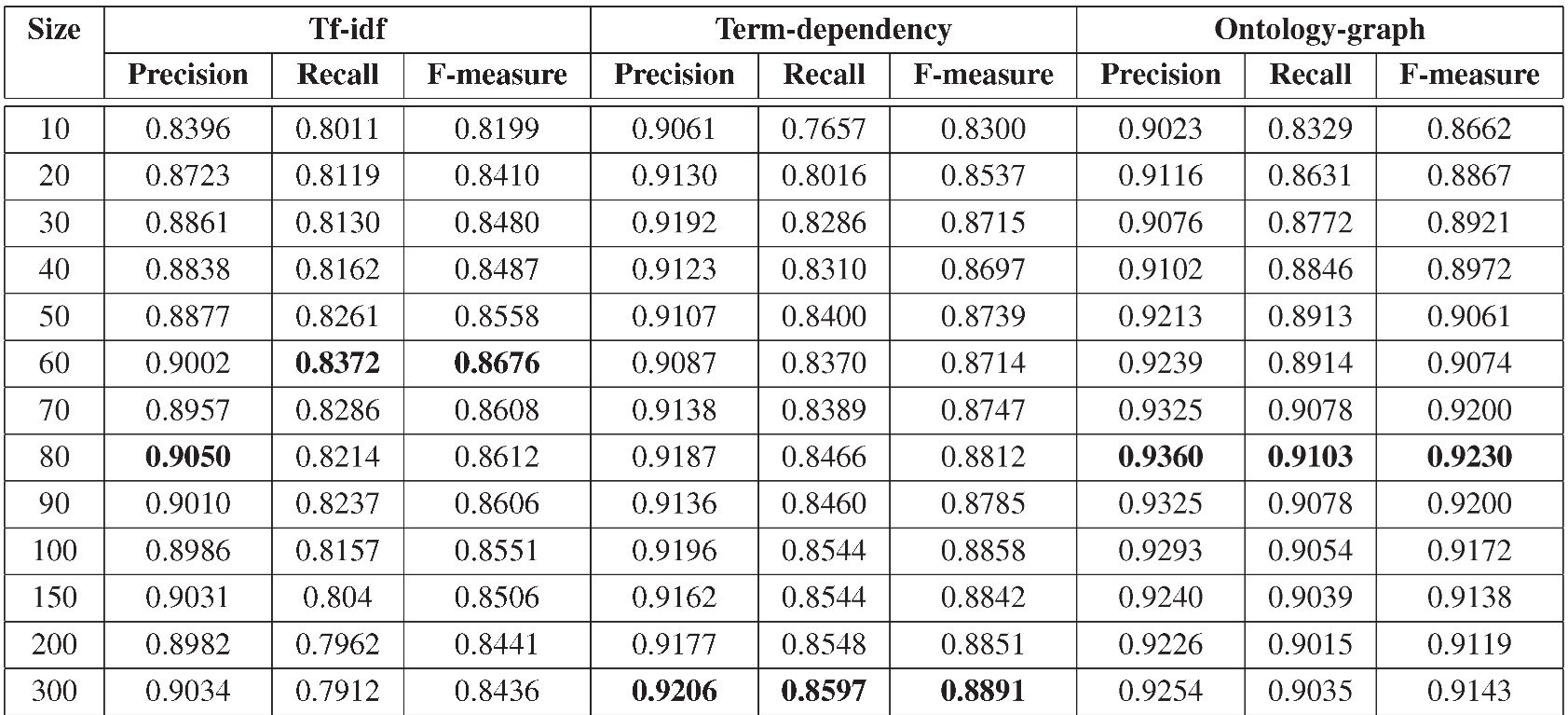
*Table 1: Performance metrics across different term dimensionalities. Note how the Ontology-graph consistently leads.*
## Critical Insight: Why Does Graph-Based Classification Work?
The secret to the DOG’s success lies in **Dimensionality Efficiency**. Traditional models require thousands of dimensions (terms) to achieve high accuracy. The DOG model achieves 92.3% accuracy with just **80 terms**. By leveraging the *relationships* between terms, the model captures semantic context that keyword-based weights simply ignore.
## Limitations and the Road Ahead
While powerful, the current DOG model has limitations:
* **Relationship Labels**: It identifies *that* a relationship exists but does not yet categorize it (e.g., distinguishing "is-a" from "part-of" automatically).
* **Static Validation**: It still requires a "human-in-the-loop" for final verification of the clusters.
Future work aims to integrate Supervised Learning to optimize the graph size automatically and extend the framework to support multilingual knowledge sharing.
## Final Takeaway
The Domain Ontology Graph transitions Chinese information management from "search by word" to "understand by relation." For developers and researchers in the Knowledge Graph space, this paper provides a robust statistical blueprint for building lightweight, highly accurate domain models with minimal human oversight.