
WRWR: Bridging the Gap Between Topology and Attributes in Link Prediction
A New Method for Link Prediction Using Various Features in Social Networks
This paper introduces WRWR (Weighted Random Walk with Restart), a link prediction framework that integrates network topology with node attributes. By using Hamming distance of discrete attributes (e.g., education, research area) to weight edges, it achieves superior prediction accuracy over standard RWR.
TL;DR
Link prediction in social networks has long been dominated by structural metrics. However, the sparsity of real-world graphs often renders topology-only methods ineffective. This paper introduces WRWR (Weighted Random Walk with Restart), a method that uses Hamming distance of node attributes to weight existing edges, creating a unified framework that leverages both "who you know" and "who you are."
Background Positioning: This work sits at the intersection of traditional graph theory and recommendation systems, specifically enhancing the Random Walk family of algorithms for discrete attribute scenarios.
The "Missing Link" Problem: Why Structure is Not Enough
Social networks are notoriously sparse. While a platform might have millions of users, any single user only interacts with a tiny fraction of the population. Traditional methods assume that if two nodes share many neighbors, they will likely link. But why did those initial links form?
The authors argue that Homophily—the tendency of individuals to associate with similar others—is a primary driver of link creation. Existing SOTA methods often overlook natural attributes like hometown, education, or professional interests, or they fail to integrate them into a cohesive mathematical model.
Methodology: Intelligence-Driven Random Walks
The core innovation is the transition from a standard Random Walk to a Weighted Random Walk where weights are learned from node attributes.
1. Attribute Integration via Hamming Distance
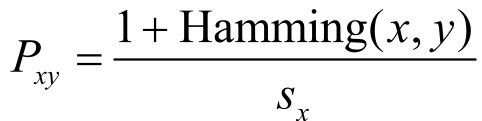
Instead of treating all edges equally, the authors assign weights based on the similarity of the connected nodes. Since the attributes (Education, School, Research Area) are discrete, they use a modified Hamming distance: This ensures that even if nodes share no attributes, there is still a baseline probability for a transition, preventing the "zero-weight" trap.
2. The WRWR Framework
By incorporating these weights into the transition matrix of a Random Walk with Restart, the algorithm focuses its "attention" on paths that connect similar individuals.
Experimental Evidence
The authors tested their method on SciNetBlog, a scholar community dataset. The network naturally exhibits high clustering, but also contains many "weak" links that structural algorithms struggle to distinguish.
Key Findings:
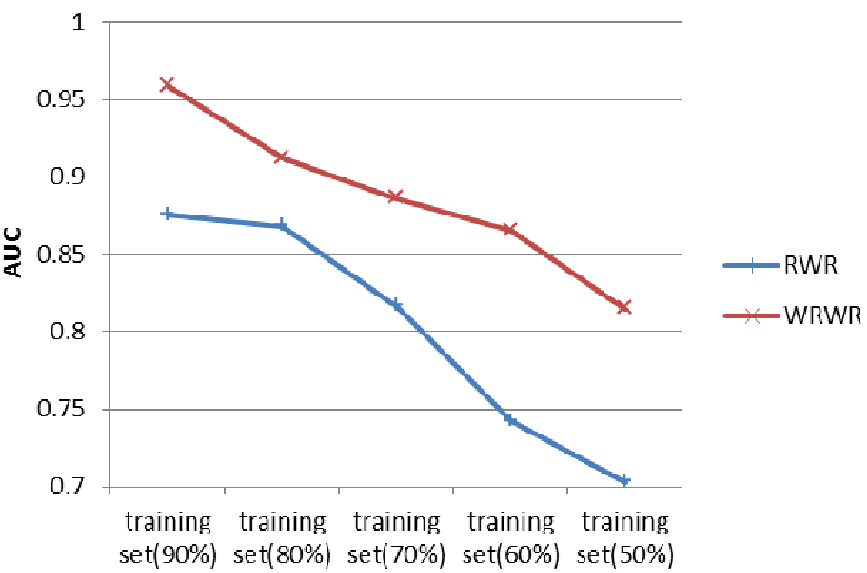
- Accuracy Boost: The WRWR index consistently maintained a higher AUC (Area Under Curve) than the unweighted RWR across all test splits.
- Robustness to Sparsity: As the training set size decreased (simulating a more "sparse" or "new" network), the standard RWR performance plummeted. In contrast, WRWR stayed remarkably stable, proving that node attributes provide a vital signal when structural data is missing.
Critical Insight & Conclusion
This paper provides a strong empirical foundation for the "Effect vs. Cause" debate in social links: people don't just become similar because they are connected; they connect because they are similar.
Takeaway for Practitioners: If you are building a recommendation engine for a new or sparse social platform, don't just rely on the graph structure. Mapping out "Attribute Similarity" and using it to bias your random-walk or traversal algorithms can significantly mitigate the cold-start problem.
Limitations: The current implementation relies on discrete Hamming distance. Future iterations could benefit from Embedding-based similarity (like Word2Vec or Bert embeddings for interests) to handle more nuanced, non-discrete node features.