
Beyond Consensus: Modeling Interdependent Ideologies in Social Networks
A new model of opinion dynamics for social actors with multiple interdependent attitudes and prejudices
The paper introduces a multidimensional extension of the Friedkin-Johnsen (FJ) model to capture opinion dynamics where social actors hold multiple interdependent attitudes. It utilizes a Multi-issue Dependence Structure (MiDS) matrix and confirms that convergence is achieved globally under the condition that every agent is influenced by at least one stubborn actor.
TL;DR
Social networks rarely agree. While classic models focus on how we reach a consensus, this paper explores why we stay divided, especially when we discuss multiple related topics at once. By extending the Friedkin-Johnsen (FJ) model into a multidimensional vector space, the authors show how our "belief systems"—where one opinion influences another—interact with social pressure to create stable, diverse clusters of thought.
Background: The Limits of Scalar Thinking
Most opinion dynamics research treats opinions as single numbers (scalars). But humans don't think in isolation. Your opinion on "Electric Vehicles" is logically tied to your stance on "Climate Change."
Existing models like DeGroot's facilitate agreement but fail to explain persistent disagreement. The original FJ model solved this by introducing prejudices (stubbornness). However, it still lacked the "logic" of how different issues interact within a single person's mind. This paper fills that gap by introducing a Multi-issue Dependence Structure (MiDS).
Methodology: The MiDS Matrix and Matrix Kronecker Logic
The authors propose a new update rule for an agent :
Where:
- : Social influence weight from neighbor .
- : The agent's original prejudice (initial opinion).
- (The MiDS Matrix): This is the secret sauce. It is a row-stochastic matrix that defines how attitudes on topic A shift attitudes on topic B.
By using the Kronecker product (), the authors represent the entire social-ideological system as one massive linear operator. They prove a vital stability theorem: The system converges if and only if every agent is eventually influenced by at least one stubborn actor. Surprisingly, the complexity of the topics (the matrix) does not destabilize the network as long as the relationships are "row-stochastic" (logical weights sum to 1).
 The multidimensional FJ update rule in vector form.
Simulation: The "Fish and Salmon" Experiment
To prove the point, the authors simulate a 4-agent network discussing two topics: "Fish (general)" and "Salmon (specific)."
- Independent Case: If topics are unrelated, agents might end up liking fish but hating salmon based on neighbor influences.
- Interdependent Case (MiDS applied): If reflects that salmon is a subset of fish, the opinions move together. The logic of the topic prevents "extreme" contradictions that would happen in a vacuum.
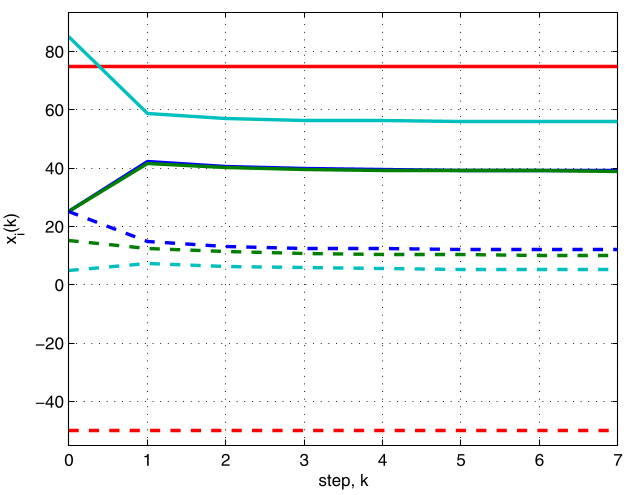 Figure 2: Notice how opinions (solid/dashed lines) converge to stable, yet distinct values due to the interplay of social influence and topic logic.
From Synchronous to Gossip: Real-World Application
In reality, we don't all talk at once. The authors tackle this by proving that an asynchronous gossip protocol—where only two people talk at a time—eventually reaches the exact same steady-state opinion "on average" (specifically, the Cesàro mean). This makes the model applicable to massive social media environments where interactions are sporadic and randomized.
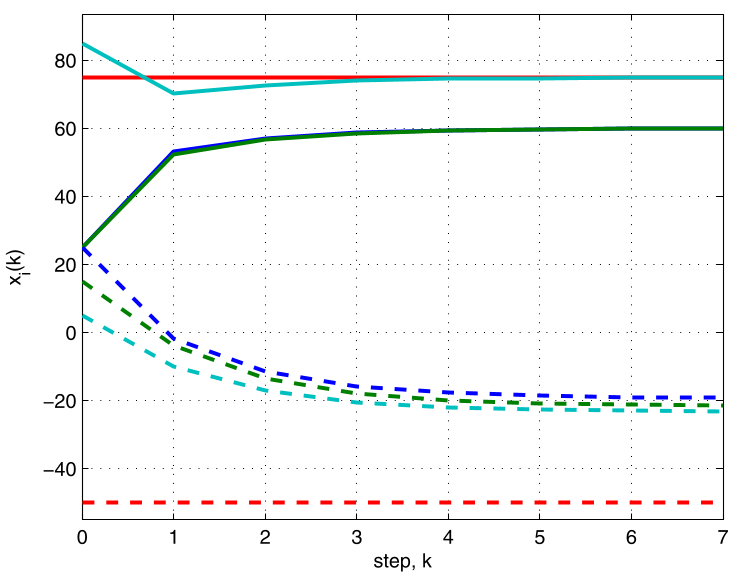 Figure 3: Even with randomized, one-on-one interactions, the time-averages of opinions converge to a predictable steady state.
Deep Insight & Conclusion
This paper's brilliance lies in its simplicity. By keeping the model linear, the authors provide a framework that is both mathematically tractable and sociologically rich.
Key Takeaways:
- Stubbornness is a Feature, Not a Bug: Without stubborn actors (prejudices), social networks would simply collapse into a boring uniform consensus. Stubbornness creates the "texture" of social groups.
- Topic Logic Matters: Polarization isn't just about who you talk to; it's about how the topics themselves are logically structured in your head.
- Identification Potential: The study suggests we can "reverse engineer" the logic of a group's belief system (the matrix) just by watching their final opinions.
Limitations: The model currently assumes a static social network and a static relationship between topics. In the real world, "logical" links between topics are often weaponized and changed via propaganda (e.g., shifting the link between "Freedom" and "Public Health"). Future work in time-varying matrices will be a major area to watch.