
Secure Social Lending: Bridging the Trust Gap with a New C2B2C Paradigm
A New Paradigm for Secure Social Lending
Serrelis and Alexandris propose a "New Paradigm" for Social Lending (P2P Lending) that transitions from anonymous P2P interactions to a brokered Citizen-to-Broker-to-Citizen (C2B2C/C2G2C) model. The method utilizes Public Key Infrastructure (PKI) and digital signatures to institutionalize trust and security in decentralized financial transactions.
TL;DR
Social Lending (P2P) has exploded from a niche trend to a multi-billion dollar industry, yet it remains plagued by fraud, default risks, and regulatory hurdles. This paper proposes a structural shift from anonymous P2P to a brokered C-B-C model, utilizing PKI (Public Key Infrastructure) and Digital Signatures to provide the same legal and technical security as traditional banks while maintaining social flexibility.
Background: The Evolution of e-Services
To understand the necessity of this shift, the authors map the trajectory of digital services:
- B2C/B2B: The foundation of e-commerce.
- P2P/C2C: The rise of social networks and file sharing.
- Social Lending: A hybrid where "Citizens" interact with "Citizens" but for high-stakes financial outcomes.
The problem is that while sharing a file (P2P) has low stakes, lending $6,000 (Prosper's average) requires a level of Technical and Legal Integrity that standard Web 2.0 social networks cannot provide.
The Core Challenge: Why Social Lending Stalls
The authors identify four critical pillars where current "Online Marketplaces" fail:
- Technical: Vulnerability to Man-in-the-Middle (MITM) attacks and lack of robust reputation mechanisms.
- Legal: A vacuum in EU/US legislation regarding micro-credit validity.
- Regulatory: Uncertainty regarding Basel II compliance and anti-money laundering (AML) duties.
- Operational: The "Trust Triangle" between Lender, Borrower, and the Platform is often broken by identity manipulation.
The Proposed Solution: The Brokered Paradigm
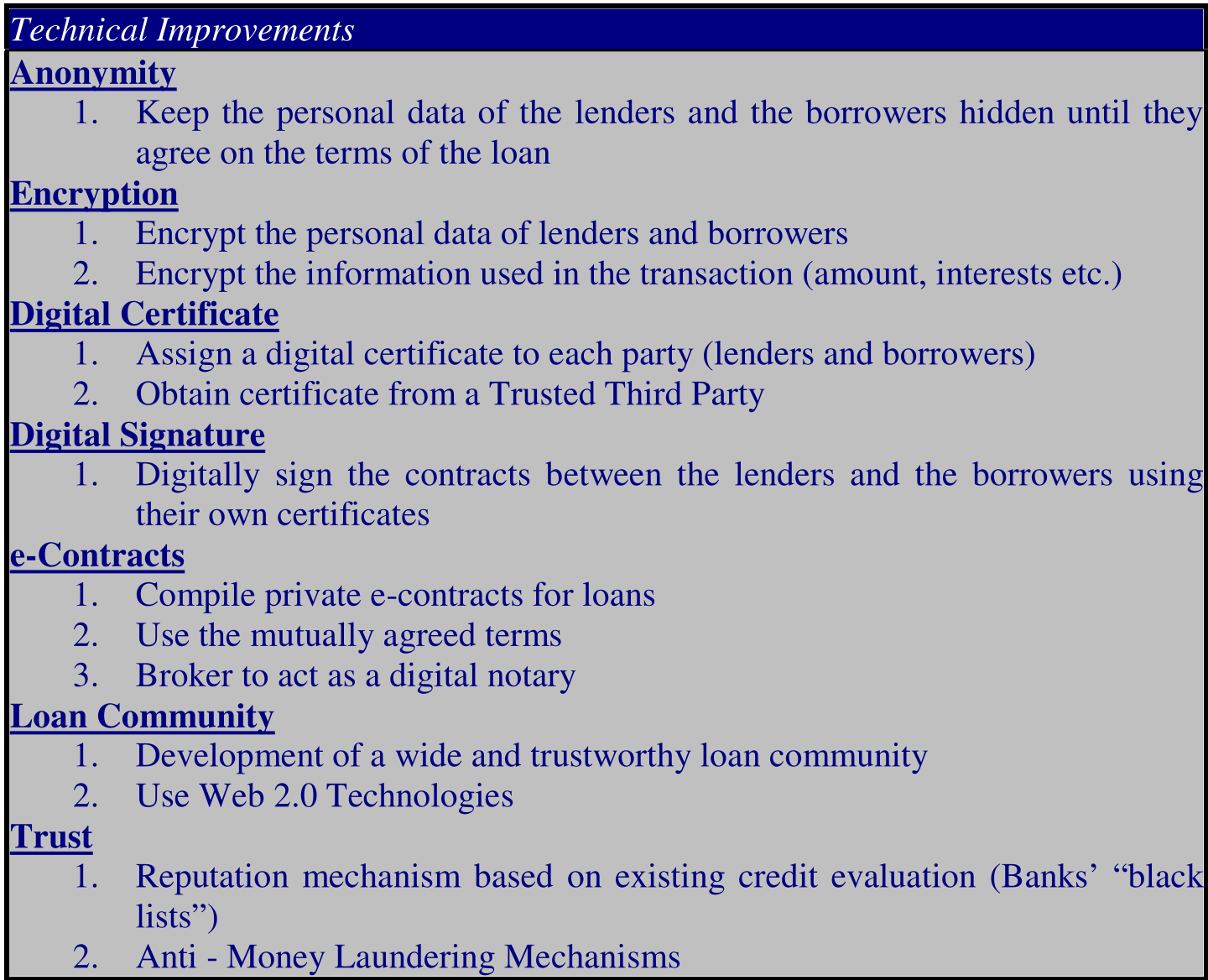
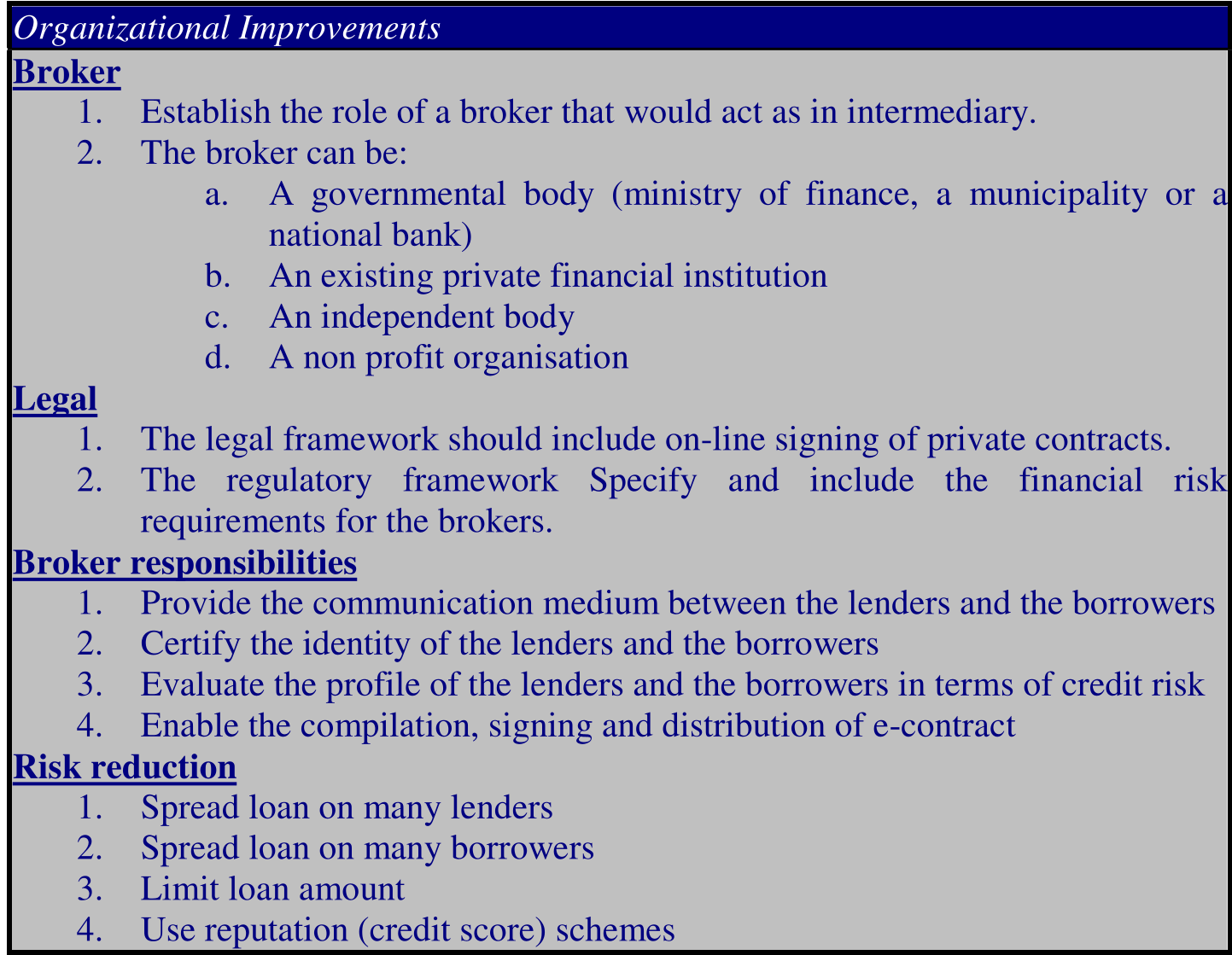
The "New Paradigm" doesn't remove the social aspect but inserts a Trusted Broker (a Bank or Government body) to act as a Digital Notary.
How the New Workflow Functions:
- Anonymity during Negotiation: Private data is hidden until terms are agreed upon.
- Reputation Scrubbing: The broker cross-references borrowers with bank "black lists."
- PKI Model: Every party uses a Digital Certificate. No "handshake" is informal; every loan is an e-Contract signed with cryptographic certainty.
- Micro-distribution: Large loans are systematically "shredded" into tiny amounts across hundreds of lenders to mitigate default impact.
Deep Insight: Why This Works
The brilliance of this model lies in Risk Management. In the "Prosper" model (US), lenders often chose borrowers based on "personal stories." While social, this is statistically dangerous. In the "Zopa" (UK) model, which this paper supports, risk is spread across 50+ borrowers with a cap (e.g., £200).
By adding the broker, the system achieves "Legal Non-Repudiation." If a borrower defaults, the digital signature on the e-contract provides the lender with immediate legal standing for recovery—something often missing in earlier P2P experiments.
Experimental Perspective: Case Comparisons
The paper highlights the divergence between Zopa and Prosper:
- Zopa: Focuses on risk management and spreading funds.
- Prosper: Focuses on the "Social Auction."
The authors argue that Prosper's legal troubles with the SEC (due to loan notes being classified as unregistered securities) prove that the "Social" part cannot exist without a "Regulatory" anchor.
Critical Analysis & Conclusion
Takeaways
The paper successfully argues that Trust is not a social feeling; it is a technical infrastructure. By moving to C(2B)C or C(2G)C, social lending can offer:
- Individuals: Lower interest rates than banks but higher security than P2P.
- Tax Authorities: Real-time audit trails and automated tax deductions.
Limitations
The primary hurdle is "Cannibalization." Why would a traditional bank act as a broker for a P2P loan that returns 5% to a citizen, when they could take the deposit themselves and lend it at 10%? The authors admit that while technically feasible, the organizational willingness of banks to disrupt their own profit-centric models remains the ultimate obstacle.
Future Outlook
As we look toward the future (and contemporary developments in DeFi), this paper's call for a "Digital Notary" serves as a precursor to the Smart Contract era. The fundamental need remains: we want the community of the social web, but the security of the central vault.