
The New Schedule of Growing Up: How Prolonged Adulthood Redistributes Risk onto the American Family
On a new schedule: Transitions to adulthood and family change
This article reviews how the prolongation of the transition to adulthood in the United States has reshaped family formation, co-residence, and intergenerational exchange. Furstenberg argues that delayed home-leaving, marriage, and childbearing are tightly coupled to the decline of well-paying unskilled jobs and expanded higher education, pushing heavier financial and emotional burdens onto parents. Because the relatively underdeveloped U.S. welfare system relies on family investment rather than public support, this longer dependency may depress fertility, shrink the future workforce, and widen the class divide in family formation.
TL;DR
Frank Furstenberg argues that the lengthened, disordered transition to adulthood in the United States is not simply a demographic curiosity but a structural transformation of the family as a support institution. Home-leaving, marriage, and childbearing now occur far later than in the post-World War II decades, and the entire increase in the age of home-leaving since the 1960s is attributable to delayed marriage. Because the U.S. welfare system invests far less in young adults than European systems do, parents absorb the cost: PSID data show an average of $2,200 per year per adult child aged eighteen to thirty-four, roughly one-third of what parents had spent over the first eighteen years of that child's life. The consequence is a class-divided transition in which affluent youth convert prolonged dependency into credentials and stable marriages while disadvantaged youth convert it into non-marital parenthood, with forty percent of all first births now occurring outside marriage.
Background and Positioning
This is a synthesis and agenda-setting piece rather than an empirical contribution or a benchmark. Its position in the field is that of a theoretical bridge: it connects the demographic literature on the transition to adulthood with the family-demography literature on marriage, gender, and intergenerational transfer, two bodies of work that Furstenberg explicitly notes had not been linked. The closing sections enumerate open research questions rather than resolving them, which is the signature of an agenda paper. The judgment that this is a synthesis rather than a SOTA claim rests on the fact that no new dataset or method is introduced; the argument is carried by assembling existing findings from the Census Bureau's Current Population Survey, the Panel Study of Income Dynamics, Add Health, and the Fragile Families Study.
The Changing Family and the Changing Course of Early Adulthood
The shared drivers of family change and delayed adulthood
Furstenberg's first move is to reject the premise that the "traditional" family has a golden past. He insists that marriage, fertility, co-residence, and parenting practices have fluctuated continuously across recorded history, responding to whatever economic and demographic conditions prevailed. The twentieth-century shift is therefore not a fall from grace but a continuation of adaptation. What distinguishes the final third of the century is the radical character of the shift: sharp increases in women's labor force participation, the gradual breakdown of the gender-based division of labor, a precipitous fertility decline, and rising rates of divorce, cohabitation, and non-marital childbearing.
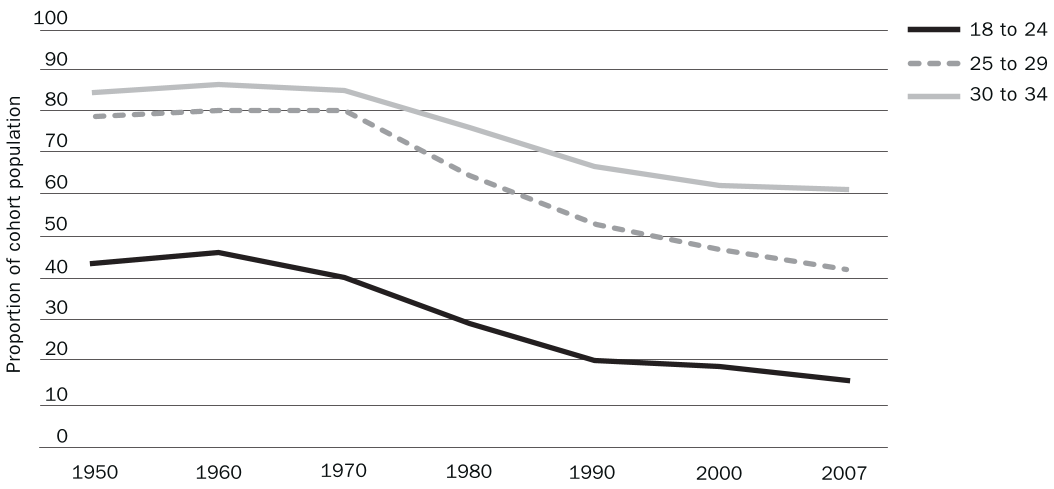
The mechanism he proposes for why this shift also lengthened adulthood is a shared-cause argument rather than a causal chain. Women's educational gains feed both labor force entry and delayed marriage; the disappearance of well-paying unskilled and semi-skilled manufacturing jobs during the 1960s made the single-earner family untenable and turned postsecondary education into a necessity rather than a luxury for anyone aspiring to middle-class earnings. Figures 2, 3, and 4 trace the resulting delays in home-leaving, marriage, and childbearing in the United States, with similar trends observable in Canada and Europe. This is the paper's core theoretical claim: the same forces that transformed the family also stretched the timetable, so any analysis that treats them separately will misattribute the effects.
What the prolongation looks like in co-residence data
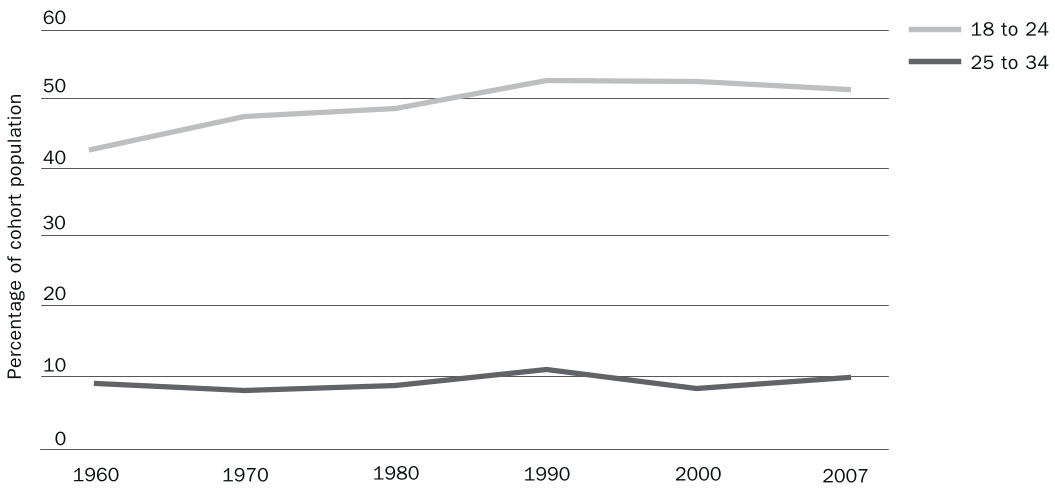
The empirical spine of the paper is the co-residence trend. Figure 2 shows the proportion of youth living at home by age cohort from 1960 to 2007, and the striking finding is that today's pattern resembles the early 1900s more than the postwar decades. Furstenberg is careful to flag that the similarity of form masks a difference in cause: at the beginning of the twentieth century, young adults stayed because they were obliged to contribute to the family economy, whereas today they stay because they are dependent on it. The mass media's alarm about youth refusing to grow up is, on this reading, an exaggeration of a real trend with the wrong explanation attached.
The mechanism behind the trend is stated with unusual precision: all of the increase in the age of home-leaving since the 1960s is attributable to delayed marriage. Unmarried young adults are simply more likely to live with parents than married ones, so when marriage moves later, co-residence mechanically extends. The 1990s saw a slight decline in co-residence, plausibly because a strong economy allowed more young adults to move out, and Furstenberg predicted a subsequent increase due to the recession of 2008 — a prediction consistent with the timing of this volume.
How divorce, gender, and class reshape the texture of co-residence
The paper's attention to the quality of relations, and not just their duration, is what separates it from a purely demographic account. Add Health data on young adults aged twenty to twenty-four show that relations with mothers are consistently closer than those with non-resident fathers, a pattern Furstenberg reads as evidence of a matrilineal tilt in American kinship following divorce and remarriage. Paternal involvement, he suggests, is something of a "package deal" that travels with marriage or at least cohabitation. Co-residence also varies by region and gender: it is substantially higher in the Northeast, plausibly due to higher housing costs and higher college attendance, and women leave home younger than men because they finish college earlier, form cohabiting unions earlier, and marry about two years earlier on average.
The class dimension receives the sharpest treatment. Youth from all economic strata are staying in school longer and marrying later, but the sequence diverges. Advantaged youth attend residential colleges and graduate schools — which the Census Bureau classifies as still living with parents — and enjoy a semi-autonomous period while acquiring credentials. Lower-income youth, if they attend college at all, typically do so while residing with their parents, and they face the added complication of non-marital parenthood. The qualitative evidence from the Baltimore longitudinal study of teen parents is used to show that co-residence can be protective or harmful depending on duration: mothers and children did better when they lived with the young mother's parents for one or two years, but fared somewhat worse if they never moved out, though Furstenberg honestly flags the possibility that this reflects selection between the families that moved out and those that stayed.
Family Formation: A Sequence That Has Come Apart
The decoupling of marriage from maturity
In the mid-twentieth century, leaving home and marrying were tightly sequenced, and couples often married before they had secure employment. Today the onset of sexual relations and marriage is typically separated by at least five years, with cohabitation and sometimes parenthood occurring in the intervening years. Marriage has become a culminating event that still signals social maturity, but social maturity now occurs well before it. The Fragile Families Study documents the fluidity of these intermediate unions: a substantial minority of non-marital births occur to cohabiting couples, but those unions are often ephemeral and only rarely convert to marriage, even though most young parents profess a desire to wed eventually.
The pessimism driving this pattern is not irrational, and Furstenberg is explicit that young parents perceive the situation correctly: many fathers lack job experience, have mental health problems, or have criminal justice involvement, so a hasty marriage carries few benefits. The Baltimore quote from a mother to her daughter — that it does no good for a child if his father cannot care for him — captures the reasoning. Support flows instead toward the natal family, and grandmothers frequently become the primary parent figures in these children's lives. The frontier question, which Furstenberg repeatedly flags as unanswered, is what actually happens inside the household day to day: what rules, routines, and understandings govern obligations, expenses, and comings and goings. He notes that anecdotal reports and studies of parental spending both suggest heavy continued investment, but that solid qualitative evidence is lacking.
The stratified pattern of union and childbearing
The contrast between college-educated and less-educated young adults is presented as the central axis of divergence. In-depth interviews with nearly 500 young adults across four sites by the MacArthur Network on Transitions to Adulthood show that college-educated young adults complete their education and gain work experience before marrying and certainly before having children. They also cohabit for lengthy periods, but those unions rarely produce children, presumably because of more reliable contraceptive practice and access to abortion. Better-educated interviewees described acquiring a "marriage mentality" that required time and experience, often gained by living together. Furstenberg reads the accumulating evidence of declining marital dissolution among the highly educated as a possible payoff for this deliberateness.
For the disadvantaged, the logic inverts. Forty percent of all first births occur outside marriage, and almost all are to women who have not completed college. Nearly half of all young adults with a high school education or less become parents in their late teens or early twenties, and these pregnancies are generally unplanned. Cohabitation functions as what Furstenberg calls a weak form of matrimony: it provides a temporary basis for childbearing without requiring high commitment, and marriage is deferred long after parenthood, sometimes indefinitely. A study with Rachel Margolis found this pattern of delayed marriage after childbearing emerging among less-educated whites as well, which supports the interpretation that socioeconomic status rather than race drives the deferral once childbearing has already occurred.
The family-formation timetable as an intergenerational transfer mechanism
The paper's most consequential synthesis is that the expanded schedule has made the family the primary investor in young adults in the United States, far more so than in Europe. Furstenberg attributes this to the relatively underdeveloped American welfare system: spending on higher education, health care, and job benefits for young adults is meager to modest, so families fill the gap. The PSID analysis by Schoeni and Ross, using 1988 data, quantifies the load. Parents provide an average of 3,500 annually at ages eighteen to twenty, to about 1,500 by the early to mid-thirties. Time contributions follow a similar arc. Measured as a share of income, lower-income families provide considerable support even though absolute amounts are smaller, and there is little or no class difference in time contributions.
Table 1 summarizes the transfer quantities reported in the paper.
| Age band of adult child | Average annual parental financial support | Notes |
|---|---|---|
| 18 to 20 | nearly $3,500 | Peak of the early adult years |
| 25 to 26 | about $2,300 | Mid-twenties plateau |
| early to mid-thirties | a little more than $1,500 | Tail of the transfer curve |
| 18 to 34 (overall average) | $2,200 | Equal to one-third of first-eighteen-years spending |
The implication Furstenberg draws is that the burden is regressive in effect even though it is roughly proportional in effort: because low-income parents lack the absolute resources to give much direct financial assistance, their children are more likely to "flounder on their own" when family help is insufficient. This is the mechanism by which the prolonged transition reinforces, rather than merely reflects, social advantage. The policy dilemma he identifies is structural: the United States must invest in children and youth while simultaneously supporting a growing population aged sixty-five and older, and the current system manages this tension largely through family exchange from the elderly to the young. If Social Security benefits are reduced to preserve the system, the middle generation may have to cut support for its own children to help elderly parents, and low-income families face the sharpest competing demands.
Experimental and Empirical Evidence
This paper does not conduct an experiment; its evidence base consists of secondary analysis of large surveys and a small number of longitudinal qualitative studies. The strongest quantitative anchors are the Census Bureau trend series behind Figures 2 through 4, the PSID transfer estimates, the Add Health third-wave tabulations on mother versus father closeness, the Fragile Families Study on union instability, and the Baltimore longitudinal study of adolescent mothers. The MacArthur Network interviews supply the qualitative account of the "marriage mentality."
Two features of the evidence deserve scrutiny. First, the transfer estimates come from 1988 PSID data, which Furstenberg himself notes may incompletely reflect the more recent extension of early adulthood; the figures are therefore a lower bound on the contemporary load rather than a current measurement. Second, the claim that all of the increase in home-leaving age is attributable to delayed marriage is a strong decomposition claim, and the paper does not present the counterfactual calculation behind it, so the reader must treat it as the author's synthesis of the literature rather than a demonstrated decomposition. The fertility consequence — that the heavier burden of longer childrearing may discourage additional childbearing and ultimately lower total fertility and shrink the workforce — is presented explicitly as a hypothesis ("it does not seem farfetched to suggest"), not as an estimated effect. There is no direct test of the fertility response in this paper.
The evidence is also unevenly distributed across populations. The class contrast is well supported by the Fragile Families and MacArthur data, and the gender contrast by Add Health. But Furstenberg states plainly that the family formation patterns and co-residence patterns of gay young adults "largely remain unexplored," and that the middle stratum — those with some college or an associate's degree — is poorly understood despite likely containing the most variety in timing and sequence. These are honest admissions that bound the generality of the argument.
Where the Analysis Is Strongest and Weakest
The synthesis is strongest where it links mechanism to measurement, as in the attribution of extended co-residence to delayed marriage and the quantification of the parental transfer load. It is weakest where the causal chain runs forward into demographic outcomes: the fertility-depression argument is plausible but untested here, and the interaction between reduced Social Security generosity and parental investment in young adults is posed as an open question rather than examined. The longitudinal data that could answer these questions — the new intergenerational transfer modules in Add Health and PSID — had, as of this writing, only just become available.
Deep Insights and Conclusion
The paper's enduring contribution is the reframing of prolonged dependency as a redistribution of risk rather than a delay. By treating the family as the de facto American welfare institution for young adults, Furstenberg makes the class divergence legible: the same extended timetable that lets affluent youth accumulate credentials and search for durable partners lets disadvantaged youth accumulate unplanned parenthood and unstable cohabitations. The claim that the transition's costs and benefits are not shared equally is the paper's most policy-relevant conclusion, and the prediction that this divide will reproduce advantage and disadvantage in the next generation's family formation is its most consequential.
The limitations are specific. The transfer estimates rest on 1988 PSID data and are acknowledged to understate the contemporary burden. The decomposition attributing all home-leaving delay to delayed marriage is asserted without a published counterfactual. The central fertility-depression mechanism is offered as a hypothesis with no direct estimate, so the strength of the policy warning about lower total fertility and a shrinking workforce depends on plausibility rather than measurement. The daily texture of co-residence — rules, routines, and negotiations over authority and money — is identified repeatedly as an unexplored topic, which means the paper cannot say whether extended co-residence is experienced as support or as strain.
The forward agenda follows directly from these gaps. The most valuable next step would be longitudinal designs that follow both the young adult and the parent through the departure and any return, using time diaries or repeated qualitative interviews to capture the negotiation of authority that Sassler and colleagues began to document. Pairing such data with the new PSID and Add Health transfer modules would allow researchers to test whether parental investment during the extended transition translates into reciprocal support in the parents' later decades, a question the European evidence suggests may hold in both early-autonomy and late-autonomy welfare regimes. Until that evidence exists, the policy recommendation Furstenberg offers — strengthen the family nest and reduce the competing demands on today's parents — remains a recognition of the problem rather than a prescription for solving it.