
MSSH: Revolutionizing Privacy-Preserving Handshakes in Mobile Healthcare Social Networks
A new secret handshake scheme with multi-symptom intersection for mobile healthcare social networks
The paper introduces MSSH (Multi-Symptom Secret Handshake), a privacy-preserving mutual authentication protocol for Mobile Healthcare Social Networks (MHSN). Built upon a linear-complexity Authorized Private Set Intersection (APSI) derived from Schnorr signatures, it achieves SOTA efficiency in multi-symptom matching without relying on expensive bilinear pairings or a centralized trusted authority.
TL;DR
As the aging population grows, Mobile Healthcare Social Networks (MHSNs) have become vital for patient support. However, sharing sensitive health data (symptoms) to find peers without leaking privacy is a major challenge. MSSH (Multi-Symptom Secret Handshake) solves this by allowing patients to authenticate each other only if they share enough common symptoms, all while using lightweight cryptography that outperforms heavy-duty bilinear pairing methods.
Background & Motivation: Why Current "Handshakes" Fail
In cryptography, a "Secret Handshake" allows two members of the same group to authenticate each other anonymously. If they are not from the same group, they learn nothing about each other.
Existing solutions for MHSNs faced a "Trilemma":
- Functionality: Most only matched a single symptom, which is insufficient for complex medical cases.
- Autonomy: They often required a "Top-level Trusted Authority," which is unrealistic for independent hospitals/healthcare centers.
- Efficiency: Advanced policy matching usually relied on Attribute-Based Encryption (ABE), which is too "expensive" (computationally) for mobile devices due to Bilinear Pairings.
Methodology: The Secret Sauce of MSSH
The authors propose a framework based on Authorized Private Set Intersection (APSI). Instead of a single master key, each Healthcare Center (HC) acts independently.
The Core Mechanism: Schnorr-based APSI
The protocol uses Schnorr signatures to authorize "symptom tokens." When two patients, A and B, meet:
- Step 1: They exchange blinded tokens representing their symptoms.
- Step 2: They perform a dynamic matching where the intersection size is calculated.
- Condition: Authentication only succeeds if (where is a threshold).
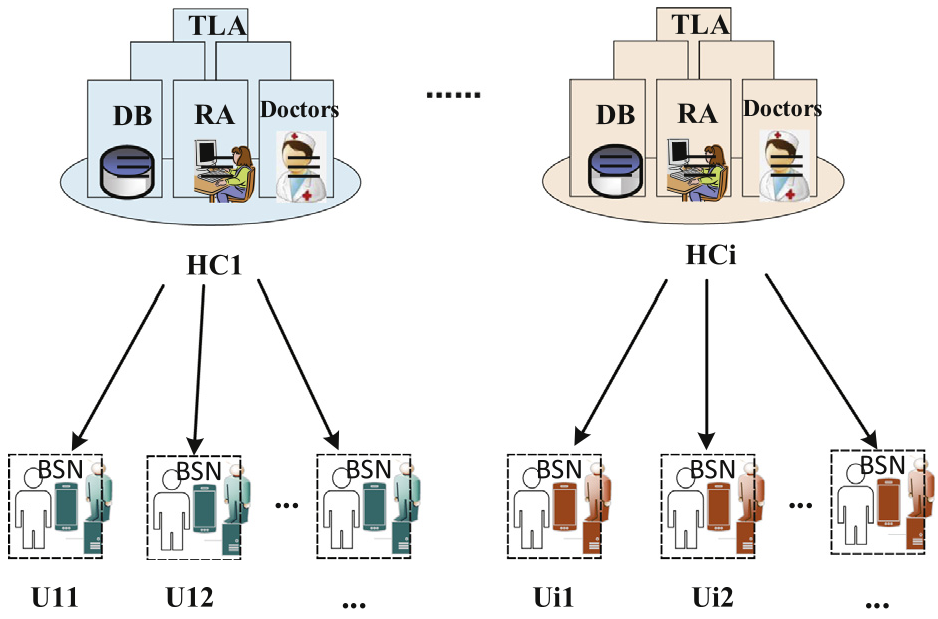 Figure 1: The decentralized MHSN architecture featuring independent Healthcare Centers and mobile patients.
The beauty of this approach is its Linear Complexity . Unlike previous "Fuzzy Matching" schemes that were quadratic , MSSH scales gracefully as the number of symptoms increases.
Experimental Results & Performance
The researchers compared MSSH against several baselines, including SSH, CDHS, and Attribute-Based Handshake (ABH).
1. Computation Efficiency
By avoiding Bilinear Pairings (which take ~4.2ms per operation) and using ECC Scalar Multiplication (~0.44ms), MSSH is significantly faster.
2. Communication Overhead
As shown in the table below, when the number of symptoms () increases to 20, the communication cost of ABH explodes to 126,624 bits, while MSSH stays at a manageable 16,480 bits.
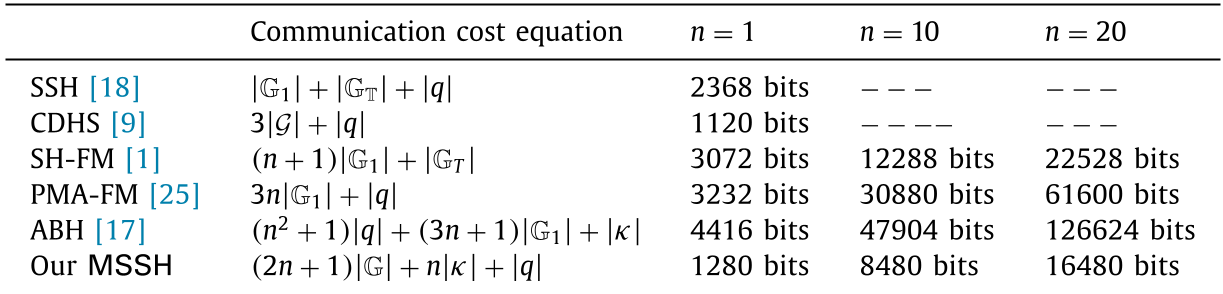 Table 1: Comparative communication costs showing MSSH's superior scalability.
Security & Traceability
Beyond just matching, MSSH includes:
- Impersonator Resistance (IR): Even if an attacker knows a patient's symptoms, they cannot forge the HC's authorization.
- Detector Resistance (DR): If the handshake fails, the "attacker" learns nothing about why it failed or what symptoms the other party has.
- Traceability: If a patient behaves maliciously, the HC can use the
TracePatientalgorithm to reveal their identity—balancing anonymity with accountability.
Critical Insight: The Shift to Lightweight Privacy
The true value of this paper lies in its rejection of "heavy" cryptographic primitives for mobile environments. By repurposing Schnorr signatures—a staple of efficient blockchain and digital signature tech—into a Private Set Intersection (PSI) framework, the authors bridge the gap between high-level security theory and practical mobile implementation.
Conclusion
MSSH provides a robust, decentralized, and efficient way for patients to find "medical peers" without sacrificing their most sensitive data. While future work might look into making these handshakes resistant to quantum attacks, MSSH currently stands as a gold standard for efficient, multi-attribute policy matching in mobile healthcare.
Senior Editor’s Note: This work effectively moves the needle for MHSN by moving away from centralized TRUST and toward decentralized PROOF.