
Newstream: Breaking the Silos of Modern Media Consumption
17212_Newstream a multi-device, cross-medium, and socially aware approach to news content.
This paper introduces Newstream, a multi-device and socially-aware framework for cross-medium news curation. It utilizes a top-down social filtering model to aggregate video, audio, and text into personalized "streams" that are synchronized across TV, mobile, and PC environments.
TL;DR
Newstream is an innovative framework developed at the MIT Media Lab that unifies news across TV, mobile, and web. By replacing traditional broadcast curators with social networks and intelligent filtering, it creates a seamless "stream" of content that understands what you've already seen on one device to prevent redundancy on another.
Context & Motivation: The Redundancy Trap
In our current media landscape, fragmented sources often lead to a "repetition tax." You read a tweet about an election, see a headline on a news site, and then sit down at your TV only to be served the exact same information in video form.
The authors identify two core failures in existing systems:
- Device Isolation: Reading an article has no effect on what your TV suggests later.
- Lack of Social Context: Content aggregators like Google News (circa 2010) lacks the "socially-constrained serendipity" that comes from knowing what your peers are discussing.
Methodology: The Socially-Aware Engine
Newstream's core "secret sauce" is its three-tiered filtering hierarchy and its mathematical approach to "Popularity" and "Likedness."
1. The Filtering Hierarchy
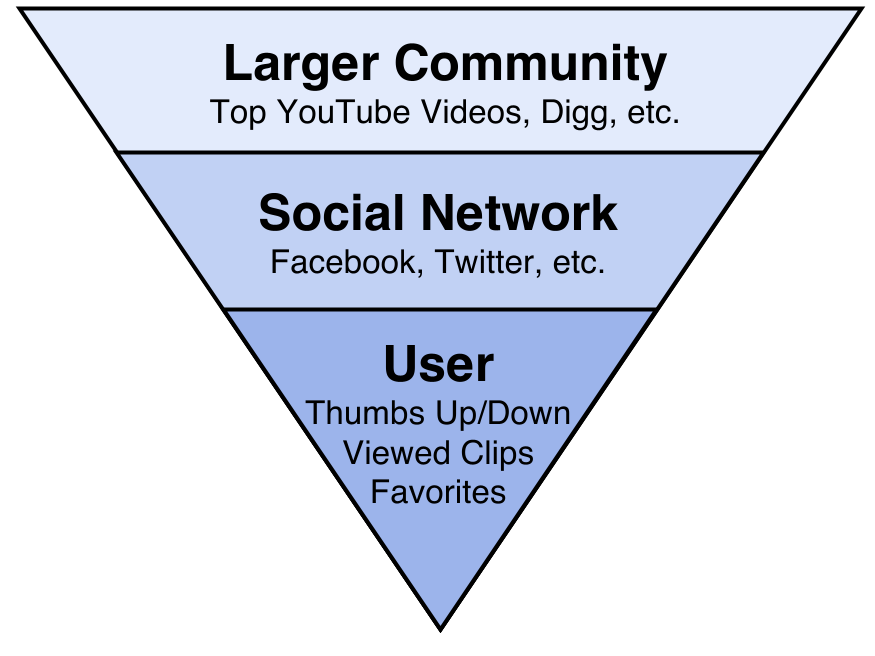
Content flows from a broad community (like YouTube or Google News) through a user's specific social network, and finally through an individual preference filter. This ensures that while a story might be trending globally, it won't clutter your feed if you've shown zero interest in the topic.
2. Redefining Popularity (The Formula)
Instead of relying solely on raw view counts (), the authors introduce a weighted popularity metric. It factors in the average percentage of the clip viewed ().
This means a high-quality video that people watch to the end is valued more than a "clickbait" video that people skip after 10 seconds, even if the latter has more total clicks.
3. Cross-Medium Deduplication
To solve the redundancy problem, Newstream tracks keyword correlation and title similarity. If a user "fully reads" a text article, the system applies a "viewed" flag to virtually identical videos, preventing the user from seeing the same information twice while still offering "Expanded Views" for deeper exploration.
The Prototype: A Proximate Ecosystem
The researchers implemented this using an iPhone as a "haptic-aware" remote, an AppleTV for the "lean-back" experience, and a PC for "lean-forward" interaction.
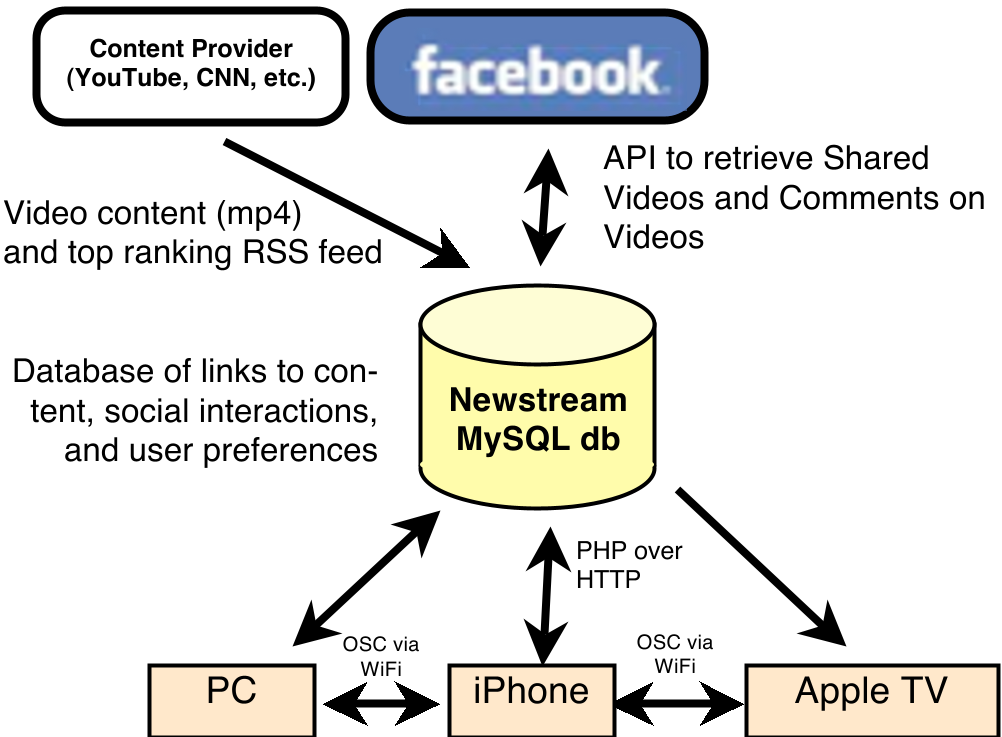
The iPhone serves as the bridge. Using the Open Sound Control (OSC) protocol and Bonjour, it pushes content to the TV. While you watch a clip on the big screen, the mobile device asynchronously displays social dialogues or related links, preserving the immersive nature of the TV without interrupting it with UI clutter.
Critical Insight: Socially-Constrained Serendipity
The most profound takeaway from this work is the concept of socially-controlled serendipity. By prioritizing what friends have watched, Newstream increases the likelihood of shared asynchronous experiences. It acknowledges that media is inherently social—we don't just consume news to stay informed; we consume it to have things to talk about.
Limitations & Future Outlook
While the 2010 implementation relied on RSS feeds and basic keyword matching, today’s LLMs could take Newstream’s vision to the next level by performing deep semantic analysis of news content. The main limitation cited was the availability of "consumption percentage" data from external silos (like YouTube), a challenge that remains relevant in today's "walled garden" era of social media.
Summary of the Newstream Experience
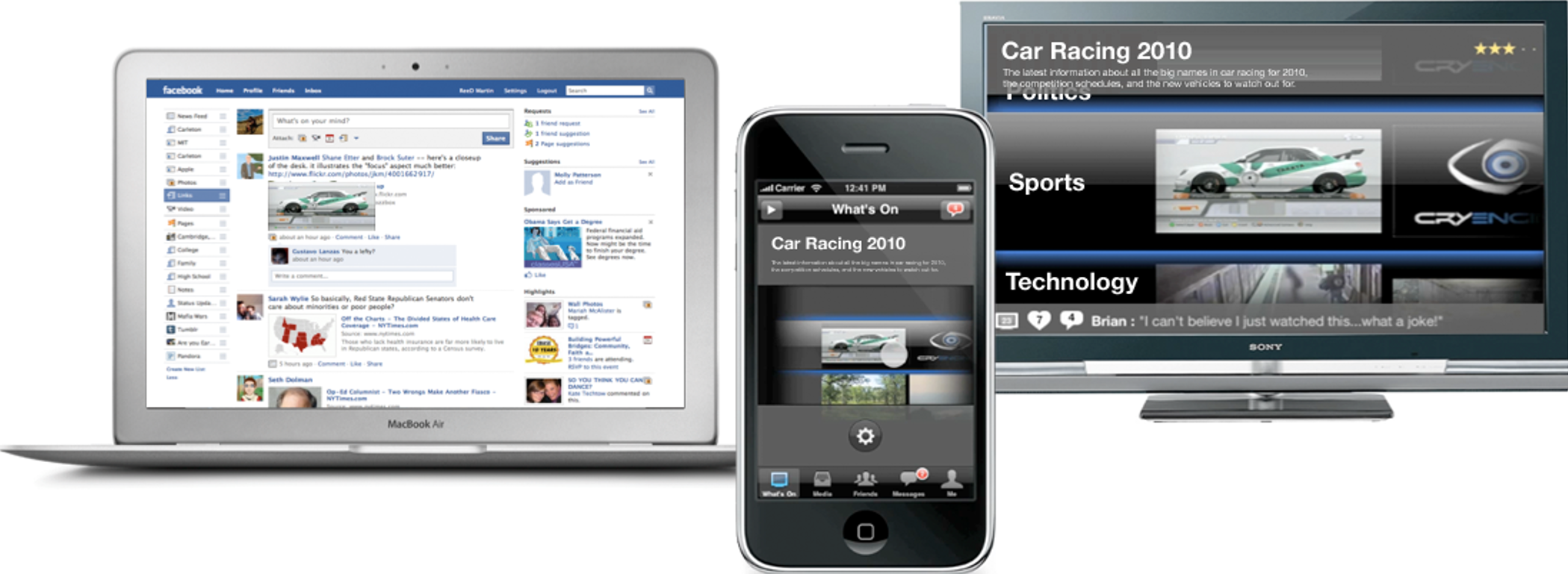
- TV: Immersive, vertical/horizontal 3D navigation for "channels" and "streams."
- Mobile: The "intelligent remote" and social interaction hub.
- Web: The archive and "lean-forward" research tool.
Newstream remains a visionary blueprint for how we should interact with a multi-device world—not as separate screens, but as a unified, socially-aware ecosystem.