
NexGenTV: Bridging the Gap Between Live Broadcast and Real-Time Social Insight
NexGenTV: Providing Real-Time Insight during Political Debates in a Second Screen Application
The paper presents NexGenTV, an end-to-end framework and second-screen application designed to provide real-time insights during televised political debates. By integrating automated multimedia content analytics (face/speech recognition) with social media monitoring, the system enables broadcasters to rapidly ingest, segment, and enrich video clips with related entities and sentiment data for mobile audiences.
TL;DR
NexGenTV is a sophisticated "second-screen" platform that automates the creation of interactive content for live political debates. By combining computer vision (FaceNet), audio processing (Speaker Diarization), and NLP (Sentiment Analysis), it allows broadcasters to push enriched, linkable video clips to smartphones as events unfold, transforming how we consume televised politics.
Background & Motivation
Television is no longer a lean-back, one-way medium. Modern viewers are "second-screening"—searching for facts, checking candidate backgrounds, and arguing on Twitter—while the broadcast is still live. However, creating the content for these apps is a bottleneck for broadcasters. NexGenTV addresses this by providing an automated pipeline that turns raw video streams into structured, searchable, and shareable "smart clips."
Methodology: The Technical Engine
The power of NexGenTV lies in its multi-layered analysis of the broadcast stream:
1. Visual & Audio Diarization
To know "who said what," the system uses:
- Face Recognition: Utilizing FaceNet embeddings and SVM classifiers to identify faces in real-time across a database of key political figures.
- Speaker Diarization: Employing Hidden Markov Models (HMM) and Gaussian Mixture Models (GMM) to segment audio into distinct speaker turns.
2. Semantic Hyperlinking & Information Extraction
Content isn't just identified; it's contextualized:
- Term Extraction: Using Okapi-BM25 weighting to pull key political terms from subtitles.
- Content Hyperlinking: The system uses Doc2Vec (distributed representations) to find semantically similar past news clips, allowing users to "jump" to related historical content.
3. Social Pulse Monitoring
The pipeline monitors Twitter in real-time, using Recurrent Neural Networks (RNNs) to perform sentiment analysis on the public's reaction to specific debate segments.
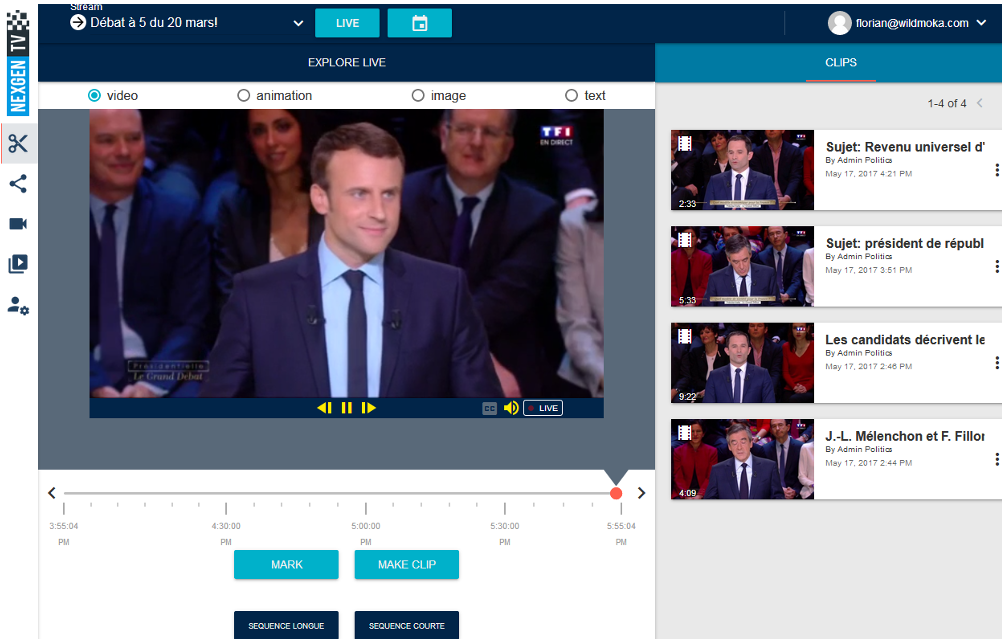 Figure 1: The NexGenTV Back-Office where broadcasters adjust clip boundaries and approve enriched metadata.
Experiments and Deployment
The system was battle-tested during the 2017 French Presidential Election, processing:
- 192 hours of total video (100 hours of debates, 92 hours of news).
- An ontology-driven knowledge base containing candidate biographies and policy positions.
The results showed that the system could effectively calculate "speaking time" vs. "visual presence" for candidates—a key metric in political fairness—while providing users with immediate access to a candidate's specific policy paper the moment they mentioned a topic like the "Wealth Tax" or "EU relations."
Critical Insight & Conclusion
NexGenTV demonstrates that the future of broadcasting is metadata-heavy. While the core technologies used (FaceNet, HMMs) have since been surpassed by Large Language Models (LLMs) and Vision Transformers (ViTs), the system architecture remains a blueprint for modern "Social TV."
Limitations
- Latency: While near real-time, the HMM/GMM diarization approach was noted as "not state-of-the-art" in terms of accuracy, though it prioritized speed.
- Diversity: The system was hard-coded for 35 specific figures; scaling this to hundreds of minor political figures would require more robust zero-shot learning.
Future Outlook
Imagine this system updated with GPT-4o or Gemini 1.5 Pro. Instead of basic keyword extraction, the app could provide real-time fact-checking or summarize complex policy shifts by comparing a candidate's current speech to their history across thousands of hours of video indexed via the NexGenTV framework.