
NHAD: Leveraging Neuro-Fuzzy Logic to Unmask Horizontal Anomalies in Social Networks
NHAD: Neuro-Fuzzy Based Horizontal Anomaly Detection In Online Social Networks
The paper introduces NHAD (Neuro-Fuzzy Based Horizontal Anomaly Detection), a novel framework designed to identify "horizontal anomalies"—users who behave normally with some sources but abnormally with others in Online Social Networks (OSNs). By integrating a self-healing neural model with a fuzzy inference system, NHAD achieves a SOTA detection rate of 99.97% on the DARPA’98 benchmark and over 99.4% accuracy on real-time traffic.
TL;DR
Horizontal anomalies—where users behave selectively "evil" across different entities—are the silent killers of Online Social Networks (OSNs). This paper introduces NHAD, a hybrid Neuro-Fuzzy model that doesn't just block users, but calculates a "healing cost" to decide if they can be redeemed. Achieving a staggering 99.97% detection rate, it sets a new bar for OSN security.
The Motivation: Why Traditional Detection Fails
Most security systems look for "outliers" based on a global average. However, the most dangerous attackers are those who maintain a "white" reputation in one community while launching "black" attacks in another. This is a Horizontal Anomaly.
Prior works like COPRA or Bayesian anomaly detection are effective at spotting group-level discrepancies but struggle with individual behavioral shifts across different sources. Furthermore, they follow a "detect-and-destroy" philosophy, which can lead to high false-positive costs in dynamic social environments.
Methodology: The Neuro-Fuzzy Synergy
NHAD’s brilliance lies in its five-paradigm trust framework:
- Missing Links: Identifying gaps between users and expected sources.
- Reputation Gain (): A weighted sum of trust properties.
- Significant Difference (): Measuring the deviation of current reputation from the historical mean.
- Trust Properties (): Analysis of unauthorized access, spam hits, and sensitive keyword usage.
- Trust Score (): A priority-ranked score ().
The Architecture
The system first constructs a Reputation Gain Graph, which feeds into a Self-healing Neural Model. Instead of simple backpropagation, it uses a Fuzzy Inference System to handle the ambiguity of social behavior.
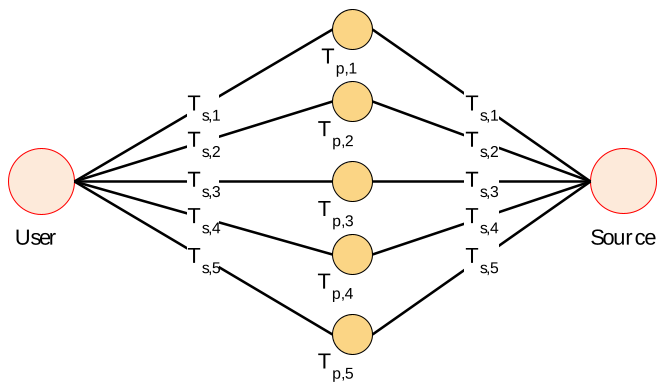 Fig 1: The Reputation Gain graph illustrating user-source interactions based on trust properties.
The final decision is guided by the Self-Healing Cost (). If a user's cost exceeds a threshold, they are flagged. But here’s the kicker: if they are in the "soft anomaly" zone (0.5 - 0.7), the system issues a warning and attempts a recovery rather than an immediate ban.
Experiments & SOTA Results
The authors validated NHAD across three rigorous environments: the DARPA’98 benchmark, a synthetic dataset with Poisson distribution, and real-time network traffic.
Performance Comparison
NHAD dominates traditional machine learning approaches. On the DARPA dataset, where methods like Zhanchun et al. (PCA+SVM) hover around 92% detection, NHAD reaches 99.97%.
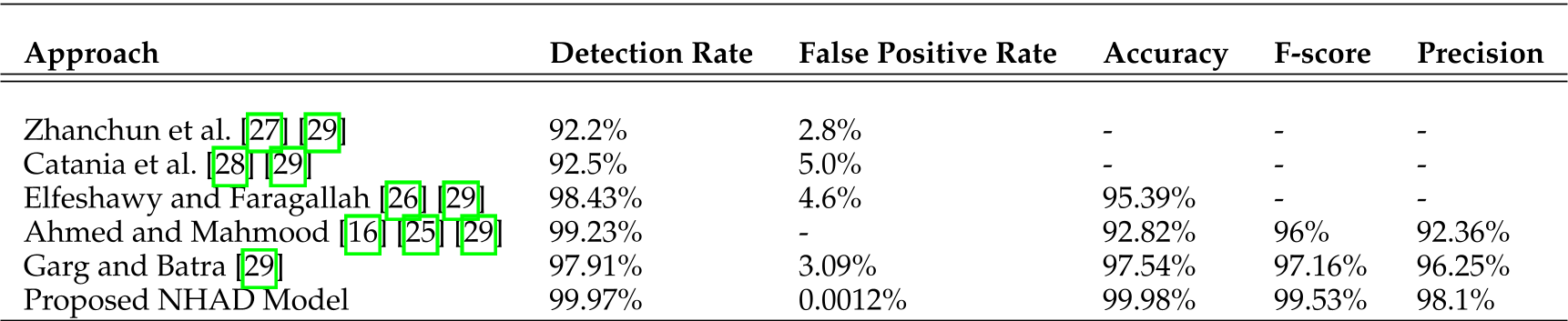 Table 1: NHAD vs. SOTA competitors on DARPA’98.
Real-Time Validation
In a real-life ethernet capture (~2.5 million packets), NHAD maintained an average accuracy of 99.42% with a decision time of less than 1 second, proving its viability for live OSN monitoring.
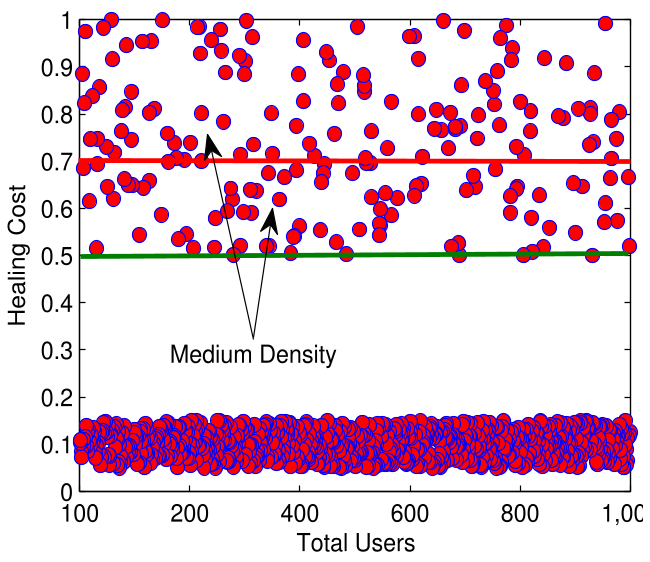 Fig 2: Distribution of anomalies across synthetic sets. Users above 0.7 are "Hard Anomalies," while those between 0.5 and 0.7 are targets for the self-healing recovery mechanism.
Critical Analysis & Takeaways
The core contribution of NHAD is the Self-Healing mechanism. By treating anomalies as "failing neurons" that can be patched, the system preserves user retention while maintaining security.
Limitations: The membership functions in the fuzzy system are currently set empirically. Future work involving Neuro-Fuzzy Reinforcement Learning could allow the system to automatically tune these thresholds in response to evolving attack vectors.
Conclusion: NHAD provides a robust, scalable, and human-centric approach to social network security. It recognizes that in the world of social media, "maliciousness" isn't always binary—it’s a spectrum that requires a fuzzy logic lens to truly understand.