
Beyond the Follow: Deciphering the Hidden Mechanics of Instagram’s Like Economy
No Reciprocity in “Liking ” Photos: Analyzing Like Activities in Instagram
This study presents a large-scale analysis of "Like" activities on Instagram, utilizing a dataset of 20 million users and 2 billion Likes. It introduces the concept of the Like Network (LN) and demonstrates that Like interactions expand more rapidly and involve more non-reciprocal, random connections than traditional Follower Networks (FN).
TL;DR
Is a "Like" just a vanity metric? This study argues it is much more: a fundamental building block of a Like Network (LN) that is structurally more dynamic and expansive than traditional follow-based social graphs. By analyzing 2 billion Likes, researchers found that half of these interactions happen between strangers, driven by content quality rather than social obligation.
The Structural Shift: Networks of Interest vs. Networks of People
In traditional social media theory, we focus on the Follower Network (FN)—a digital representation of who you know or admire. However, this paper identifies a "hidden" social structure: the Like Network (LN).
The authors reveal a stark contrast:
- Followership is sticky and reciprocal: It grows slowly and involves a social "contract."
- Liking is fluid and ephemeral: It is often a "single" interaction from a random user navigating hashtags or search results.
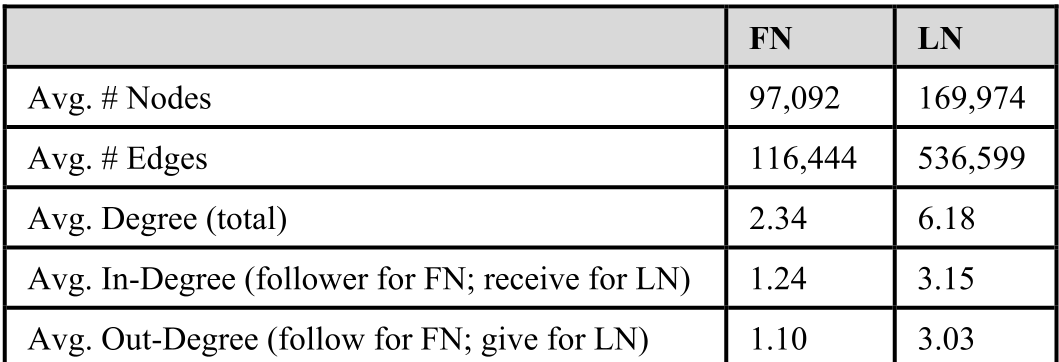
The study proves that LNs expand exponentially, boasting an average degree centrality nearly 3x higher than FNs. This suggests that the "Like" button is the primary engine of information discovery, bypassing the "gatekeepers" of your immediate social circle.
What Drives the Like? A Multi-Factor Analysis
Using negative binomial regression, the researchers quantified the "Incident Rate Ratio" (IRR) of various Instagram actions to see what actually moves the needle on Like counts:
- Followers (IRR 1.082): The strongest predictor. More followers lead to an 8.2% increase in Likes per unit.
- Photos & Tags: Both show positive influence, reinforcing the idea of "findability."
- Follows (IRR 0.994): Interestingly, following more people has a negative effect (-0.5% influence). This debunked the "follow-for-follow" efficacy at a large scale; being a prolific "follower" does not correlate with being a popular "content creator."
The Taxonomy of Success: Specialists vs. Generalists
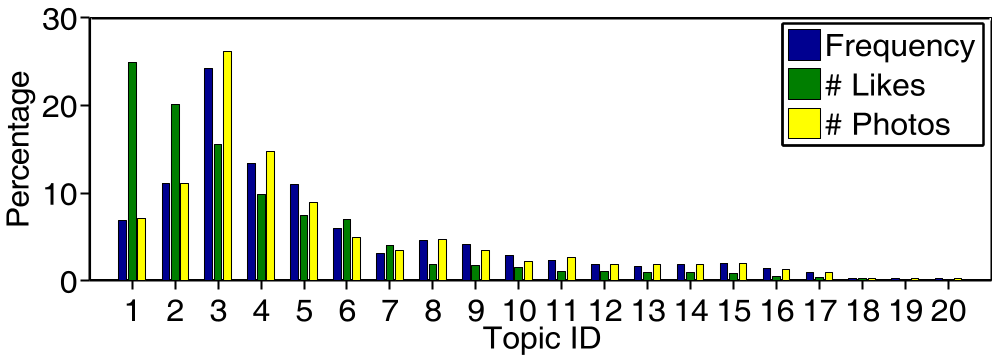
The most striking insight comes from the application of Information Entropy. By using Latent Dirichlet Allocation (LDA) to categorize user photos into 20 topics (Nature, Fashion, Food, etc.), the authors measured how focused a user is.
- Specialists (Entropy < 1): Users who "stick to their lane" (e.g., only posting architectural photography).
- Generalists (Entropy > 3): Users who post a mix of family, food, and daily life.
The data is conclusive: Specialize or remain ignored. Specialists receive a median of 10,893 Likes, while Generalists linger at 2,375. Specialists often use Instagram as a portfolio for self-promotion or commercial websites, treats the platform as a professional gallery rather than a personal diary.
Critical Insight: The "No Reciprocity" Phenomenon
The paper's title, "No Reciprocity," highlights a hard truth of social media: Liking is a one-way street. Because nearly 50% of Likes come from random users seeking specific content (the "Nature" topic, for example, receives disproportionately high Likes relative to the number of photos posted), the Like Network is a meritocracy of the image, not a reciprocal social exchange.
Conclusion
This research shifts our understanding of Instagram from a "Social Network" to an "Interest Graph." For researchers and marketers, the takeaway is clear: the most valuable interactions happen outside of the follower list. To maximize impact, content must be optimized for the Like Network—aiming for high thematic specialty to attract the "random" but high-value "Like" from the global user base.
Limitations: The study reflects the 2015 Instagram landscape. In the era of algorithmic feeds and AI-driven discovery, the "randomness" of Likes has likely decreased as platforms become better at predicting exactly which "stranger" will like your specific photo.