
Dynamic Influence Maximization: Why Your "Seed" Strategy is Only Half the Battle
19034_Using Node Centrality and Optimal Control to Maxim
This paper presents a joint optimization framework for seed selection and time-varying resource allocation to maximize information diffusion in social networks. By modeling information spread as a Susceptible-Infected (SI) epidemic process and applying Pontryagin’s Maximum Principle, the authors achieve significant performance gains over traditional static seeding strategies across real-world datasets like Facebook and Slashdot.
TL;DR
In the world of viral marketing, we usually obsess over who to pick as the initial influencers (the seeds). This paper argues that when and how much you advertise to different groups throughout a campaign is just as critical. By treating information spread like a biological epidemic (SI model) and applying Optimal Control Theory, the authors prove that dynamic resource allocation can vastly outperform static strategies, especially when simple node metrics like Degree Centrality are used to guide the process.
The "Fire and Forget" Fallacy
Most benchmark studies in influence maximization are static: you pick a set of influential nodes at , and then you hope for the best. This ignores the reality of modern digital marketing, where budgets are spent over weeks, not seconds.
The authors identify two major gaps in existing research:
- Lack of Temporal Control: Prior work doesn't solve for the optimal "pulse" of a campaign.
- Structural Neglect: Previous optimal control models assumed everyone meets everyone (homogeneous mixing), ignoring the specific "who-knows-whom" of social adjacency matrices.
Methodology: Fusing Epidemics with optimal Control
The researchers use the Susceptible-Infected (SI) model. In this setup, "Infected" simply means "Informed." The evolution of the spread is defined by a system of Ordinary Differential Equations (ODEs) where the rate of change depends on both the network structure (Adjacency Matrix ) and an external control signal (Advertising).
The Core Mechanism
Nodes are grouped by Centrality (PageRank, Degree, Closeness, or Betweenness). Each group receives a unique control signal. The goal is to maximize:
(Note: This represents the state equations where control directly boosts the transition from Susceptible to Infected.)
To solve this, they utilize Pontryagin’s Maximum Principle, deriving "Adjoint Equations" that act as a shadow price for information spread. They solve these using a Forward-Backward Sweep:
- Forward: Simulate the epidemic spread with a current guess for advertising.
- Backward: Calculate the "importance" of infecting each node at each time step, starting from the deadline and moving back to the start.
Key Insights: Who to Target?
The most profound takeaway from the paper is how the "optimal" target changes based on your budget:
- Resource Scarcity ( is high): The optimal strategy targets Central Nodes. If you have very little money, you must hit the "super-spreaders" early to let the network's natural mechanics do the heavy lifting.
- Resource Abundance ( is low): The strategy pivots to Non-Central Nodes. Since you have plenty of budget, you can afford to directly "infect" the isolated nodes who would otherwise never receive the message through organic spread.
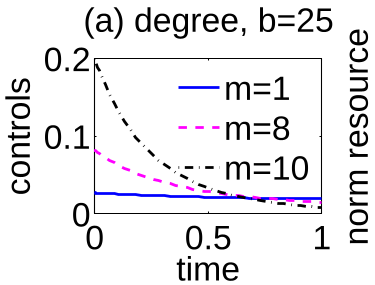 Figure 1: Comparison of control signals. Note how the high-centrality groups (m=10) receive intense, front-loaded effort compared to lower groups.
Experimental Results: The Power of Simplicity
Using datasets from Facebook and Slashdot, the authors found that Degree Centrality—the simplest local measure—performs almost as well as computationally expensive measures like Betweenness.
- SOTA Comparison: The joint optimization (Seeds + Dynamic Control) provided massive percentage improvements over "Best Static" controls.
- Ablation on Groups: Increasing the number of groups () provides diminishing returns; usually, dividing the network into 5-10 groups based on centrality is enough to capture the necessary variance for efficient control.
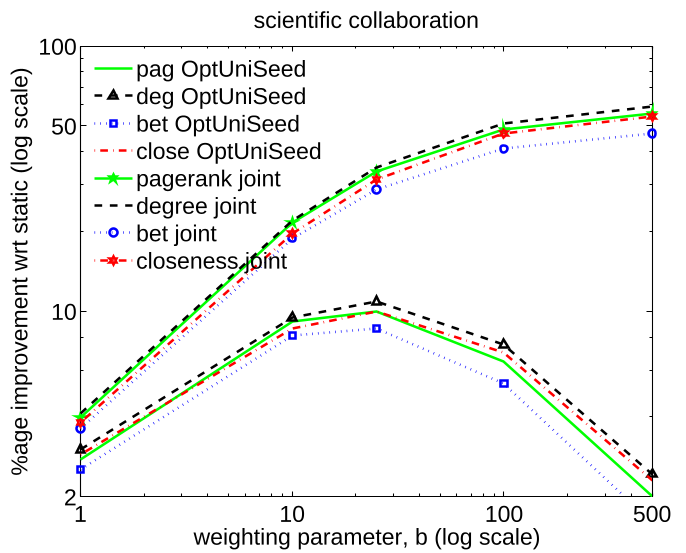 Figure 2: Percentage improvement of the optimal strategy over static baselines as the cost of resource () increases.
Critical Analysis & Conclusion
While the paper provides a robust mathematical framework, it operates under the SI model, which assumes users never "forget" or "recover" from the information. This is perfect for short-term movie buzz or charity drives but might need adjustment for long-term brand fatigue (requiring an SIR or SIS model).
The Takeaway: If you are running a campaign, don't just find the "cool kids" at the start. Monitor your budget: if you're broke, stick to the influencers; if you're flush, spend your money on the hard-to-reach outskirts of the social graph. Logic dictates the strategy, but math proves it.