
NECTAR: Overcoming the Louvain Limit for Overlapping Community Detection
Node-Centric Detection of Overlapping Communities in Social Networks
NECTAR is a node-centric community detection algorithm that generalizes the Louvain method's local search heuristic to identify overlapping community structures. It achieves SOTA performance by dynamically selecting between two objective functions, WOCC and QE, based on the network's intrinsic triangle density.
TL;DR
NECTAR (Node-centric ovErlapping ComMunity deTection AlgoRithm) bridges the gap between the efficiency of the Louvain Method and the reality of overlapping social structures. By dynamically switching between triangle-based (WOCC) and modularity-based (QE) objective functions, it achieves superior accuracy in identifying nodes that belong to multiple social circles.
Problem & Motivation
In the real world, communities are rarely disjoint. A person belongs to a family, a workplace, and a hobby group simultaneously. However, the famous Louvain Method (LM)—the gold standard for fast community detection—is fundamentally "winner-take-all," assigning each node to exactly one cluster by maximizing modularity.
The authors identify a critical insight: No single objective function works for every graph. Networks with heavy overlapping (like co-authorship) exhibit high triadic closure, while others might follow more traditional modularity patterns. NECTAR is built to handle this diversity.
Methodology: The Core Architecture
NECTAR's power lies in its Heuristic Generalization. Instead of picking the single best community for a node, it evaluates the "gain" (Δ) for all neighboring communities and admits the node into any community that provides a gain within a factor of of the maximum.
The Secret Sauce: Dynamic Objective Selection
Before the local search begins, NECTAR calculates the average triangle rate ():
- If : It uses WOCC (Weighted Overlapping Community Clustering), focusing on triadic closures.
- Otherwise: It uses QE (Extended Modularity), which is better suited for sparser overlaps.
 Note: The algorithm iteratively refines community memberships, ensuring stability through a "merge" procedure that collapses communities with an overlap higher than .
Experimental Results
The authors tested NECTAR against industry standards like BigClam, OSLOM, and Link Communities.
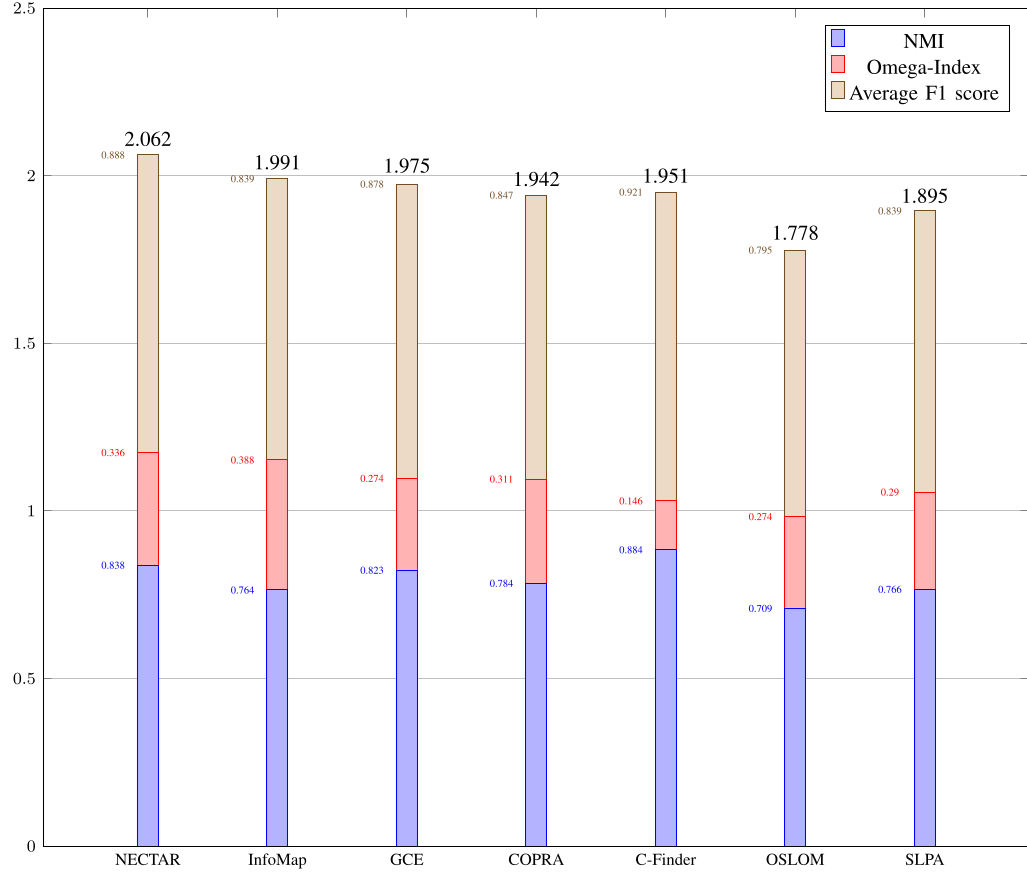
- Performance: In the Amazon co-purchasing network, NECTAR demonstrated a significant lead in F1 and NMI scores.
- Stability: The node-centric approach ensures that even as the number of communities changes dynamically, the algorithm converges efficiently.
(Ref: Figure 1 in the original paper highlights the competitive advantage of NECTAR over 6 SOTA baselines.)
Critical Analysis & Conclusion
Takeaway
NECTAR proves that the local search heuristic of Louvain is more versatile than previously thought. The introduction of WOCC provides a specialized tool for high-overlap social networks where traditional modularity fails due to the resolution limit.
Limitations
While NECTAR is efficient, the triadic closure calculation (step 5) can be computationally expensive on massive graphs compared to simple edge-counting. Furthermore, the selection of the threshold is empirical and might require tuning for non-social networks (e.g., biological or infrastructure networks).
Future Work
The concept of Dynamic Objective Selection is the most promising path forward. Future research could utilize Graph Neural Networks (GNNs) to predict the optimal objective function for a specific subgraph before starting the clustering process.