
SNOMA-COA: Reimagining Fog Computing with NOMA and Social Trust
Exploiting NOMA into socially enabled computation offloading
This paper proposes SNOMA-COA, a social-trust-based Non-Orthogonal Multiple Access (NOMA) cooperative computation offloading algorithm for fog computing. It integrates physical layer transmission efficiency with social layer trust metrics to minimize system latency and maximize spectrum efficiency.
TL;DR
This research introduces a novel framework for fog computation offloading that breaks the limitations of traditional orthogonal access. By integrating NOMA (Non-Orthogonal Multiple Access) for high spectral efficiency and a Social Trust Index for node reliability, the proposed SNOMA-COA algorithm significantly reduces system latency and enhances communication stability compared to distance-based or random offloading strategies.
Context & Motivation
As mobile applications become increasingly computation-intensive (e.g., VR/AR, real-time AI), typical Mobile Cloud Computing (MCC) struggles with the "long-haul" latency of reaching remote data centers. Fog Computing addresses this by leveraging nearby idle devices.
However, two critical gaps remain in current fog research:
- Transmission Efficiency: Most systems use Orthogonal Multiple Access (OMA), where resources are locked to one user, wasting spectrum.
- Node Reliability: Algorithms often assume every "neighbor" node is willing and reliable to compute your task, ignoring the inherent uncertainty of peer-to-peer interactions.
Methodology: The Fusion of Physical and Social Domains
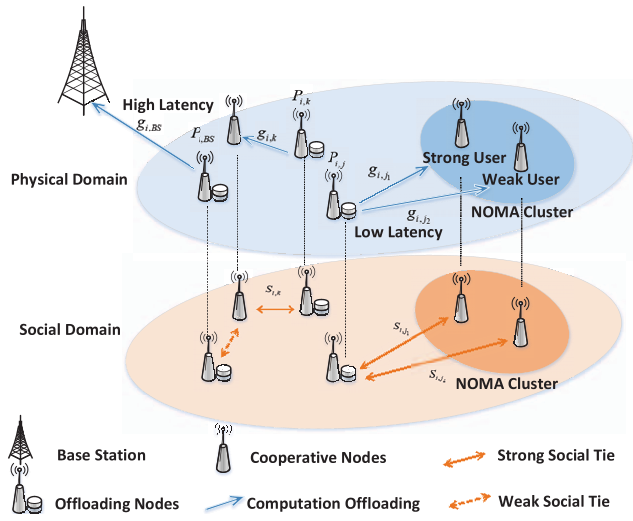
The core innovation lies in the Social Trust Based NOMA Cooperative Computation Offloading Algorithm (SNOMA-COA). The authors distinguish between three offloading modes:
- Single Cooperative Node: Traditional one-to-one helper offloading.
- NOMA Cluster: One offloading node reaches two trusted helpers simultaneously on the same frequency, using Successive Interference Cancellation (SIC) to decode signals.
- Edge Base Station: The "fail-safe" option when no local trusted nodes are available.
The NOMA Advantage
By forming NOMA clusters, the system allows a "strong user" (better channel) and a "weak user" to share the same resource block. This doesn't just save spectrum; it allows tasks to be computed in parallel by two cooperative nodes, drastically cutting down the "Execution Time" component of latency.
The Social Trust Filter
The algorithm introduces a social trust index . Before any offloading decision is made, nodes must pass a dual-threshold check:
- Physical: Minimum channel gain ().
- Social: Minimum trust level ().
Experimental Insights
The paper evaluates SNOMA-COA against three benchmarks: ROA (Random), MDOA (Minimum Distance), and MSTOA (Maximum Social Trust).
Key Findings:
- Latency & Data Rate: SNOMA-COA consistently achieves the highest data rates and lowest latency. While MSTOA (Social-only) ensures reliability, it lacks the spectral efficiency of NOMA.
- The Trust Paradox: Interestingly, the simulation reveals that a higher trust requirement () is a double-edged sword. While it filters out bad actors, set too high, it leaves offloading nodes with no local options, forcing them back to the high-latency Base Station.
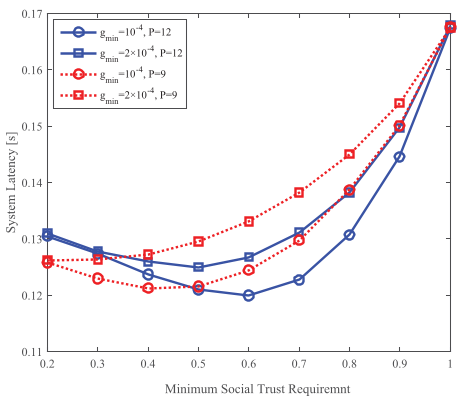 Fig 1: System data rate comparison showcasing the superiority of SNOMA-COA.
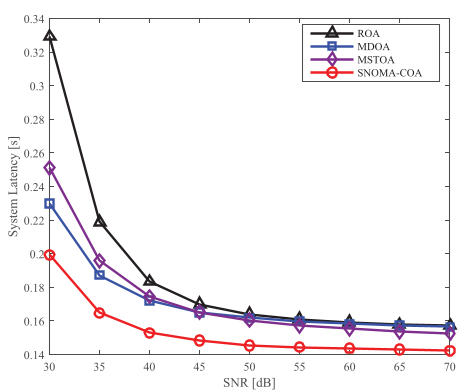 Fig 2: System latency reduction achieved through parallel NOMA computation.
Critical Analysis & Conclusion
The beauty of this work lies in its Inductive Bias: the assumption that social relationships are a proxy for communication link stability. By mathematicalizing "trust," the authors bridge the gap between network sociology and physical layer communications.
Takeaway: The move toward 6G requires "Socially-Aware" networking. Efficiency is no longer just about signal-to-noise ratios; it's about the probability of a successful, trusted collaboration between edge devices.
Limitations: The trust index is assumed to be a known static value. Future work should investigate dynamic trust modeling—how trust values change based on the success or failure of previous offloading tasks (Reinforcement Learning).