
Non-Bayesian Social Learning: Why "Naïve" Networks Can Still Find the Truth
Non-Bayesian social learning
This paper introduces a non-Bayesian dynamic model of opinion formation in social networks where information is dispersed. It proposes a linear updating rule that combines an agent's Bayesian posterior from personal signals with the expressed beliefs of neighbors, proving that this simple mechanism achieves full information aggregation and learning of the true state in strongly connected networks.
TL;DR
In the world of social networks, we often assume that for a group to find the "truth," individuals must be hyper-rational, aware of the whole network, and perfectly Bayesian. This paper, "Non-Bayesian Social Learning," turns that assumption on its head. It proves that even if agents use a simple, mathematically "naïve" rule—mixing their own data with their neighbors' opinions—they will eventually learn the truth as perfectly as a global super-computer, provided the network is connected.
The Problem: The High Cost of Being "Smart"
Standard Bayesian learning models assume agents are geniuses. To update beliefs perfectly, an agent needs to know:
- The exact structure of the entire social network.
- The reliability of every other agent's signals.
- How to "undo" the correlations of opinions (i.e., making sure they don't count the same piece of news twice when it comes from two different friends).
In reality, this is impossible. The computational burden is too high. Conversely, simpler models like the DeGroot model often result in people converging to a wrong opinion if the "influential" person in the group is biased or misinformed.
The Insight: "Self-Reliance" + Social Contagion
The authors propose a middle ground. Agents in this model are locally Bayesian but socially naïve.
How it Works (The Methodology)
Every period , an agent receives a private signal and observes their neighbors' beliefs. They update their belief using a simple convex combination:
- (Self-Reliance): The weight given to their own data.
- (Bayesian Update): The agent is rational about their own experience.
- (Social Weight): The weight given to neighbor .
The genius of this approach is that agents don't need to know where the information comes from. As long as they keep observing new data (), the "truth" acts like a contagion. Even if a highly influential person is uninformed, the constant flow of real-world signals eventually "washes away" the misinformation.
 A representation of how information flows through a directed network.
Key Results: The Strength of Strong Connectivity
The paper's most powerful finding is that Strong Connectivity is the only structural requirement for learning.
- Correct Forecasts: Agents eventually predict their own future signals with 100% accuracy.
- Aggregation of Dispersed Information: Even if no single agent has enough data to know the truth (an "identification problem"), the network as a whole learns the truth.
- Resistance to Influence: Unlike previous models, "persuasive" but uninformed agents cannot stop the network from learning. They might slow it down, but the truth is asymptotically inevitable.
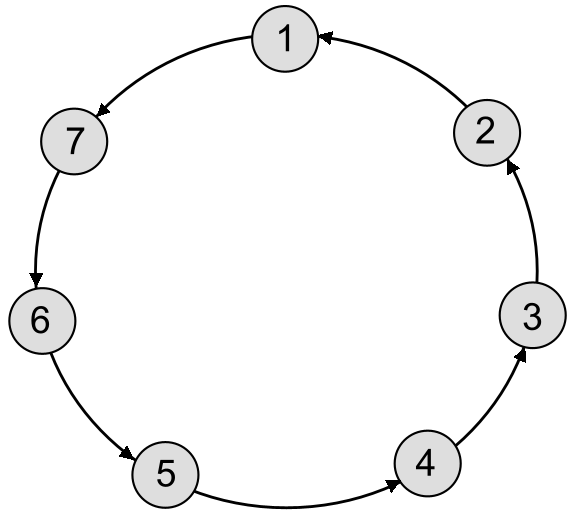 Figure 1: Example of a 7-agent network where each agent has an identification problem, yet the group achieves full learning.
Critical Insight & Conclusion
This work bridges the gap between the "hyper-rational" Bayesian world and the "rule-of-thumb" non-Bayesian world. It shows that individual Bayesianism toward personal signals is the "anchor" that prevents social groups from drifting into permanent delusion.
Limitations
- The Rate of Learning: While the paper proves agents learn eventually, it doesn't guarantee they learn fast. In some topologies, it might take thousands of iterations to reach consensus.
- Static Influences: The model assumes social weights are constant. If people stop listening to others over time, the "contagion of truth" might break.
Final Takeaway: To build a system (or a society) that finds the truth, you don't need everyone to be an expert on the whole system. You just need everyone to be an expert on their own small "slice" of reality and maintain a basic level of trust in their neighbors.