
Guardian at the Gate: Leveraging the Crowd to Detect Improper Tasks
Leveraging non-expert crowdsourcing workers for improper task detection in crowdsourcing marketplaces q
This paper presents a machine learning framework for the automatic detection of improper tasks in crowdsourcing marketplaces like Lancers. By combining expert operator judgments with non-expert worker labels using quality control techniques (such as the Dawid and Skene model), the authors achieve a SOTA performance of 0.962 AUC.
TL;DR
As crowdsourcing grows, so does the influx of "dirty tasks"—malicious requests for fake reviews, account hijacking, or private data harvesting. Researchers from the University of Tokyo and Lancers Inc. have developed a machine learning system that not only detects these tasks with 0.962 AUC but also reduces the expert monitoring workload by 25% by intelligently integrating judgments from non-expert workers.
Background: The Hidden Darkness in Crowdsourcing
Crowdsourcing is often associated with innovation, but it has a dark side: Crowdturfing. Requesters frequently post tasks that violate terms of service, ranging from Stealth Marketing (fake retweets) to identity theft. For platforms like MTurk or Lancers, manually vetting every task is a logistical nightmare.
The core challenge is scalability vs. accuracy. Experts are accurate but expensive; automated systems are fast but can be fooled; and non-expert workers are cheap but notoriously "noisy" and unreliable.
Methodology: A Multi-Modal Approach
The authors formulated improper task detection as a supervised binary classification problem. Their feature engineering was particularly comprehensive, moving beyond simple text:
- Textual Features: Bag-of-Words from task titles and instructions, identifying "red-flag" terms like password, email, and blog.
- Task Metadata: Reward amounts (higher rewards often correlate with improper tasks) and worker qualification requirements.
- Requester Profiles: Historical reputation, identity verification status, and account age.
Architecture of the Collective Intelligence
The most innovative part of the study is the Hybrid Annotation Strategy. They didn't just ask workers "Is this task bad?"—they asked four specific binary questions (e.g., "Is this asking for personal info?").
 Visualizing the flow from task posting to automated classification and expert review.
To handle the noise from non-experts, they utilized the Dawid and Skene (1979) method, which uses an EM algorithm to estimate a worker's latent reliability.
The "SKIP; POS" Insight
A key finding was how to handle disagreements between experts and the crowd. The authors discovered that a specific logic—SKIP; POS—worked best:
- If the Expert says it's Improper, believe them (POS), even if the crowd disagrees.
- If the Expert says it's Proper but the crowd says it's Improper, SKIP the sample. This avoids training the model on ambiguous data where the crowd might be over-sensitive.
Results & Experimental Evidence
The results prove that "more eyes" lead to better models. Using the complete feature set, the classifier reached impressive heights:
| Training Data Source | AUC Score |
|---|---|
| Expert Judgments Only | 0.950 |
| Crowd Judgments Only | 0.817 |
| Combined (Hybrid) | 0.962 |
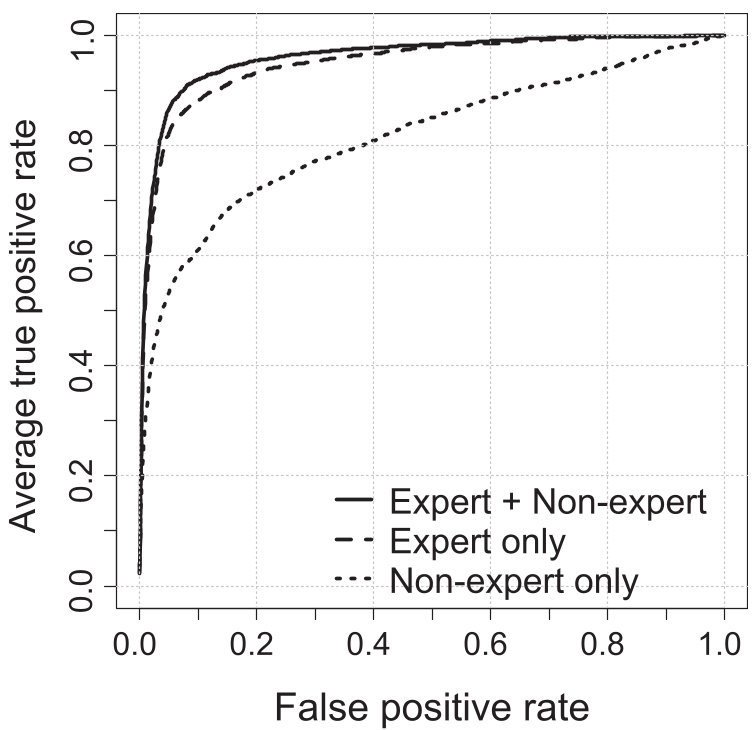 The ROC curve demonstrates the superior performance of the combined Expert + Non-expert model.
Key Insights from the Data:
- High Rewards are Red Flags: Tasks paying over $10 were statistically far more likely to be improper (11.5% vs 0.5% for proper tasks).
- Reputation Matters: 83.3% of "clean" requesters had perfect ratings, while malicious requesters averaged significantly lower scores.
Critical Analysis & Takeaways
The brilliance of this work lies in its practicality. It doesn't attempt to replace experts; it empowers them. By reducing the expert label requirement by 25%, platforms can save massive operational costs while actually increasing their detection precision.
Limitations: The study relies on a Japanese dataset (Lancers), and performance might vary in Western markets like MTurk due to different spam patterns. Furthermore, as NLP evolves, simple BoW features should be replaced with Transformer embeddings (BERT/RoBERTa) to capture the semantic nuance of "stealth" instructions.
Future Outlook
This paper serves as a blueprint for "Self-Policing" platforms. By turning workers into moderators and using machine learning to filter their noise, we can create safer digital marketplaces that are resistant to abuse.