
Beyond Words: A Vision-Based Approach to Tuning into Human Emotions
A Non-Linguistic Approach for Human Emotion Recognition from Speech
This paper proposes a non-linguistic speech emotion recognition method that treats audio spectrograms as visual images. By applying the "Bag-of-Visual Words" (BoVW) model—a classic computer vision technique—with SURF descriptors and SVM classifiers, the system achieves robust emotion classification across multiple languages and real-life scenarios.
TL;DR
Researchers have developed a method to detect human emotions from speech without "listening" to the words or using traditional audio engineering metrics. By transforming speech into spectrograms and treating them as images, they applied the Bag-of-Visual Words (BoVW) model—a staple of computer vision—to achieve state-of-the-art results across various languages and real-world classroom settings.
Background: The Language Barrier in Emotion AI
Recognizing how someone feels through their voice is a cornerstone of Human-Computer Interaction (HCI). However, most systems hit a wall when faced with different languages. If a model is trained on English semantics, it fails in a Greek or Italian context. Even non-linguistic methods that look at "pitch" or "rhythm" can be fragile.
The authors of this paper argue that we should stop looking at audio as a signal and start looking at it as a visual pattern.
The Core Insight: Spectrograms as Textures
The researchers' intuition is elegant: an emotional outburst (like anger) creates a specific visual "texture" on a spectrogram that differs fundamentally from the texture of sadness. By using a grid-based sampling technique, they can capture these patterns regardless of what language is being spoken.
The Methodology Pipeline
- Spectrogram Generation: Raw audio is transformed via Short-Time Fourier Transform (STFT) into a 2D image.
- Feature Extraction: Instead of finding "points of interest," they overlay a rigid 8x8 grid on the image and extract SURF (Speeded-Up Robust Features) descriptors from each cell.
- Visual Vocabulary: They use k-means clustering to find "exemplar" patterns (visual words).
- Quantization: Every segment of the audio is "translated" into a histogram of these visual words.
- Classification: A Support Vector Machine (SVM) looks at the histogram and predicts the emotion (Happiness, Sadness, Anger, Fear, or Neutral).
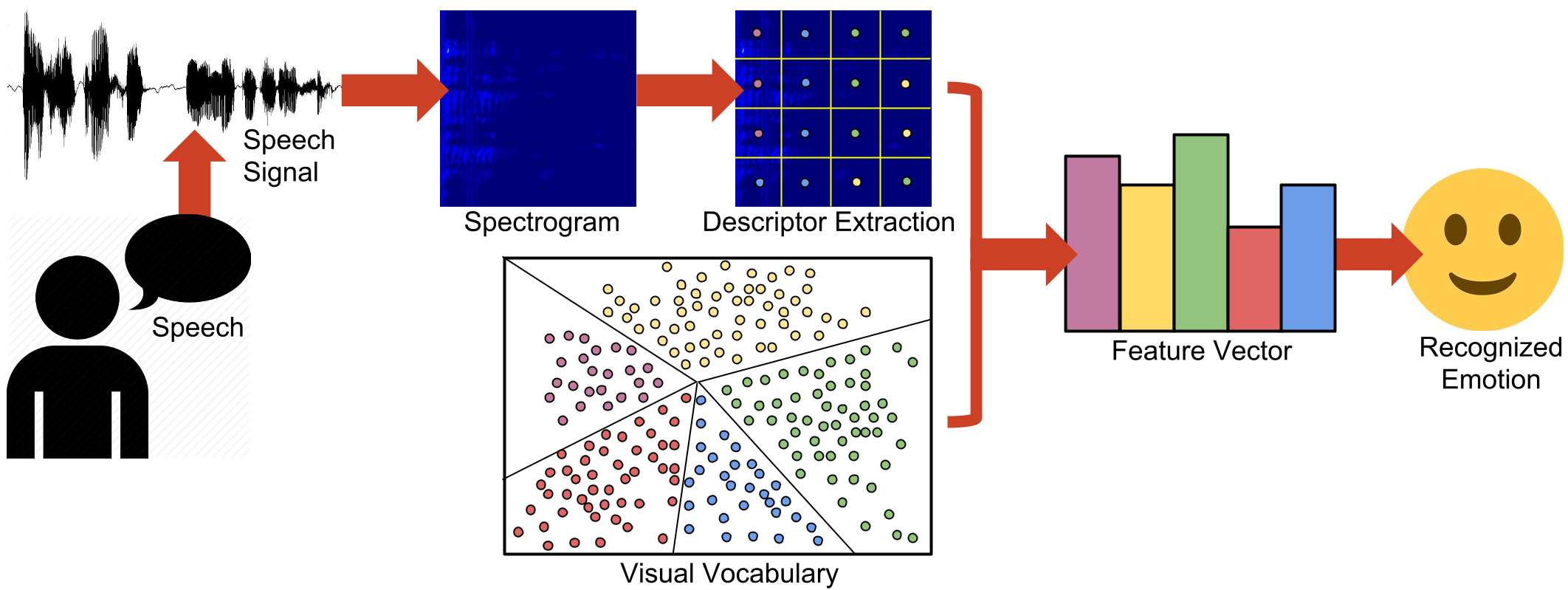 Fig 1: The transition from raw speech signals to an emotional classification via visual word histograms.
Experiments: From Lab to Classroom
The study tested the model on three different languages:
- EMOVO (Italian)
- SAVEE (English)
- EMO-DB (German)
More interestingly, they conducted a real-life experiment involving 24 middle-school students building LEGO robots. This "KIDS" dataset is particularly valuable because it captures authentic, unrestrained emotion rather than actor performances.
Performance Comparison
The BoVW approach consistently beat two strong baselines:
- Baseline 1: Classic image features (HOG, LBP).
- Baseline 2: Standard audio features (MFCCs, Spectral Flux, etc.).
| Dataset | Proposed BoVW | Audio Baseline |
|---|---|---|
| EMOVO (Italian) | 0.63 | 0.45 |
| EMO-DB (German) | 0.74 | 0.80 |
| KIDS (Real-life) | 0.83 | 0.75 |
(Note: While the audio baseline performed better on the German dataset, the visual approach showed superior robustness in the real-life classroom environment.)
 Fig 2: A visual representation of "Anger" as seen by the model.
Critical Insight & Conclusion
Why does this work so well? By using SURF descriptors on a grid, the model captures local frequency changes that are often ignored by global spectral averages. It treats the "sound" of an emotion like the "texture" of a fabric.
Limitations: The current model uses a relatively small vocabulary (N=100 to 1500) and relies on 2D images. Modern Deep Learning (CNNs) might extract even more abstract features, but this BoVW approach is significantly more "explainable" and requires less training data.
Future Outlook: This work paves the way for "emotionally-aware" classrooms and assistive living spaces where the technology is invisible, unobtrusive, and—most importantly—doesn't need to understand what you're saying to know how you're feeling.