
EP-WOCD: Scaling Whale Optimization for Complex Community Detection
A novel community detection method based on whale optimization algorithm with evolutionary population
This paper introduces EP-WOCD, a novel community detection method that adapts the Whale Optimization Algorithm (WOA) to discrete symbol spaces. By integrating an evolutionary population dynamics (EPD) strategy and specialized search operators, the method achieves State-of-the-Art (SOTA) performance in partitioning complex networks while significantly reducing computational overhead.
TL;DR
Community detection is essentially finding "who belongs with whom" in a massive web of connections. While swarm intelligence (like the Whale Optimization Algorithm) is great at searching for solutions, it is usually "math-heavy" and "slow." EP-WOCD changes the game by translating whale behaviors into "genetic updates" and using an evolutionary pruning strategy to make the algorithm faster and smarter, even solving the notorious "Island Node" problem where traditional algorithms fail.
Problem & Motivation: The "Local Optima" and "Island" Trap
In complex networks, we often face two hurdles:
- Computational Deadweight: Swarm algorithms usually keep a fixed number of "searchers" (whales). In the beginning, you need many whales to explore; by the end, you only need a few to refine. Keeping all of them active is a waste of CPU power.
- Island Nodes: Some nodes belong to a community but aren't directly connected to any other members of that group. Most algorithms, which rely on local connections, will wrongly classify these nodes 100% of the time.
The authors' insight was to create a "survival of the fittest" mechanism for the whales themselves and a post-processing step to merge these lonely islands back into the main continent.
Methodology: From Ocean Waves to Genetic Codes
The transition from continuous WOA to discrete EP-WOCD involves three core pillars:
1. Discrete Whale Behaviors
Instead of moving in a coordinate space, whales in EP-WOCD update their "location" through Gene Replacement.
- Moving to Prey: A whale copies segments of the "best" whale's community labels.
- Encircling: Using a spiral function to decide the probability of replacing a specific node's label.
2. Evolutionary Population Dynamics (EPD)
To solve the efficiency problem, the authors introduced an Elite vs. Ordinary group system. After every iteration, the weakest "ordinary" whales have a high probability of being removed based on their fitness (Modularity or NMI). This shrinks the search space as the algorithm converges.
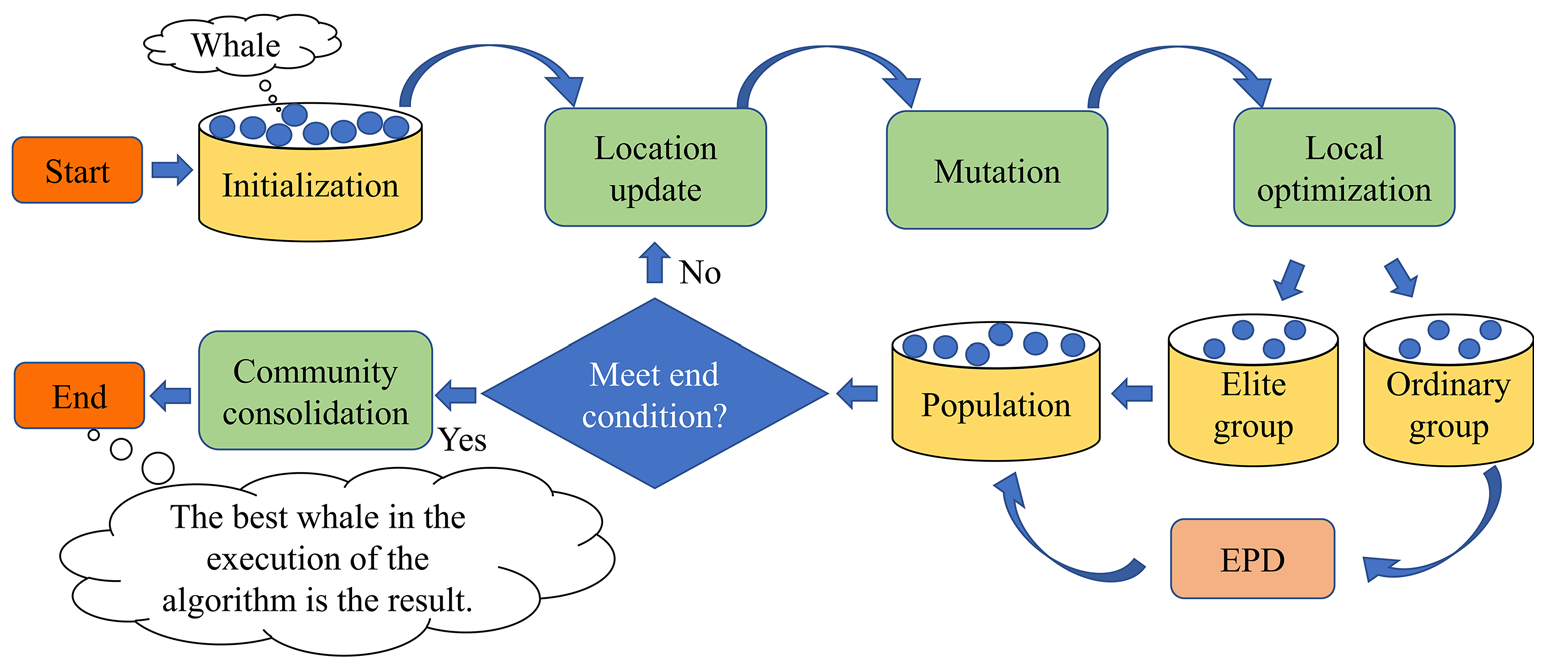 Fig 1: The framework of EP-WOCD, highlighting the initialization, iterative location updates, and population pruning.
3. Solving the Island Node via Consolidation
The algorithm includes a "Secondary Community Consolidation" step. If the search results in many tiny, isolated communities (a common byproduct of the mutation strategy), the algorithm intelligently merges them into the most similar neighboring community.
Experiments & Results: Stability and Precision
The researchers tested EP-WOCD against 6 SOTA algorithms (like DMFWA and GDPSO).
Performance on Real-World Networks
Whether it was the Zachary Karate Club or the American College Football league, EP-WOCD consistently reached the highest Modularity (Q) and Normalized Mutual Information (NMI).
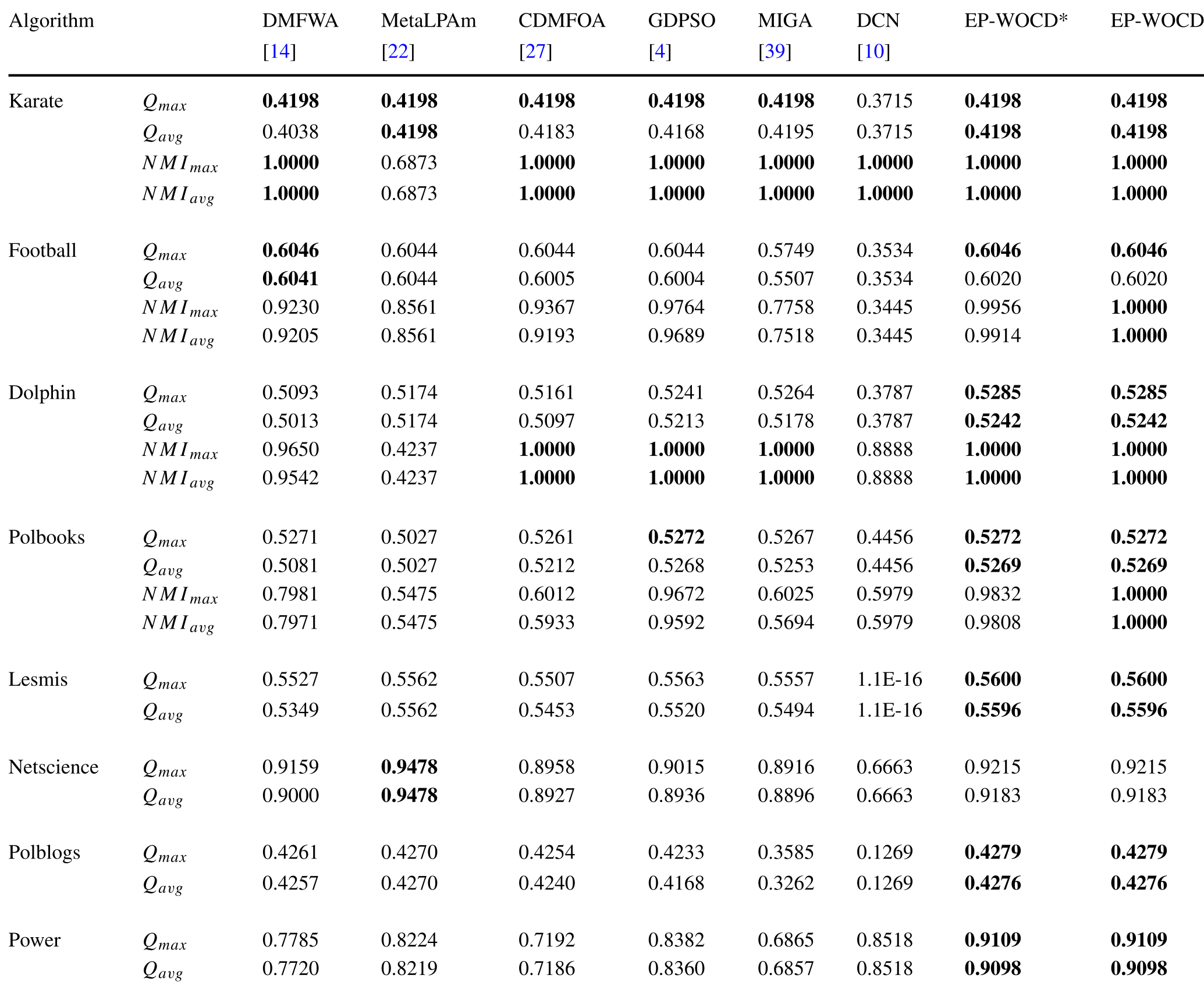 Table 1: EP-WOCD achieves the highest average and maximum scores across almost all tested networks, proving its stability.
The Efficiency Gain
Thanks to the EPD strategy, the time consumption of EP-WOCD drops significantly compared to a version with a fixed population.
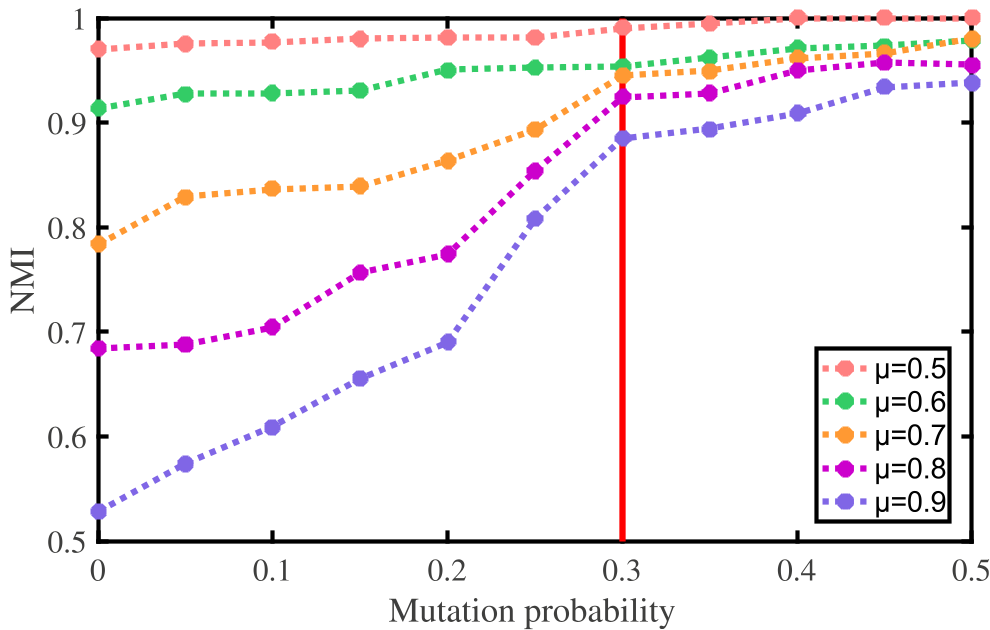 Fig 2: As iterations progress, the time cost per iteration for EP-WOCD (blue line) falls below its competitors as the "population" evolves and shrinks.
Critical Analysis & Conclusion
Takeaway
EP-WOCD proves that nature-inspired meta-heuristics are not just for numerical optimization. By carefully mapping biological behaviors to discrete graph operations and implementing dynamic population pruning, we can create algorithms that are both more accurate and more efficient than standard label propagation or greedy methods.
Limitations & Future Work
The main drawback mentioned is that the length of the "chromosome" (the network code) grows with the number of nodes. For massive networks (billions of edges), this will still become a bottleneck. The authors suggest that parallel frameworks and graph-clustering-based pre-processing to reduce gene length are the next frontiers for EP-WOCD.
Written by the Senior Academic Tech Editor. Source: "A novel community detection method based on whale optimization algorithm with evolutionary population" (2020)