
Tracking the Life Cycle of Groups: A New Framework for Overlapping Community Evolution
A Novel Framework for Analyzing Overlapping Community Evolution in Dynamic Social Networks
This paper introduces an event-based framework for analyzing overlapping community evolution in dynamic social networks. It utilizes a novel "community tag" indexing method for intuitive tracking and applies a BP neural network model to predict community events (Birth, Death, Merge, Split, etc.) with lower computational complexity than existing baselines.
Executive Summary
TL;DR: This paper presents a streamlined framework for detecting and predicting how overlapping communities change over time in dynamic social networks. By introducing "community tags" and a lightweight neural network model, the authors achieve high prediction accuracy (up to 89%) with significantly less computational baggage than current state-of-the-art methods.
Background: Within the landscape of Social Network Analysis (SNA), moving from static snapshots to dynamic "living" networks is a critical shift. This work positions itself as a practical optimization, bridging the gap between high-accuracy complex models and high-efficiency simple models.
Problem & Motivation: The Dynamic Complexity Trap
In the real world, social circles aren't just overlapping; they are fluid. A group might grow (Expand), shrink (Contract), split into two, or dissolve entirely (Death).
Previous frameworks like Asur and Takaffoli paved the way but hit two walls:
- Strictness vs. Reality: Asur’s definitions are often too rigid, missing many "Merge" or "Split" events in actual datasets like DBLP.
- Computational Explosion: Takaffoli’s method compares communities across many non-consecutive timestamps, leading to a complexity that scales poorly with network size.
The authors' intuition was simple: If we can track a community's identity using a persistent "tag" and focus on local temporal changes, we can maintain accuracy while slashing computation time.
Methodology: Tags and Predictions
The framework operates in three core phases:
1. Detection and Tagging
First, the system extracts overlapping communities at each timestamp. To solve the "identity problem" (Is Community A at the same as Community B at ?), the authors introduce Community Tag Allocation. Communities that share significant node similarity across time steps retain the same tag, providing an intuitive "lineage" for researchers.
2. Event Definition
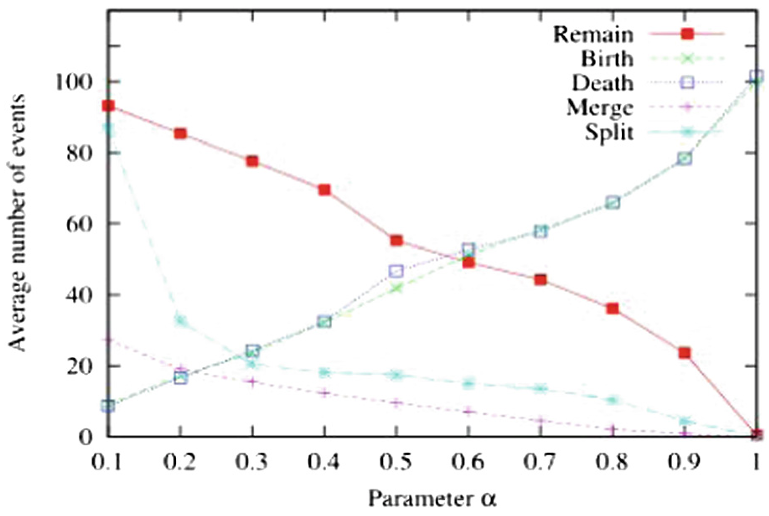
The framework identifies seven key events: Birth, Death, Remain, Merge, Split, Contract, and Expand. By including "Contract" and "Expand," the model captures subtle shifts in community scale that other frameworks often ignore or misclassify as "Death" or "Birth."
3. Neural Network Prediction
Instead of using raw graph data, the authors extract 5 high-level features (Scale, RNE, Popularity, Influence, Sociability) and feed them into a BP Neural Network. This "feature-lite" approach is why the model is so much faster—it only needs to process 5 numbers per community to predict its next state.
Experiments & Results
The authors validated their framework on three diverse datasets: DBLP (Co-author network), Facebook (Social interaction), and Synthetic networks.
Efficiency and Performance
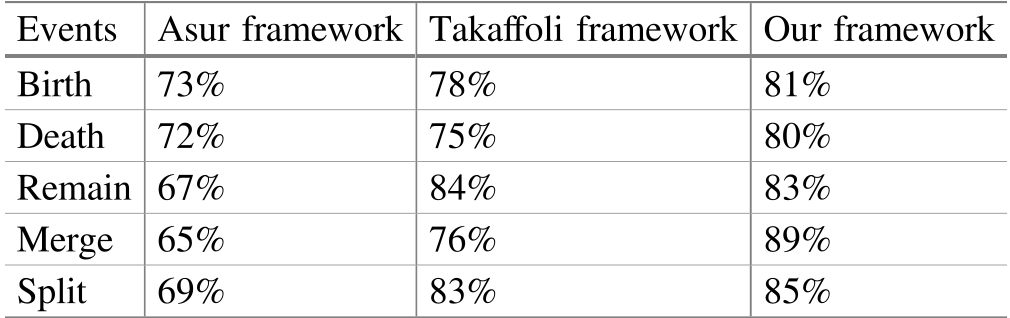
- Versus Takaffoli: While Takaffoli sometimes finds more "Remain" events, the proposed framework is significantly faster and provides more precise "Merge" and "Split" detections by focusing on continuous timestamps.
- Versus Asur: The proposed framework consistently outperformed Asur, which suffered from a high rate of missed events due to its strict parameters.
Prediction Accuracy
The BP Neural Network showed impressive results across all datasets:
- Facebook: Achieving 89% prediction accuracy for Merge events and 85% for Split events.
- DBLP: Maintaining stable performance even with smaller, more volatile communities.
Deep Insight & Conclusion
The Takeaway: Complexity is not always a prerequisite for accuracy. By focusing on a "tagging" system that mirrors human intuition about identity, and using a small set of powerful topological features, the authors proved that we can monitor social evolution effectively in near real-time.
Limitations: The reliance on a BP neural network is efficient but might miss long-range temporal dependencies that more modern architectures (like LSTMs or Temporal Graph Networks) could capture. Additionally, the threshold tuning for parameters , , and remains a manual process.
Future Outlook: This work lays the groundwork for more proactive social network tools—imagine a system that predicts the dissolution of a support group or the merger of two corporate departments based solely on five structural indexes.