
Moving the Brain to the Backbone: A Network-Centric Architecture for Future Social Services
A novel network-centric infrastructure for social networking services using a messaging network
The paper proposes a network-centric infrastructure for Social Networking Services (SNS) using an intelligent messaging network. By leveraging content/topic-based routing and a structured overlay network, it achieves seamless service integration and automated message mediation between heterogeneous platforms.
TL;DR
Existing social networking services (SNS) struggle with the heavy lifting of information aggregation—forcing either servers or users to do all the work. This paper proposes an intelligent messaging network that moves these responsibilities into the network infrastructure itself. By using topic-based routing, automated format mediation, and graph databases, the network becomes "aware" of the content it carries, enabling seamless integration of different social services.
The Middleware Crisis in Social Networking
As social networks have evolved, we’ve hit two major roadblocks:
- The Publisher-Centric Burden: Servers are overwhelmed by the complexity of aggregating heterogeneous content.
- The Subscriber-Centric Burden: Users must manually navigate fragmented platforms to find relevant information.
The authors argue that the missing piece is a Network-Centric Infrastructure. Instead of being a "dumb pipe" that just moves bits, the network should be a "smart mediator" that understands what is being sent to whom and in what format.
Methodology: The Intelligent Messaging Network
The proposed scheme functions as a structured overlay on top of the existing Internet. It relies on a few core mechanisms:
1. Content and Topic-Based Routing
Unlike traditional IP routing which cares about "where" a packet is going, this messaging network cares about "what" is inside. Publishers simply push content to a channel; the network handles the discovery of interested subscribers.
2. Format and Policy Mediation
One of the most innovative aspects is the Mediation Gateway. If two social networks have different security policies or data formats (e.g., XML vs JSON), the network converts these messages on the fly. This ensures "loosely coupled" integration—meaning services can work together without needing to be built on the same codebase.
3. Graph Database Integration
To manage the complex web of relationships between users, topics, and services, the system utilizes a Graph Database. This allows for sophisticated "Message Mashups," where the network can aggregate related content from multiple sources based on semantic relationships.
Experimental Setup & Performance
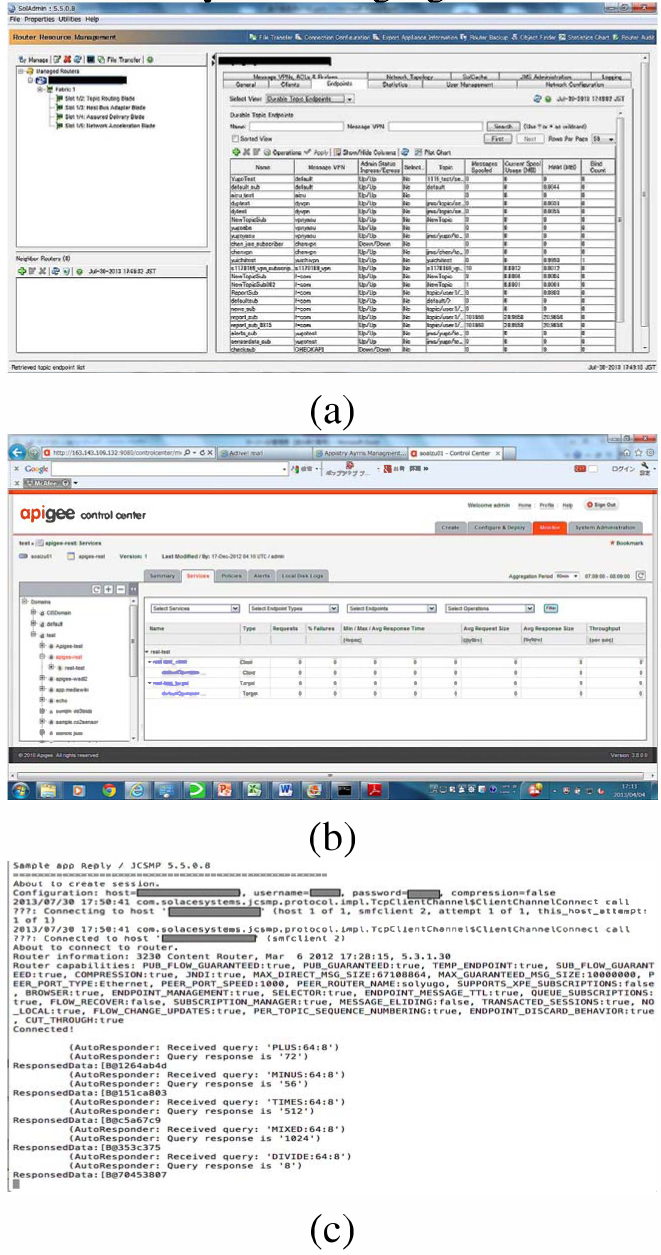
The team built a prototype using high-performance Solace 3230 Message Appliances and Apigee API Gateways.
- Asynchronous Processing: By utilizing asynchronous messaging, the system minimizes latency, allowing the network to process and route messages without blocking the publisher.
- Scalability: The network-centric approach allows for "Scalability on Demand," as message mediation nodes can be added to the overlay as traffic grows.
- Service Integration: The API mapping between different services proved that disparate platforms could be unified into a single user-facing "mashup" without modifying the original services.
Critical Analysis & Future Outlook
This work represents a significant shift toward Content-Centric Networking (CCN), applied specifically to the social layer.
Strengths:
- Reduced Complexity: Publishers don't need to track thousands of individual subscribers.
- Flexibility: Policy mediation solves the "walled garden" problem of modern social media by translating rules between platforms.
Limitations:
- Privacy Concerns: Because the network is "content-aware," it must inspect messages to route them. This raises questions about end-to-end encryption and user privacy that need further addressing.
- Hardware Dependence: The prototype relies on specific messaging appliances which might limit general adoption across standard cloud environments.
Conclusion
The move toward an "intelligent infrastructure" marks the end of social networks as isolated islands. By treating the network as a proactive mediator rather than a passive carrier, we can build social ecosystems that are more elastic, sustainable, and user-friendly.
Key Takeaway: In the future of SNS, the network won't just move your data—it will understand it, format it, and find the people who need it.