
Beyond the Classic SIR: Modeling the Offline-Online Nexus in Product Promotion
A Novel Propagation Model Coupling the Offline Network with Online Social Network Framework
This paper proposes a three-layer propagation model coupling offline social networks with online frameworks to simulate product promotion dynamics. It integrates a generalized linear threshold model for offline decisions and an improved SIR model for online information diffusion, achieving a more realistic simulation of interconnected human-account interactions.
TL;DR
Information doesn't just spread online; it lives and dies by our offline decisions. This paper introduces a three-layer propagation model that bridges the gap between physical individuals and their digital shadows. By coupling an improved SIR model with a generalized linear threshold mechanism, the authors demonstrate why digital marketing often reaches a "stable equilibrium" rather than just burning out like a traditional virus.
Problem & Motivation: The "Single-Layer" Fallacy
In the traditional study of network science, we often treat "nodes" as abstract entities. However, in the real world:
- An individual (Offline Layer) might have multiple accounts (Online Layers).
- Negative experience with a physical product leads to "negative immunity" online.
- A person rarely buys two competing products simultaneously.
Current SOTA models struggle with these cross-layer dependencies. The authors' insight is that propagation isn't just a "simple contagion" (infection via contact) but a hybrid process influenced by "complex contagion" (threshold-based decision making).
Methodology: The Three-Layer Architecture
The model consists of Layer 1 (Online A), Layer 2 (Offline Individuals), and Layer 3 (Online B).
- Offline Layer (Layer 2): Uses a Generalized Linear Threshold Model. Decisions are based on the ratio of neighbors who have adopted a product.
- Online Layers (Layers 1 & 3): Uses an Improved SIR Model. Crucially, the "R" (Recovered) state here represents not just immunity, but a refusal to transmit info due to offline dissatisfaction or lack of interest.
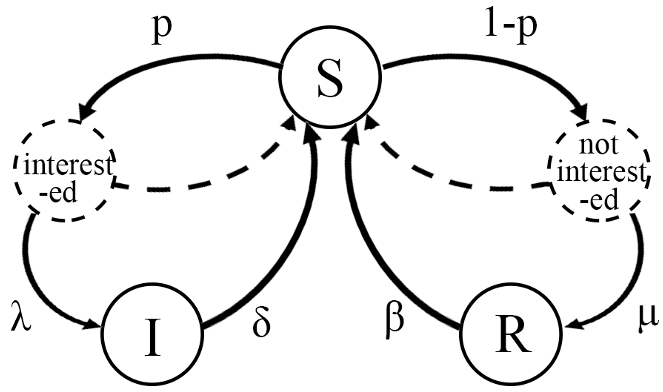
The authors employ Mean-Field Approximation to solve the system's dynamics. They define the probability of a node shifting from Susceptible (S) to Infected (I) as a function of both intra-layer neighbors () and inter-layer accounts ().
Experiments & Results: The Departure from Classic SIR
The most striking finding is the comparison between the classic SIR and the proposed model.
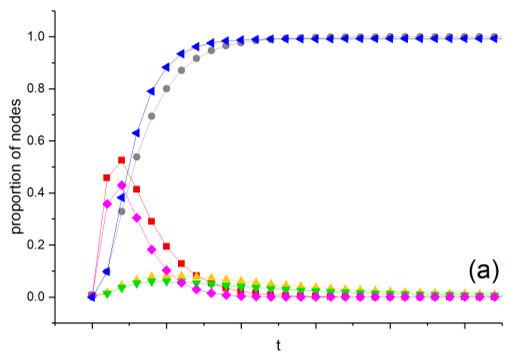
- Persistence over Extinction: In classic SIR, the infected population eventually drops to zero. In this coupled model, infected nodes reach a stable plateau. This mimics real-world brand awareness where a product maintains a baseline presence.
- The "Account Multiplier" Effect: The parameter (interlayer links) represents how many accounts an individual controls. The study proves that (one person, many accounts) has a far more significant impact on spreading success than simply increasing the average friendship degree () within the network.
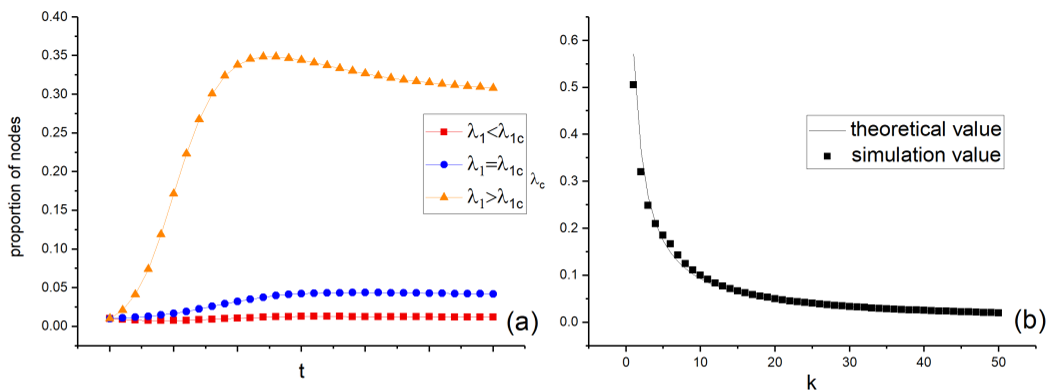
- Critical Thresholds: The team successfully derived the analytical solution for , providing a mathematical blueprint for exactly how much "infection rate" is needed to prevent a promotion from failing at the start.
Critical Analysis & Conclusion
Takeaway
The paper effectively argues that digital propagation cannot be analyzed in a vacuum. The inter-layer mapping—specifically the transition to a state of "negative feedback" (State R)—is what makes this model more robust for actual marketing or public health scenarios.
Limitations & Future Work
While the model is mathematically elegant, it assumes an ER (Erdos-Renyi) Random Network structure, which is less common in social media than Scale-Free Network (power-law) distributions. Future research should test if "Hub" nodes in scale-free networks accelerate the transition to the stable state even faster, and how varying node counts across layers (simulating niche vs. mass-market platforms) would shift the critical thresholds.
Final Insight: If you want a message to stick, don't just reach more people—reach people who are active across multiple platforms simultaneously.