
Beyond Direct Links: A Context-Aware Model for Social Relationship Strength
A novel relationship strength model for online social networks
The paper introduces a novel Relationship Strength Model for Online Social Networks (OSNs) that integrates topic classification and indirect relationship analysis. It utilizes an Artificial Bee Colony (ABC) optimized K-means algorithm and a language modeling sentiment analysis to achieve superior Accuracy in predicting user intimacy levels across different discussion contexts.
TL;DR
Quantifying the "closeness" between users is the holy grail of personalized recommendations. This paper presents a sophisticated relationship strength model that moves beyond simple interaction counts. By utilizing contextual topic clustering (ABC-optimized K-means) and indirect social path analysis, the researchers achieved a Precision boost from ~55% to nearly 80% on major microblogging platforms.
Background: Why Simple Metrics Fail
In the era of Online Social Networks (OSNs), not all connections are equal. Granovetter’s seminal "Strength of Weak Ties" theory tells us that the intimacy between two people determines how information flows. However, most existing models treat relationship strength as a static, global variable. They ignore two critical realities:
- Context Matters: Two users might be "Strong Ties" when discussing Technology but "Weak Ties" regarding Movies.
- Hidden Connections: Even without a direct link, user A can influence user B through a common friend C—an "Indirect Relationship" often overlooked by standard algorithms.
The Core Methodology: A Multi-Dimensional Fusion
The researchers developed a dual-step framework to quantify what they call Comprehensive Relationship Strength.
1. Contextual Intelligence via ABC-K-Means
To ensure the model is topic-aware, the paper uses an Artificial Bee Colony (ABC) algorithm to optimize K-means clustering. This avoids the "local optimum" trap typical of standard K-means, allowing interactive documents to be accurately categorized into 13 topics (e.g., Economy, Sports, Science).
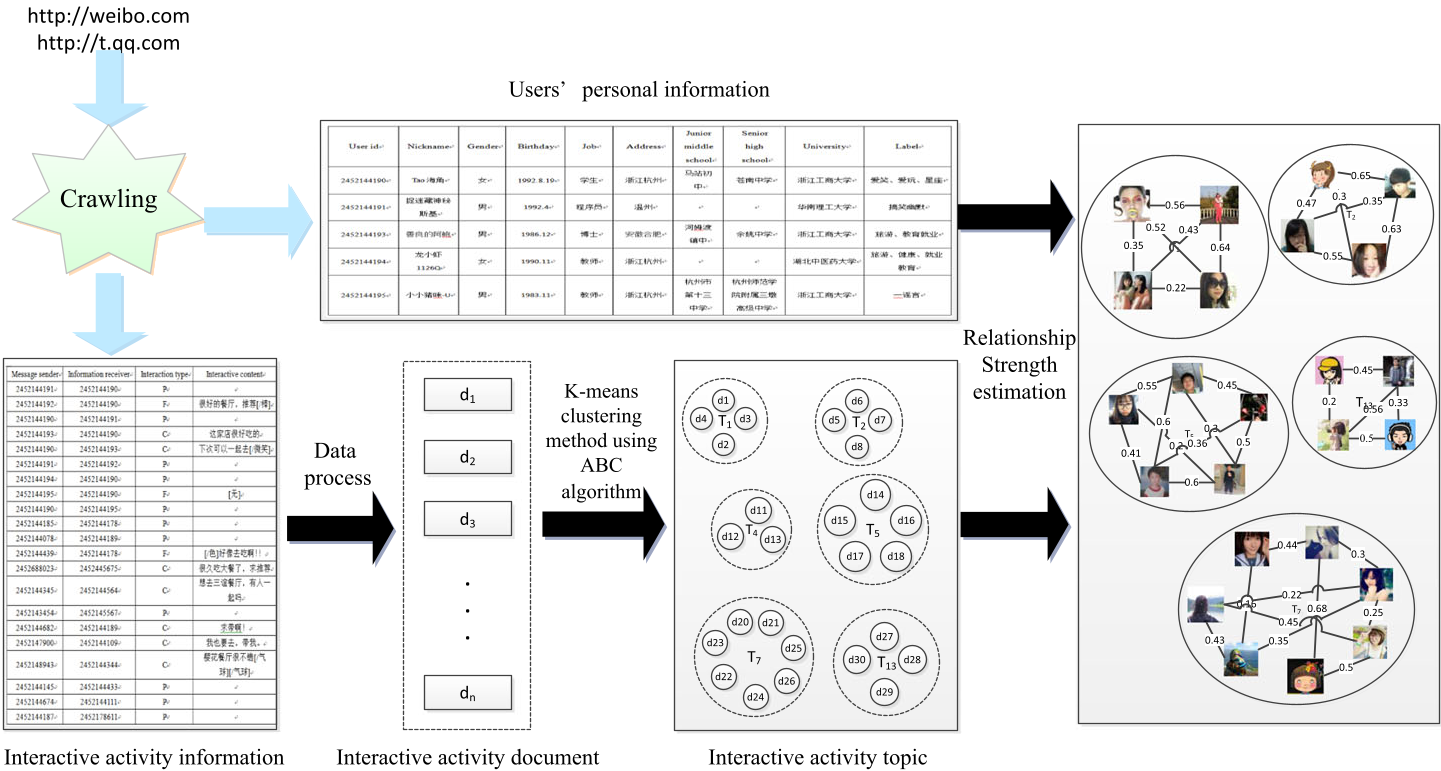
2. The Three Pillars of Direct Strength
The model calculates direct strength () using:
- Similarity (): Profile matching (age, job, location) and shared Official Accounts (Jaccard similarity).
- Timeliness (): A decay function where recent and frequent interactions carry higher weights.
- Interactivity (): A language model-based sentiment classifier that distinguishes between "Agree" and "Disagree" in comments and shares.
3. Incorporating Indirect Ties
Recognizing the social influence of intermediate nodes, the model introduces an attenuation coefficient () to calculate strength across multi-hop paths ():
Experiments & SOTA Comparisons
The authors validated their model using massive datasets from Sina Microblog (295,300 docs) and Tencent Microblog (215,000 docs).
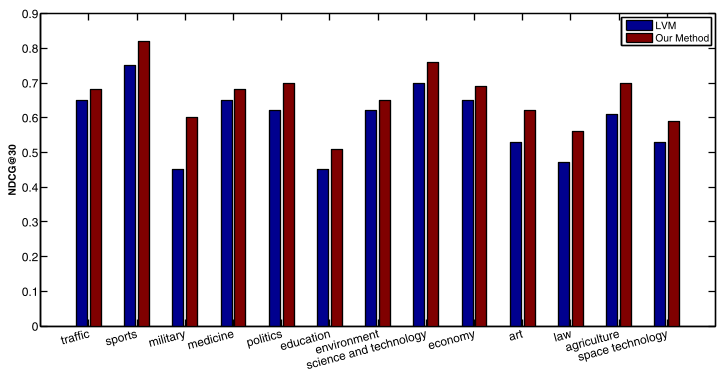
The results were categorical. In terms of nDCG@30 (Normalized Discounted Cumulative Gain), the proposed method consistently outperformed Linear Combination (LCM) and Latent Variable Models (LVM) across diverse topics like Medicine, Art, and Law.
Key Findings:
- Precision Upgrade: The model reached 79.8% precision, a significant jump from the 55-56% seen in previous methods.
- Path Influence: Considering even just one intermediate node significantly improves the "Recall" of the social graph, capturing relationships that were previously invisible.
Critical Insight & Future Outlook
The primary strength of this work lies in its Semantic Sensitivity. By classifying interactions into "Agree/Disagree" and segmenting them by topic, the model reflects human social dynamics far more accurately than a "one-size-fits-all" graph.
Limitations: The model currently only considers a single intermediate node for indirect relationships. In denser networks, exploring 3-step or 4-step paths via Graph Neural Networks could provide even deeper insights.
Conclusion: This paper serves as a blueprint for the next generation of social recommendation engines. By understanding what people are talking about and who sits between them, platforms can finally move from "general recommendations" to "contextually relevant influence."