
Analyzing Regional Economies via Recommender Systems: An SVD and Money Flow Approach
A novel technique applied to the economic investigation of recommender system
This paper introduces a recommender system for economic investigation, specifically leveraging Singular Value Decomposition (SVD) and Money Flow models to analyze stock market trends. Applied to China's western regional plates (e.g., Xinjiang, Tibet), the method aims to forecast regional economic development through big data mining of stock volatility and capital movement.
TL;DR
Predicting regional economic health is notoriously difficult due to the lag in traditional reporting. This paper proposes a "recommender" framework that applies Singular Value Decomposition (SVD) and Money Flow models to stock market plate data. By denoising price signals and tracking capital movement, the authors demonstrate a high correlation between regional stock performance and the real economy in China's western provinces.
The Problem: Noise vs. Signal in Economic Data
Traditional economic indicators are often "rear-view mirrors"—they tell us what happened months ago. Stock markets are forward-looking, but they are plagued by high noise, nonlinearity, and irrational investor behavior.
Previous research tried to link exchange rates or neural networks to prices, but these often missed the "regional" pulse. How can we differentiate between a single stock's fluke and a genuine regional economic boom?
Methodology: Denoising and Flow Modeling
The authors' "Insight" is two-fold: clean the signal first, then follow the money.
1. SVD for Denoising
The paper treats stock data as a matrix where singular values represent energy. By focusing on the larger singular values (the "top p" components), the model reconstructs a cleaner price trend, effectively stripping away the high-frequency volatility that represents market noise.
2. The Money Flow Model (Queueing Theory)
The methodology utilizes an queue system to measure practical money flow. This allows researchers to see if a price rise is backed by genuine capital entry (Active Inflow) or just low-volume speculation.
The equation above represents the P.G.F. of additional queue length, used to calculate the accumulation of capital flow within the system.
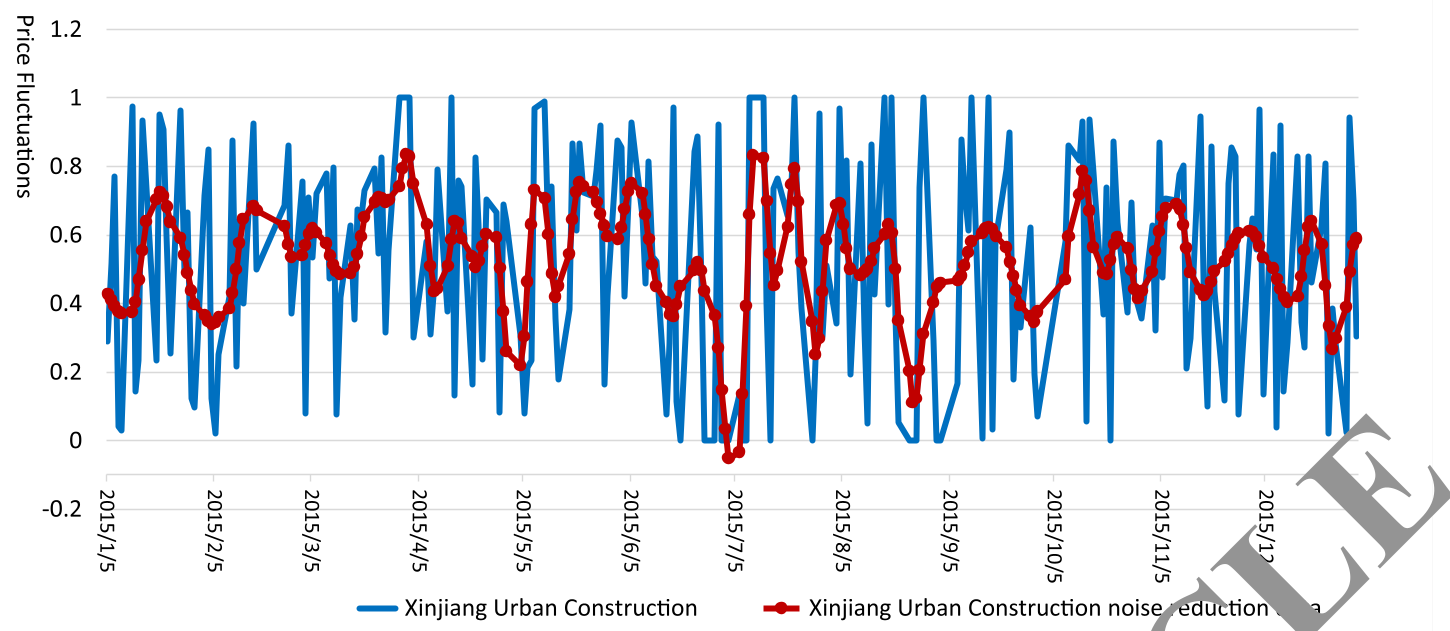 Fig 1. Contrast between raw Xinjiang Urban Construction stock data (blue) and SVD-denoised data (red dotted line).
Experiments: Tibet vs. Qinghai
The research analyzed stocks in five western regions: Xinjiang, Gansu, Qinghai, Tibet, and Ningxia.
Key Findings:
- Tibet's Vitality: Tibet's economy was identified as the most active. In May 2015, "clever investors" began reducing positions before the June crash, a move reflected in the Money Flow metrics before the price drop.
- Qinghai's Stagnation: Stocks in the Qinghai plate (like Salt Lake Industry) showed very small capital activity and minimal price changes, leading the authors to conclude that the regional economic level was relatively weak.
- Leading Stock Averages: The authors created "Leading Stock Averages" (averaging the top performers in a province) to act as a benchmark. Most individual stocks follow this regional trend with a slight time delay.
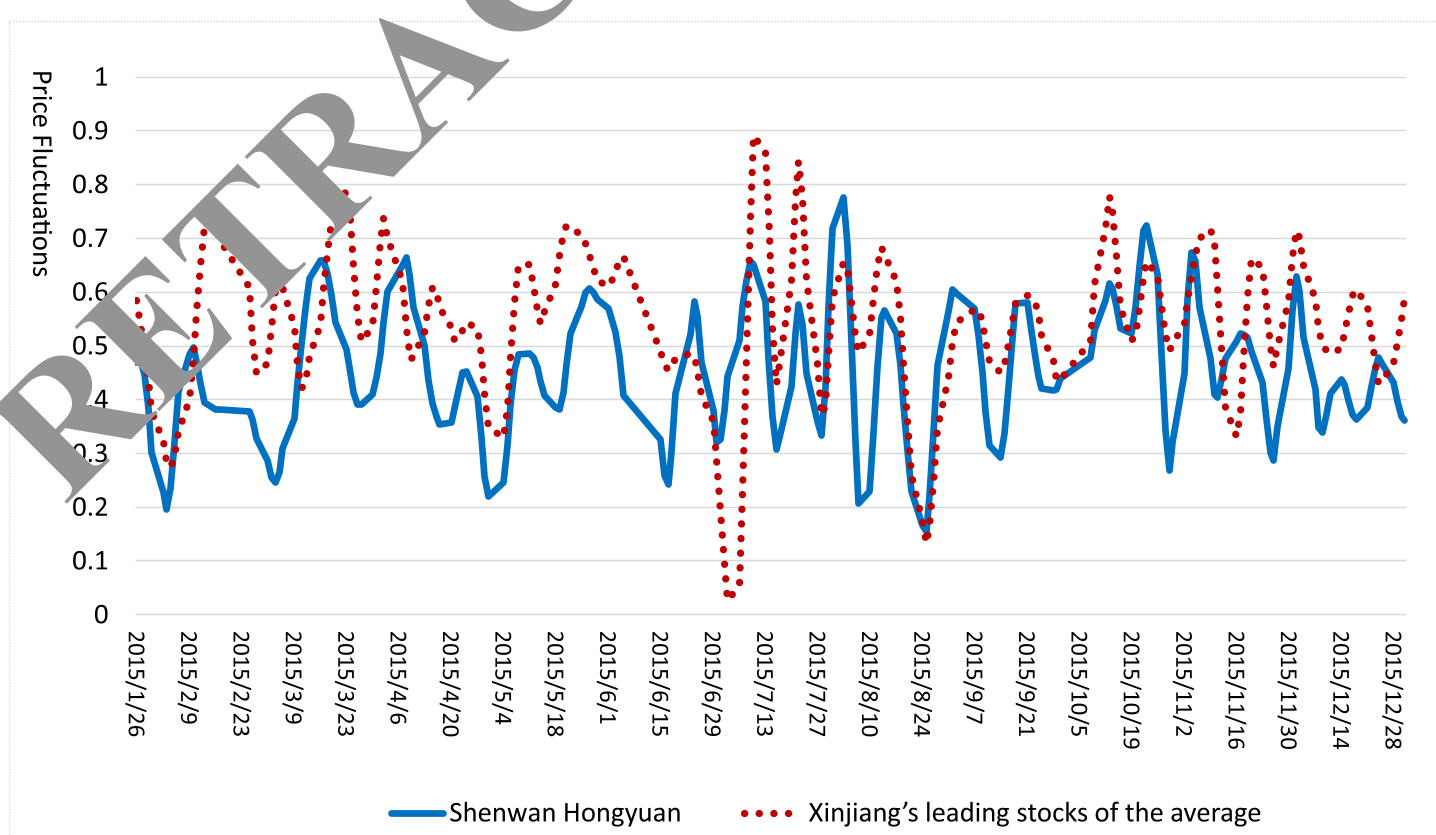 Fig 2. Comparison between a specific stock (Shenwan Hongyuan) and the Xinjiang regional leading average.
Critical Insight & Conclusion
The core takeaway is that economic development is readable through the lens of capital flow and denoised price trends.
While this paper provides a robust mathematical framework (SVD + Queueing Theory), it is worth noting its limitations:
- Single Market Bias: The data focuses on a specific period in the Chinese market (2014-2015).
- Model Simplicity: While SVD is excellent for linear noise, more complex "black swan" events might require deep learning approaches (like LSTMs or Transformers) which were not the focus here.
Ultimately, for investors looking at the "Western Region," the paper suggests that Tibet is the priority for growth, while Qinghai remains at the bottom of the regional economic stability ranking. This work bridges the gap between purely financial "Stock Prediction" and broader "Economic Investigation."