
Safeguarding Recommendations: A Multi-Dimensional Trust Model for Mobile Social Networks
A novel trust recommendation model for mobile social network based on user motivation
This paper introduces a novel trust-based recommendation model for Mobile Social Networks (MSNs) that combines trust relationship reconstruction with a defensive clustering mechanism. Leveraging Bayesian numerical methods (Beta distribution) and dynamic clustering, the system effectively filters out malicious recommendation attacks, achieving significant improvements in prediction accuracy and network throughput.
TL;DR
Mobile Social Networks (MSNs) are prone to "recommendation pollution" where malicious nodes lie about others to degrade system performance. This paper proposes a robust defense mechanism that uses Bayesian logic and Dynamic Clustering—based on confidence, deviation, and physical proximity—to filter out dishonest advice. The result? A system that remains stable even when the majority of the network is compromised.
The Vulnerability of Digital Trust
In the world of Mobile Ad Hoc Networks (MANETs), we rely on "neighborly advice" to navigate services and information. However, Collaborative Filtering (CF) is brittle. It fails when data is sparse and, more importantly, it is defenseless against strategic subversion.
The authors identify several "Assault Styles" that cripple standard trust models:
- Ballot Filling (BSA): Colluding nodes hyper-inflate the reputation of a poor-performing node.
- Bad Mouth (BMA): Nodes spread false negatives to ruin a good node's standing.
- Location-Related Attacks (LDA): This is a unique focus of the paper, where nodes behave differently based on their GPS coordinates to evade detection.
Methodology: The Trinity of Trust Filtering
Instead of relying on a single "trust score," the proposed model utilizes a Cluster Manager that acts as a gatekeeper. When a node receives recommendations, it groups them into clusters and evaluates them against three distinct dimensions:
1. The Bayesian Confidence Engine
The model uses a Beta Distribution to represent trust.
- : Positive interactions.
- : Negative interactions.
- Insight: The authors improve upon the standard TMUC model by ensuring that zero interaction equals zero confidence, preventing "phantom trust" in new nodes.
2. Deviation Testing (Compatibility)
The system compares incoming recommendations against the user's own "first-hand" experience. If a recommendation deviates significantly from what the user has seen personally, it is flagged.
3. Intimacy Centrality
Trust is social. The model assumes that nodes physically closer to each other (or with higher interaction frequency) are more likely to have accurate, convergent views of the network. This "proximity bias" acts as a powerful filter against remote attackers.
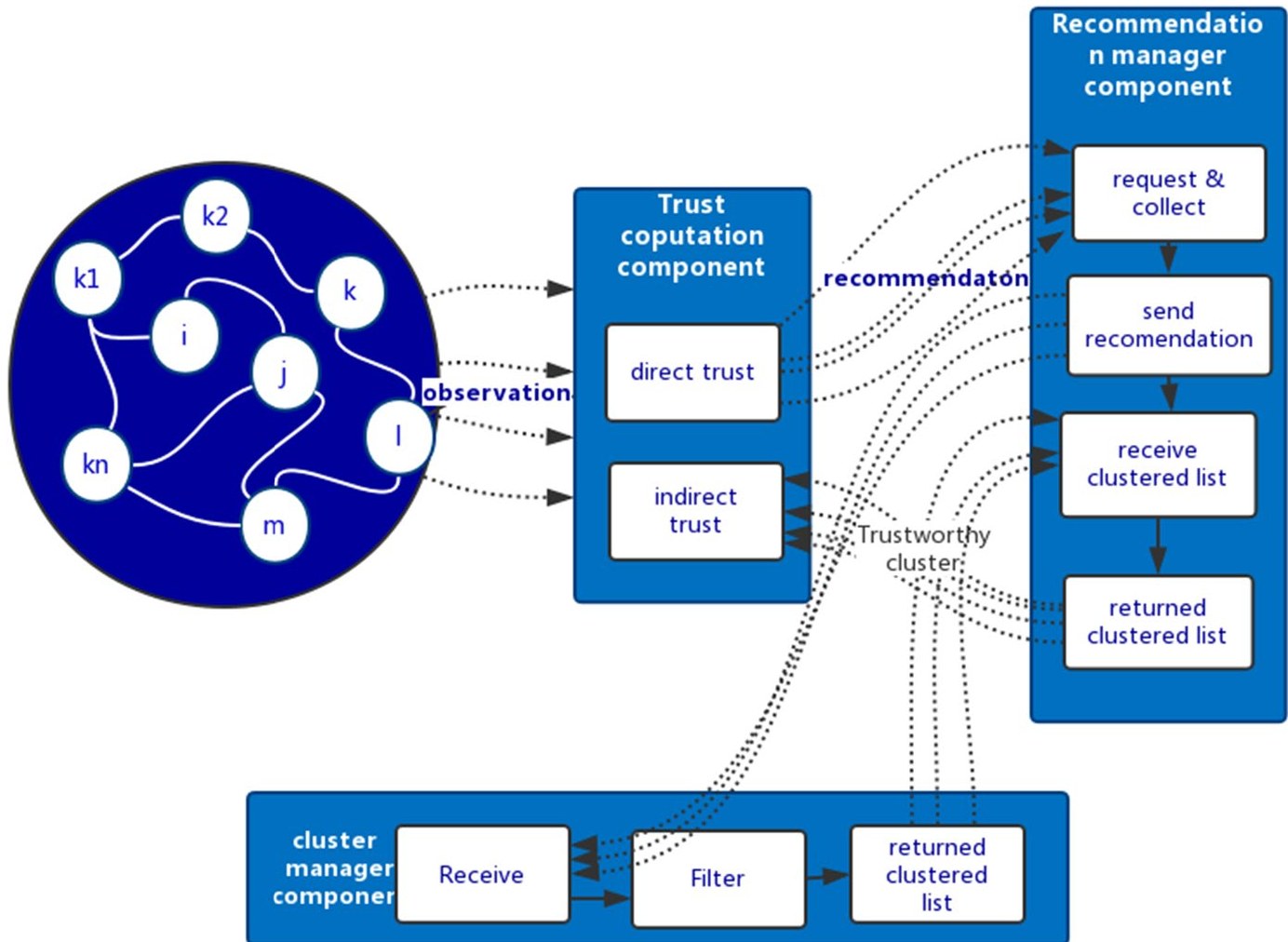 Figure 1: The interaction between the Recommendation Manager, Cluster Supervisor, and the Trust Calculation Engine.
Experimental Performance: Resisting Chaos
The authors tested the model in a simulation of 50 mobile nodes. The results highlight a staggering resilience to high "malicious node" density.
- Throughput Stability: While non-defensive networks saw throughput drop to 30% under heavy attack, this model maintained 80% efficiency.
- Error Convergence: The Trust Level Error (TLE) of this model converges toward 0.01 much faster than the established "Maturity Model," which plateaus at 0.1.
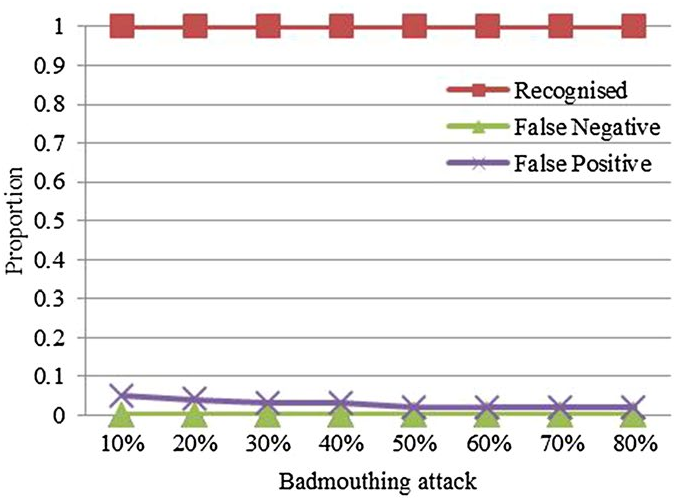 Figure 2: Trust values for good nodes (left) and bad nodes (right) under varying percentages of malicious participants.
Critical Analysis & Future Outlook
The standout contribution here is the Clustering-based filtering. By using majority rules within the "most reliable cluster," the model circumvents the problem of attackers outnumbering honest nodes in the general population—as long as the honest nodes remain highly consistent with each other.
Limitations
- Computational Overhead: Maintaining clusters and calculating Euclidean distances in a high-mobility environment consumes significant battery and memory.
- Threshold Sensitivity: The system relies on "preset thresholds" for proximity and deviation. In a real-world MSN, these thresholds might need to be adaptive rather than static.
Conclusion
This research moves us closer to a "Self-Healing" social network. By treating trust as a spatial and behavioral pattern rather than just a number, we can build recommendation engines that aren't just smart, but are also incredibly tough.