
Nudging the Crowd: How to Manage Workforce Micro-tasks Without Annoying Employees
15215_Nudge your Workforce A Study on the Effectiveness of Task Notification Strategies in Enterprise Mobile Crowdsourcing.
The paper investigates Enterprise Mobile Crowdsourcing (EMC) by conducting a large-scale study and experiment at IBM Benelux to optimize employee engagement. It proposes E-Crowd, a mobile platform that tests various task notification strategies, discovering that moderate, regular nudges during breaks are more effective for worker retention than "aggressive" or activity-aware notifications.
TL;DR
How do you get busy IBM employees to help with data processing tasks on their phones? This study reveals that less is more. By testing notification strategies on the custom E-Crowd platform, researchers found that stable, moderate "nudges" during coffee breaks are far superior to "aggressive" notifications or even high-tech sensor-based activity detection.
The "Work vs. Work" Dilemma
Enterprise Crowdsourcing (EMC) is a goldmine for companies. It taps into the internal expertise of a trusted workforce to solve problems like image annotation or workplace surveys. However, it faces a unique hurdle: The Primary Job.
If notifications are too frequent, they feel like spam; if they are too rare, employees forget the platform exists. The researchers at TU Delft and IBM Benelux set out to find the "Goldilocks zone" of employee engagement.
Methodology: The E-Crowd Experiment
The team developed E-Crowd, an iOS app capable of sensing user activity (like walking) while offering three types of tasks: Content Creation, Image Annotation, and Workplace Surveys.
They split participants into four groups based on two dimensions:
- Temporal Distribution: Notification only during "Popular Breaks" (Coffee/Lunch) vs. "All Breaks" (including start/end of day).
- Activity Awareness: "Fixed Time" (sending exactly at break start) vs. "Walking" (waiting until the phone detects the user is moving).
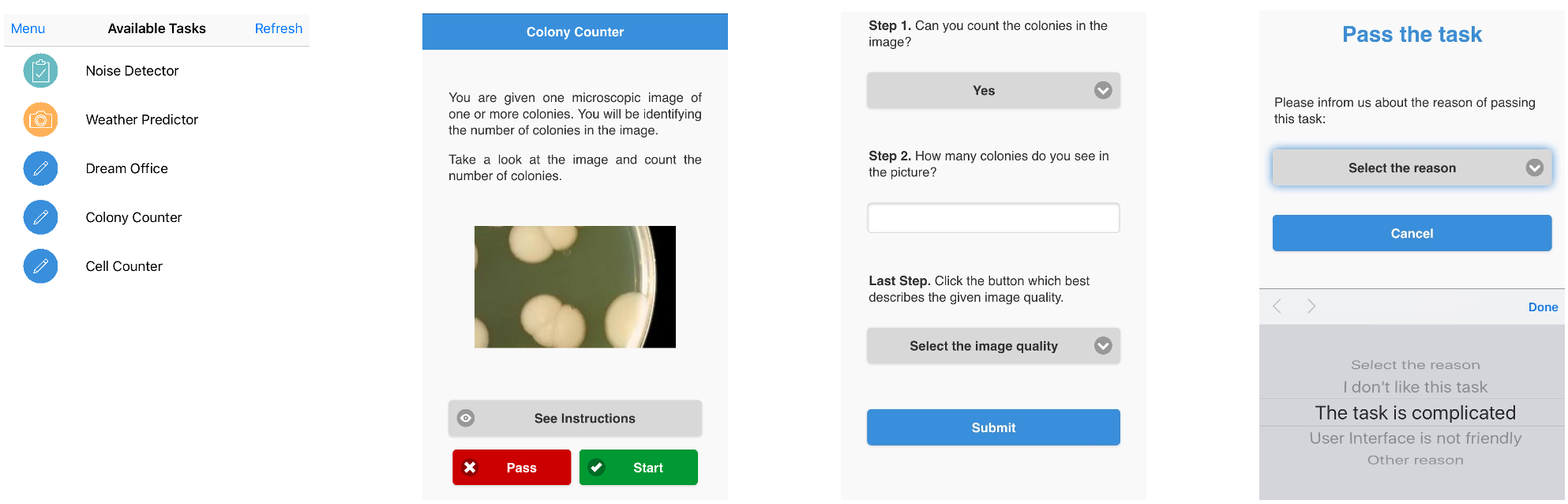 Figure 1: The E-Crowd home screen and task selection interface.
Counter-Intuitive Results: Sensors Aren't Always Smarter
The results from the 2-month deployment challenge common assumptions in "context-aware" computing:
- The Walking Paradox: In surveys, employees said they check phones while walking. However, in the experiment, Group 3 & 4 (Walking-triggered) showed the lowest participation. The researchers hypothesize that seeing a notification "waiting" for you when you return to your desk is more effective than receiving one while you are physically moving and potentially distracted.
- Frequency Deterrence: The "All Breaks" (AB) group had lower retention. Excessive nudging caused a "crowd-out" effect where users abandoned the app faster.
- The "Free Time" Factor: Surprisingly, 30% of work happened during weekends/evenings when the app was silent. This suggests that if the task is meaningful (like "Improving Work Conditions"), employees will voluntarily contribute during their own time.
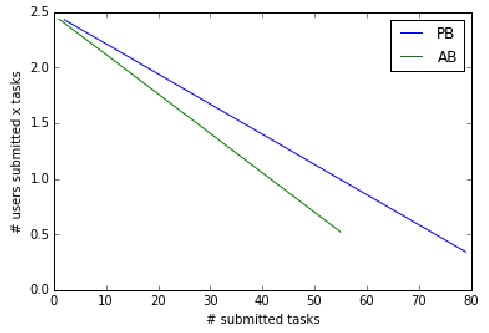 Figure 2: Retention curves showing that moderate notification frequency (PB) keeps users for longer than high frequency (AB).
Experimental Data Overview
The following table summarizes participation across the groups, highlighting how Group 1 (Popular Breaks + Fixed Time) outperformed the rest in terms of app opens and submissions.
| Metric | Group 1 (PB/FA) | Group 2 (AB/FA) | Group 3 (PB/WA) | Group 4 (AB/WA) |
|---|---|---|---|---|
| # Opens | 319 | 102 | 85 | 149 |
| # Submissions | 259 | 188 | 114 | 136 |
Critical Insight & Conclusion
The main takeaway for CTOs and HR managers is that predictability trumps complexity. While it is tempting to use sophisticated motion sensors to find the "perfect" moment to interrupt an employee, the cognitive load of an unexpected vibration while walking may be higher than a static notification waiting on the lock screen.
Future Outlook: The study suggests that "Learning" is the top motivator. Future EMC systems should likely focus on "Duolingo-style" mechanics where the task itself provides educational value to the employee, further bridging the gap between "working for the company" and "growing as an individual."