
Subject-Specific UWB Modeling: Why Your Body Mesh Matters for Wireless Health
18925_Numerical Characterization and Modeling of Subject-Specific Ultrawideband Body-Centric Radio Channels and Systems for Healthcare Applications.
This paper presents a subject-specific numerical study of Ultra-Wideband (UWB) Body-Centric Wireless Networks (BCWNs) using a parallelized Finite-Difference Time-Domain (FDTD) technique. By analyzing nine distinct digital phantoms, the research establishes a direct link between physical human attributes and radio channel performance.
TL;DR
Wireless Body Area Networks (WBANs) are the backbone of future remote healthcare, but they face a major hurdle: the "human factor." This paper demonstrates that because every human body is unique in shape and size, the radio signals traveling across our skin behave differently for every patient. By using advanced FDTD simulations on 9 different MRI-derived phantoms, the authors prove that ignoring a patient's BMI and height can lead to over 50% error in predicting system reliability.
The Motivation: Moving Beyond the "Average Human"
In the early days of Body-Centric Wireless Networks (BCWNs), researchers often used simplified models—sometimes just simple cylinders—to represent the human body. However, the human body is a complex, inhomogeneous, and lossy dielectric environment.
The authors argue that for Ultra-Wideband (UWB) technology to work reliably in hospitals, we must understand how specific physical traits like BMI, gender, and height affect the radio link. If we design a heart monitor based on a "standard male" model, it might fail when worn by a petite female or an obese patient due to unexpected signal attenuation.
Methodology: FDTD and Virtual Phantoms
To capture this complexity, the study employed the Finite-Difference Time-Domain (FDTD) method. This is computationally expensive but incredibly accurate for inhomogeneous objects.
- Digital Phantoms: 9 subjects (5 female, 4 male) were scanned via MRI and converted into 1mm resolution volumetric meshes.
- Simulation Environment: Because full-body UWB simulations at 10 GHz are massive, the authors used a PC cluster with 60 cores to handle the workload.
- The System Model: They didn't just look at signal strength; they modeled a full MB-OFDM (Multiband Orthogonal Frequency Division Multiplexing) system, the standard for high-speed UWB.
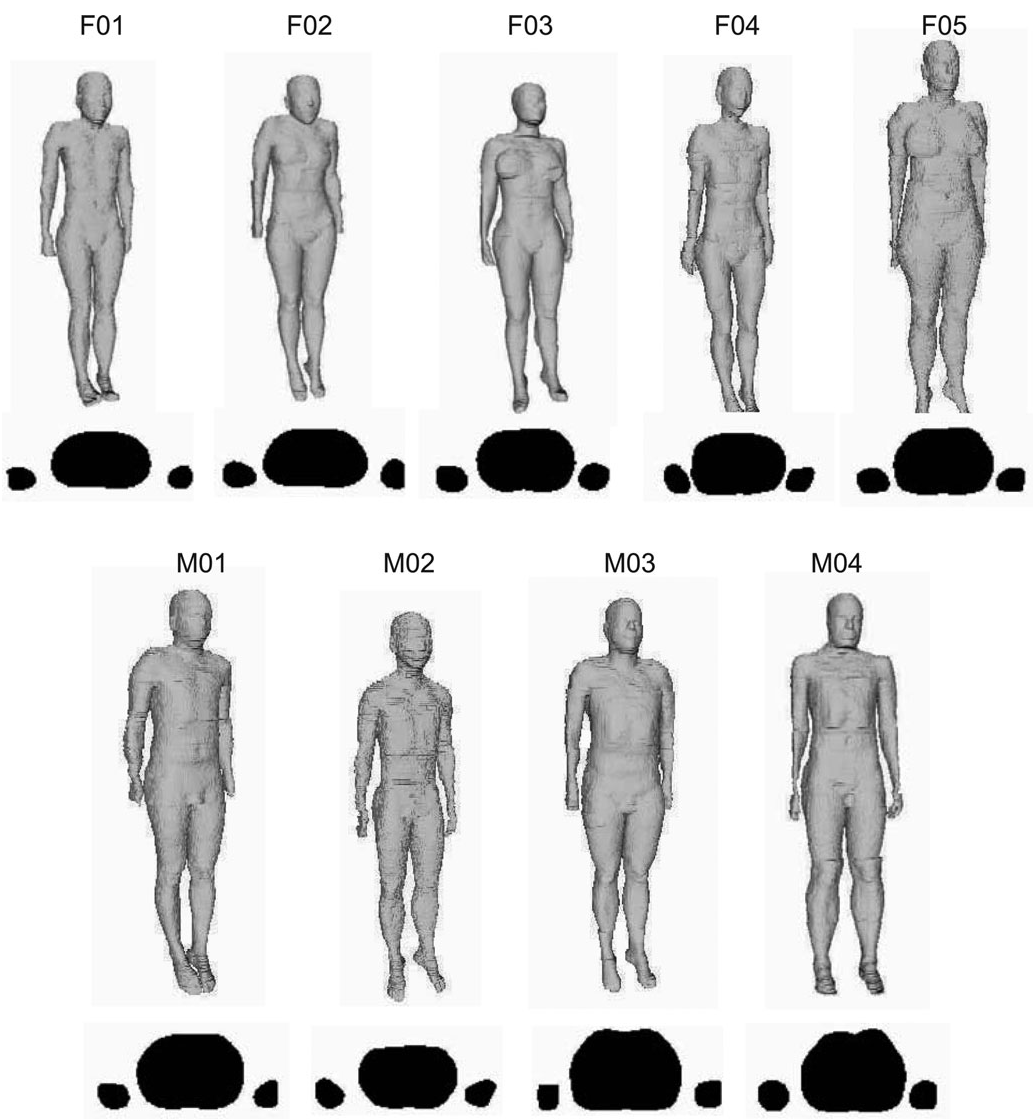 Fig 1. The 9 voxelized subjects used in the study, showcasing the diversity in BMI and waist/chest circumferences.
Experimental Insights: The BMI Connection
The core finding is the correlation between subject morphology and the Path Loss Exponent (γ). This exponent tells us how fast the signal fades as the distance increases.
- Small Subjects: Individuals with smaller waist circumferences (like subjects F01 and F03) showed lower values of γ (~2.7). This is due to the smaller curvature radius, which allows signals to "creep" around the body more efficiently.
- Larger Subjects: Subjects with higher BMI (like M04) reached γ values up to 3.6, indicating much harsher signal degradation.
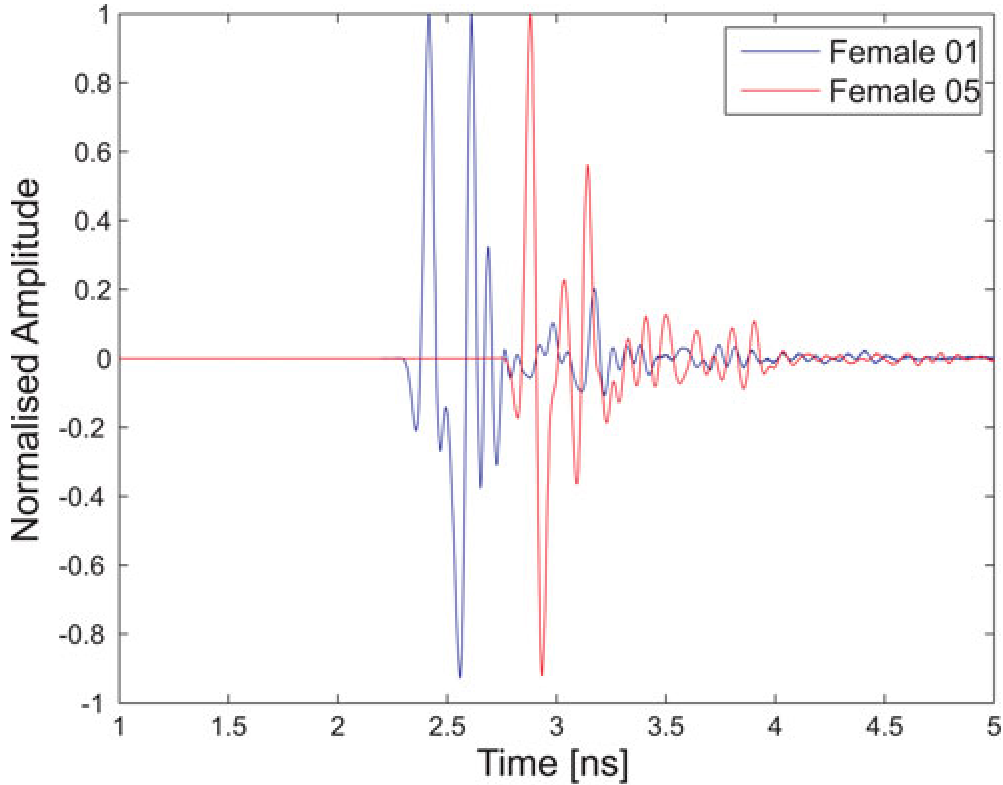 Fig 2. Path loss as a function of distance across different subjects, showing the variation in signal decay.
The Impact on Bit Error Rate (BER)
The study found that these variations aren't just theoretical. In system-level tests at a fixed energy level (Eb/No = 4 dB):
- There was an inverse relationship for males between BMI and BER for most links (ear, chest, back).
- Variation in BER reached over 50% across different subjects.
This means a device that works perfectly for one person might totally lose connection for another under the same power settings.
Critical Analysis & Future Outlook
This work was a pioneer in advocating for Subject-Specific Radio Modeling. The 18.51% variation in path loss and >50% variation in BER is a wake-up call for medical device engineers.
Limitations:
- Static Posture: The study focuses on standing subjects. Real-world movement (walking, arm swinging) would introduce even more dynamic variations.
- Homogeneous vs. Stratified: While the authors justified homogeneous phantoms due to low skin depth at UWB frequencies, internal tissue layers might still influence near-field antenna performance.
Future Impact: This research paves the way for "Patient-Centric" link adaptation, where a wearable device could potentially calibrate its transmission power based on the user's physical profile (height/weight) entered during setup, ensuring a "greener" and more reliable healthcare monitoring experience.
Takeaway
Designing for the "mean" is designing for "failure" in WBANs. Subject-specific modeling is the only way to guarantee the reliability required for life-critical medical applications.