
Lego Mindstorms NXT: Bridging the Gap Between Abstract Logic and Physical Reality in CS Education
Using the NXT as an educational tool in computer science classes
This paper introduces an interactive educational platform using Lego Mindstorms NXT robots to physically demonstrate abstract Computer Science concepts. By integrating robotics with a custom "Arbiter" application and RoboRealm vision software, the authors created a pedagogical tool for visualizing data structures and search algorithms (e.g., Dijkstra's, Prim's) in real-time.
TL;DR
This research presents a modular educational platform that uses Lego Mindstorms NXT robots to turn abstract data structures and search algorithms into tangible, real-world demonstrations. By combining a central "Arbiter" application, overhead computer vision (RoboRealm), and Bluetooth-controlled drones, the authors created an interactive environment where students can literally watch algorithms like Dijkstra’s or Prim’s navigate a physical space.
Contextual Positioning
In the landscape of Computer Science pedagogy, this work sits at the intersection of Physical Computing and Algorithm Visualization. While many tools focus on screen-based animations (like Brown University's ALGORITHM ANIMATION), this project argues that the "messiness" of the physical world—sensor noise, Bluetooth packet loss, and mechanical drift—provides a superior learning environment for understanding robust system design.
The Core Problem: The Abstraction Barrier
Introductory students often view Data Structures (Graphs, Trees, Heaps) as purely mathematical constructs. When these concepts are taught via standard lectures, the "Why" behind algorithmic efficiency is lost. The specific challenge addressed here is the lack of interactive feedback loops; students write code that executes in a black box, making it difficult to visualize the incremental steps of a search algorithm or the importance of state management.
Methodology: The "Arbiter" Architecture
The system is built on a tripartite architecture designed for scalability and modularity:
- The Arbiter (The Brain): A C# application that maintains the "Global Truth" of the data structure. It calculates navigational headings and manages the state of all connected drones.
- RoboRealm (The Vision): An overhead webcam captures the arena. Using blob detection and image processing, it tracks the coordinates of drones to correct for the inherent inaccuracy of onboard sensors.
- The NXT Drones (The Actuators): Semi-autonomous units that execute granular commands (e.g., "Move 10 inches at 90 degrees").
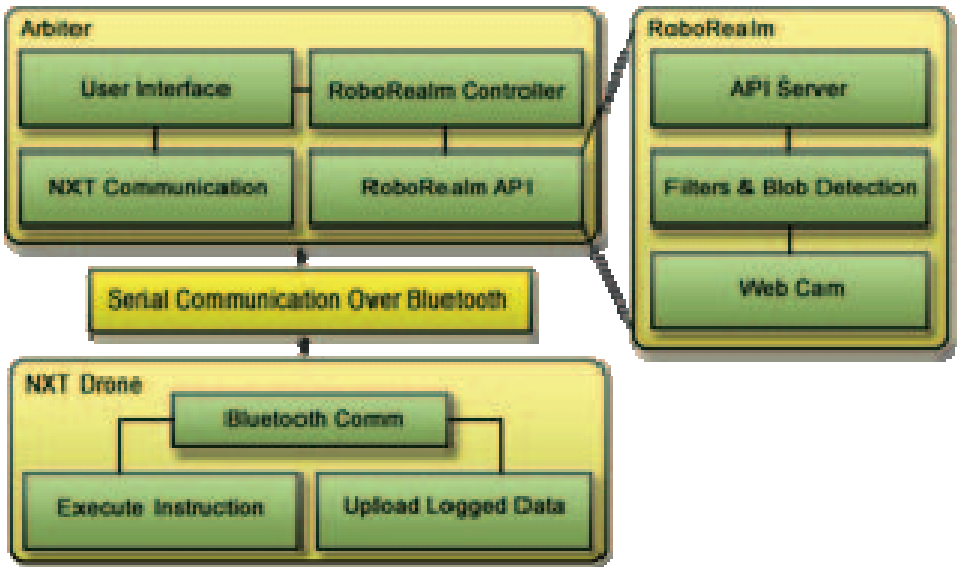 Figure 1: The hierarchical communication flow between the vision system, the central controller, and the physical robots.
Technical Insight: Handling Sensor Noise
One of the paper's critical insights involves the Magnetometer (Compass Sensor). The authors noted high susceptibility to magnetic noise. Their solution was both mechanical (extending the sensor away from the motor's magnetic field) and algorithmic (using a request-response "help" protocol with the Arbiter when a drone detects location drift).
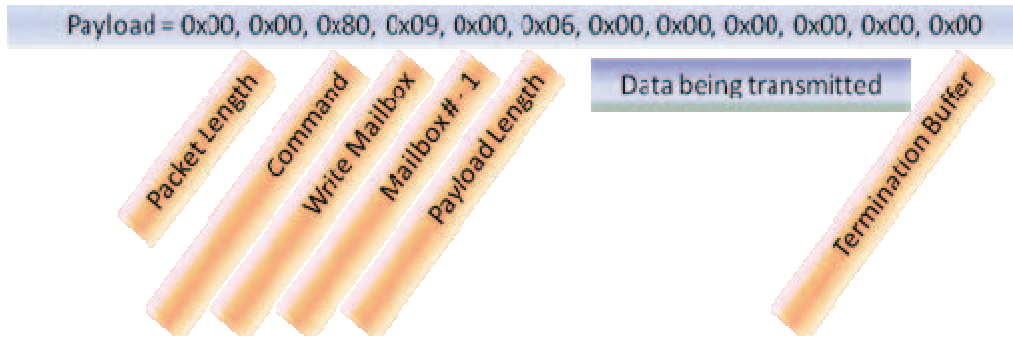 Figure 2: The custom Bluetooth packet structure used for communication, highlighting the transition from simple 5-byte commands to complex 58-byte payloads.
Experiments and Educational Modules
The project wasn't just a technical demo; it was a curriculum. The authors structured the learning into hierarchical modules:
- Level 1: Basic locomotion and sensor polling ("How do I make it move?").
- Level 2: RobotC programming and event-driven logic.
- Level 3: Complex data structure traversal (Visualizing a Graph search in real-time).
By physically marking "nodes" in an arena, the robot behaves as a pointer in a graph. When a drone visits a node, the UI updates to show the "visited" state, reinforcing the logic of algorithms like Dijkstra's.
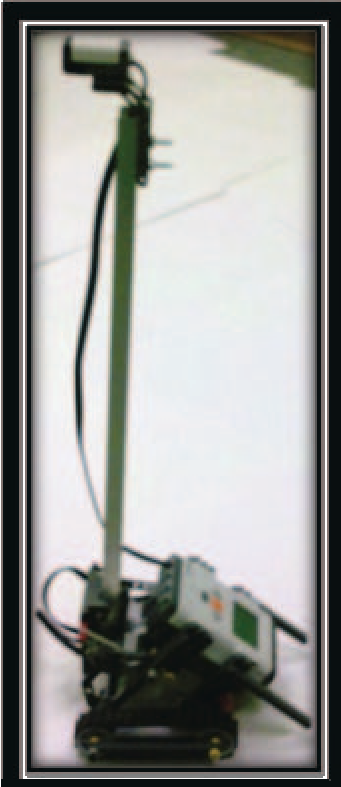 Figure 3: Hardware modification: Extending the compass sensor to minimize motor interference, a lesson in real-world hardware constraints.
Critical Insight & Conclusion
Takeaway
The true value of this work lies in Information Transparency. By visualizing the internal state of a search algorithm through the movement of a physical robot, the "invisible" becomes "visible." This bridges the gap between high-level software engineering and low-level system constraints.
Limitations & Future Work
The reliance on Bluetooth and a single overhead camera limits the system's scale to a single "arena." Future iterations could benefit from Decentralized Swarm Intelligence, where robots communicate peer-to-peer rather than through a central Arbiter, reflecting modern trends in Edge Computing and Autonomous Systems.
In conclusion, using the NXT as an educational tool proves that Computer Science is not just about code—it's about how that code interacts with and maps the physical world.