
Reimagining LBSN: Moving from Geo-tags to Location Objects
17827_An object based conceptual framework for location based social networking.
This paper proposes an object-based conceptual framework for Location-Based Social Networking (LBSN). It introduces the "Location Based Information Object" (LBIO) to elevate location from a simple metadata attribute to a primary, independent entity with its own social behaviors and geometric properties.
TL;DR
Social networking has long mastered the "Who," "What," and "When," but the "Where" has historically been relegated to a mere footnote. This paper argues that the current "Geo-tagging" approach—where location is just an attribute of a post—undermines the potential of Location-Based Social Networking (LBSN). By transforming locations into independent objects (LBIOs) with their own social behaviors, the authors create a framework where you can "friend" or "register" with a physical space, enabling a sophisticated "Social-Spatial" bond.
The "Attribute" Trap: Why Current LBSNs are Limited
In platforms like Facebook or Instagram, location is treated as ancillary. You post a photo and then tag it with a location. This creates several structural bottlenecks:
- Peer-Dependency: You only get location info if a friend posts it. You can't directly "hear" what a location has to say.
- Privacy Risks: Because location is tied to your identity, sharing "Where" often means exposing "Who" is there at that exact moment.
- Spatial Simplification: Real-world interests aren't just points on a map; they are complex, non-contiguous "Zones" (e.g., all your favorite parks across a city).
Methodology: The Birth of the LBIO
The core of the paper is the Location Based Information Object (LBIO). Instead of a photo having a "latitude" attribute, the "Place" itself becomes the object, and photos/comments become attributes of that place.
1. Geometric Classification: Place vs. Zone
The framework distinguishes between physical reality and user interest:
- Place Objects: Geographically contiguous points, lines, or polygons (e.g., a specific cafe).
- Zones: Subjective collections of Places. A Zone can be non-contiguous, representing a user's personal "Interest Area" that spans entire cities or countries.
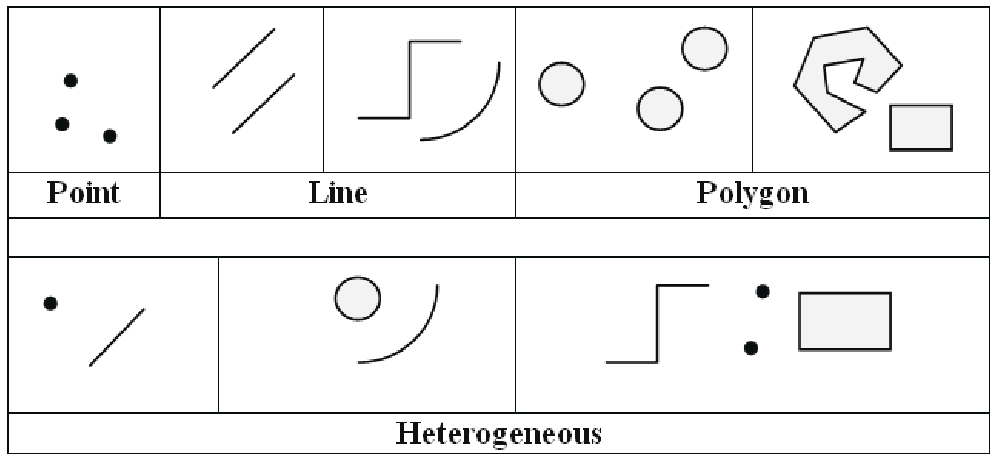 Figure: Geometrical types of Zones objects, illustrating non-contiguous interest areas.
2. Social Hierarchy
The authors wrap these geometric objects in a social layer. An LBIO can be:
- Private: For personal tracking.
- Shared: Visible to friends (e.g., a list of "cool hidden bars").
- Public: Open to everyone (e.g., a museum's news feed).
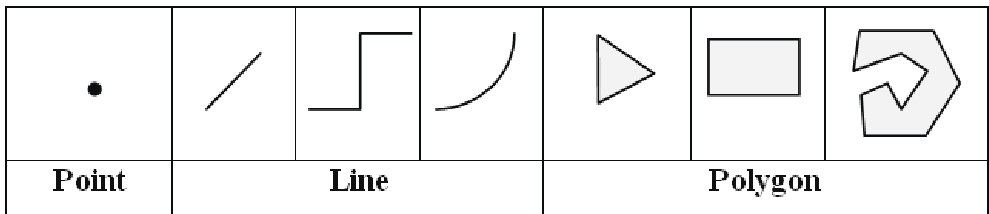 Figure: The hierarchical categorization of location objects based on discovery and registration permissions.
The Social-Spatial Bond: A Case Study
How does this change information flow? Imagine User A is friends with User B. User B creates a "Zone" for historical landmarks. User P1 (a stranger) posts information to a "Public Place" (a specific statue) that happens to fall inside User B's Zone.
In this framework, the information skips from P1 to User B (via spatial overlap) and then to User A (via social connection). This "two-hop" propagation allows for serendipitous discovery that traditional "Follower" models can't achieve.
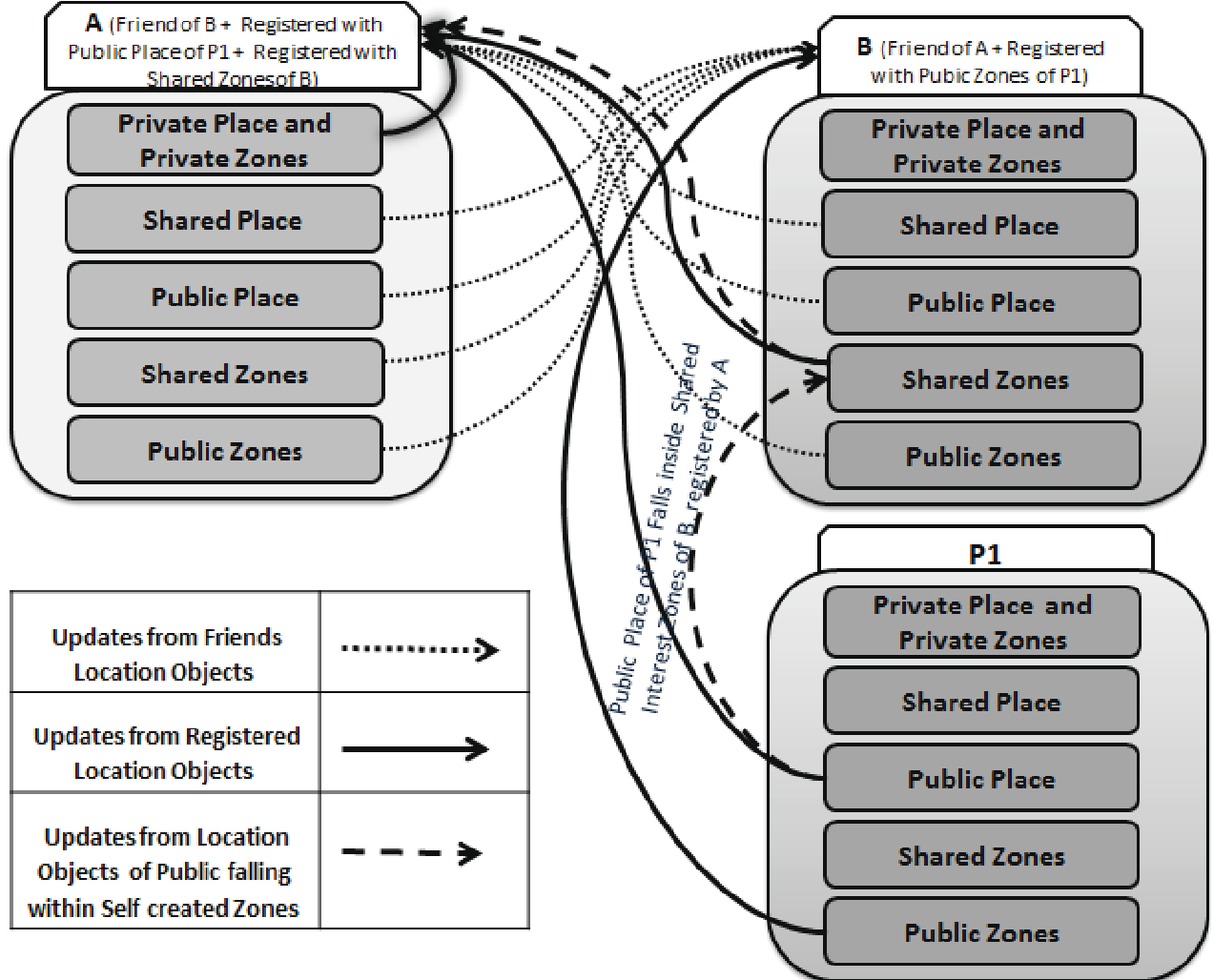 Figure: The Social-Spatial communication model showing how information flows through geographical commonality and social links.
Critical Insight: Why This Matters
The fundamental value-add here is decoupling. By making the location an independent object, the framework allows for:
- Direct Interaction: You can subscribe to a "Building" to get its history or safety alerts without needing to know a person inside.
- Sophisticated Filtering: Instead of "Nearby" alerts (which are often irrelevant), you get alerts based on your predefined "Zones" of interest.
- Privacy: A user can interact with a location's public feed without necessarily broadcasting their live GPS coordinates to their entire social circle.
Conclusion
This paper serves as a blueprint for a more mature LBSN ecosystem. While industrial implementations have slowly moved toward "Pages" for businesses, they still lack the flexible spatial logic (like the "Zone" concept) proposed here. The transition from "Social Networking with Location" to "Location-Based Social Networking" requires a deep structural shift where the map is not just a background, but the primary interface for social data.
Limitations: The paper is conceptual; while it provides a logical framework, it lacks massive-scale performance benchmarks for real-time spatial "Watch Area" triggers, which would be computationally intensive in a global production environment.