
Beyond Subjectivity: Quantifying ASD Social Behaviors via Wearable Sensing
Objective Measurement of Social Communication Behaviors in Children with Suspected ASD During the ADOS-2
This pilot study introduces a multimodal automated framework for the objective measurement of social communication behaviors in children during the ADOS-2 clinical assessment. Using adult-worn camera-embedded eyeglasses combined with computer vision and audio signal processing, the study quantifies social gaze, shared smiles, and vocal turn-taking to augment traditional ASD diagnostic practices.
TL;DR
Diagnosis of Autism Spectrum Disorder (ASD) has long been an "art" of clinical observation. This study shifts the paradigm toward "science" by using camera-embedded eyeglasses to objectively measure social gaze, smiles, and vocal interactions during the standard ADOS-2 assessment. The results demonstrate that automated computer vision and audio analysis can effectively capture symptom severity, paving the way for data-driven diagnostic tools.
Background: The Subjectivity Gap in Clinical Gold Standards
The Autism Diagnostic Observation Schedule-2 (ADOS-2) is the industry benchmark for ASD diagnosis. However, it suffers from two major bottlenecks:
- Observer Bias: Human clinicians, however well-trained, remain subjective.
- High Barrier to Entry: Training for ADOS-2 is expensive and time-consuming.
The motivation for this research is to create a "digital biomarker" for ASD—quantifiable metrics that don't sleep, don't have bad days, and can see social nuances in the millisecond range.
Methodology: The Multimodal Sensor Approach
The study leveraged a unique data collection setup: both the examiner and the parent wore camera-embedded eyeglasses. This provided a "first-person" perspective of the child's social world.
1. Computer Vision (The Visual Social Metric)
Using the AFFDEX algorithm, the team tracked:
- Social Gaze: Estimated via 3-D head orientation (yaw, pitch, roll).
- Social Smile: Detected via Facial Action Unit 12 (the Zygomaticus major muscle) using Support Vector Machines (SVM) and Histogram of Oriented Gradients (HOG).
2. Audio Processing (The Vocal Interaction Metric)
Using the LENA (Language Environment Analysis) system, the researchers segmented audio into:
- Child speech-like vocalizations.
- Adult-child vocal turn-taking.
- Atypical vocalizations (like crying or squeals).
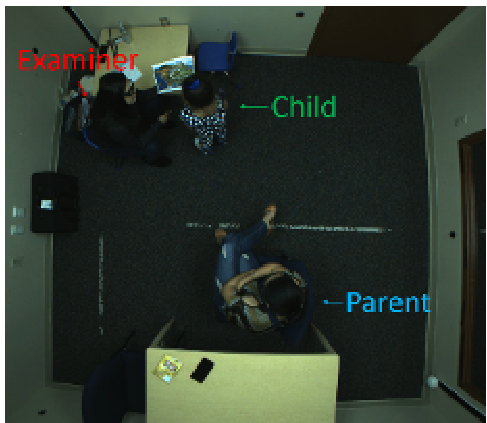 Figure 1: (a) Clinical ADOS-2 environment, (b, c) Camera-embedded glasses used for data collection, (d) Child's face as seen from the examiner's perspective.
Key Results: Data vs. Diagnosis
The study found that the automated metrics significantly tracked with traditional clinical scores (higher ADOS-2 scores indicate higher severity):
- The Social Affect Correlation: Children who smiled less objectively (as captured by the cameras) received significantly higher Social Affect (SA) and Overall ADOS-2 scores.
- The RRB Link: A decrease in "Social Gaze at Adults" was strongly correlated with a higher "Restricted and Repetitive Behavior" (RRB) score (r = -0.33).
- Conversational Turn-Taking: A higher rate of adult-child vocal turns was associated with lower ASD severity, confirming that conversational engagement is a vital marker of social health.
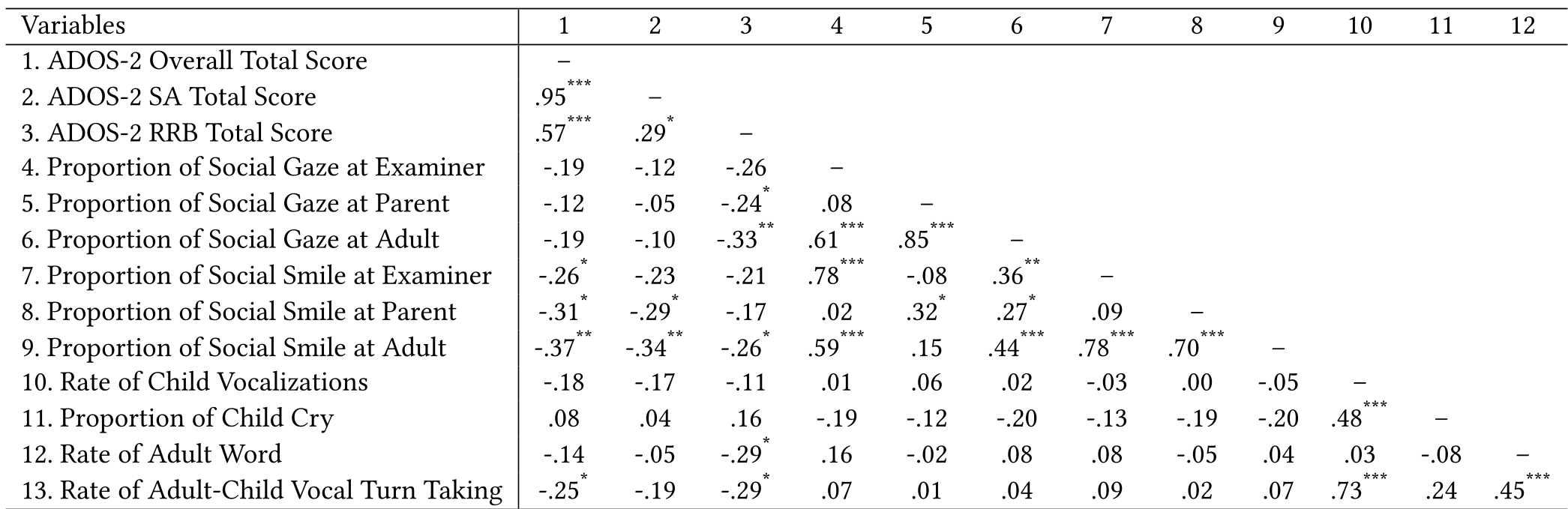 Table 1: Bivariate associations highlighting the negative correlations between objective social behaviors and ADOS-2 total scores.
Critical Analysis & Future Outlook
While this was a pilot study with 66 children, its implications are profound.
The Takeaway: The ability to quantify social interaction through head-worn sensors means we can move diagnostics out of the sterile clinic and into the "wild"—homes, parks, and schools.
Limitations: The study noted that objective measures still show "relatively low levels of association" in some areas compared to expert clinicians. This suggests that while sensors are great at counting instances of behavior, they may still struggle with the quality or contextual appropriateness of the social behavior—a domain where human intuition still leads.
Future Work: Integrating deep learning models to better categorize "overlapping vocalizations" (when two people talk at once) and refining gaze-tracking to distinguish between looking at a face and looking into the eyes will be the next frontier for this technology.