
Mastering the 3D Space: A Deep Dive into LBSN Recommender Systems
Objectives and State-of-the-Art of Location-Based Social Network Recommender Systems
This survey paper provides a comprehensive review of Location-Based Social Network (LBSN) recommender systems, introducing an object-oriented taxonomy involving Users, Locations, and Activities. It categorizes existing State-of-the-Art (SOTA) methods into 11 distinct recommendation objectives based on 3D relationships (User-Location-Activity).
Executive Summary
As GPS-enabled devices become ubiquitous, the recommendation landscape has evolved from suggesting digital items to guiding physical movement. This survey paper, published in ACM Computing Surveys, systematically deconstructs Location-Based Social Network (LBSN) recommender systems. Unlike traditional systems that operate on a 2D User-Item plane, LBSNs operate in a 3D space involving Users, Locations, and Activities. The paper categorizes the field into 11 specific objectives, moving from simple POI discovery to complex path and sequence planning.
The Shift from 2D to 3D: Why Traditional CF Fails
Traditional Collaborative Filtering (CF) relies on the premise: "If you liked Movie A, you might like Movie B." In the physical world, this logic is incomplete. A user might love a specific restaurant (Activity: Dining), but if it is 500 miles away (Location), the recommendation is useless.
The Inductive Bias of LBSNs must account for:
- Spatial Constraints: Users are naturally inclined to visit nearby locations (Geographical Influence).
- Temporal Dynamics: A park is popular in the afternoon; a club is popular at midnight.
- Social Dependency: Your check-in history is often a reflection of your social circle's mobility.
Methodology: The 3D Object Taxonomy
The core insight of this paper is the subdivision of LBSN objects. The authors argue that to provide meaningful recommendations, we must look beyond the "Point" and consider the "Flow."
Core Framework
The paper introduces a hierarchy where:
- Users are split into individuals and Groups.
- Locations are split into points and Trips (sequences of points).
- Activities are split into single events and Activity Sequences.
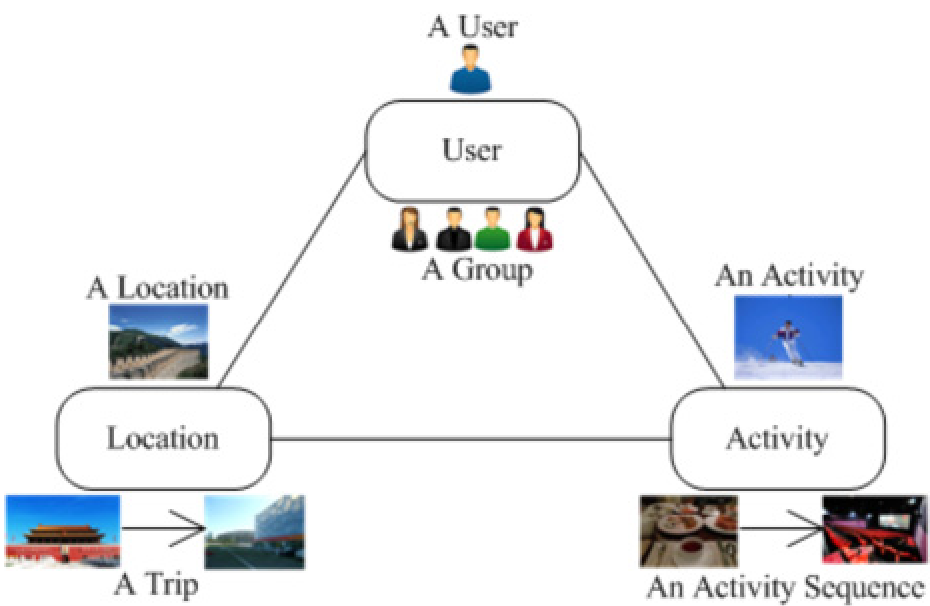 Above: The hierarchical view of LBSN objects and their interconnections.
The Power of Tensor Decomposition
To solve the data sparsity problem (most users only visit 0.01% of all possible locations), researchers use High-Order Singular Value Decomposition (HOSVD). By modeling the relationship as a 3D Tensor (), missing values can be predicted through latent factor discovery.
SOTA Performance and Key Insights
The survey highlights several milestone algorithms:
- HITS-based Inference: Using the Hyperlink-Induced Topic Search (HITS) logic, the system treats highly visited locations as "Authorities" and active travelers as "Hubs."
- HGSM (Hierarchical-Graph-based Similarity Measurement): This method improves on basic CF by considering the "granularity" of overlaps. Two users sharing a specific coffee shop are considered more similar than two users sharing a general city-level location.
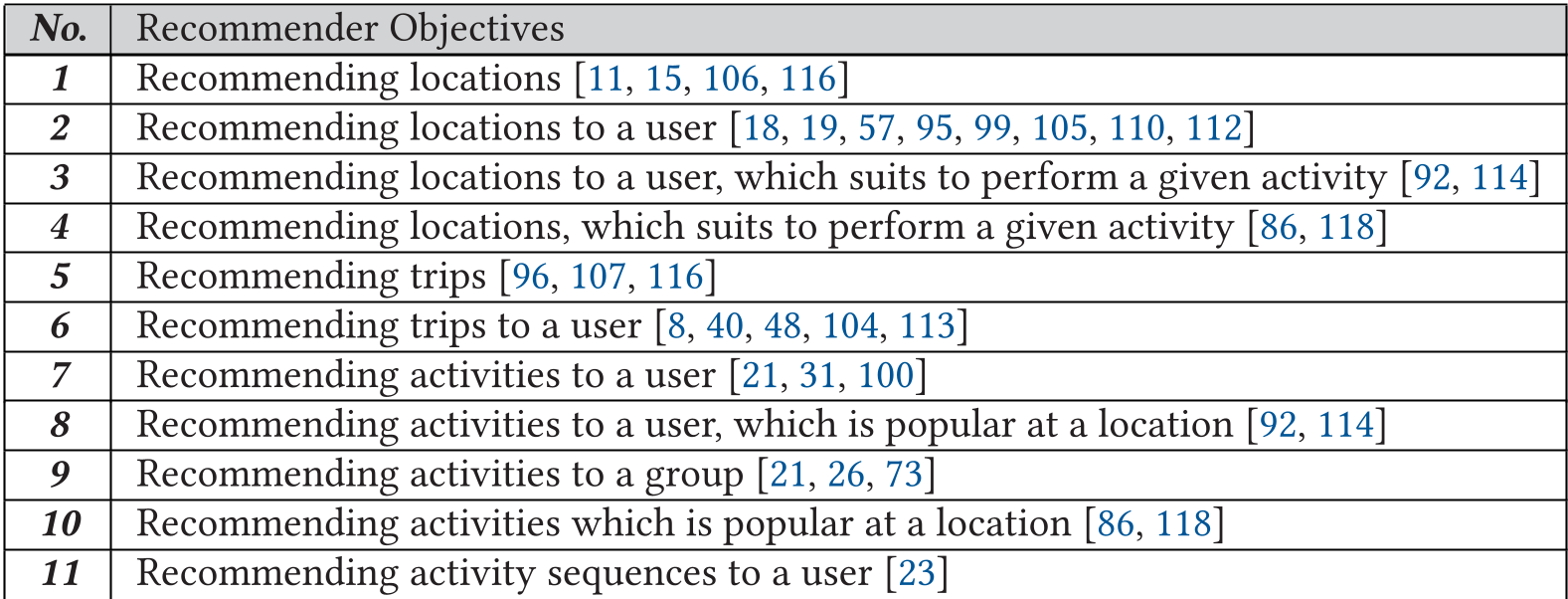 Experimental evidence across several datasets (Foursquare, Gowalla) confirms that hybrid models—those combining category hierarchy (WCH) and spatial-temporal features—consistently outperform pure social or pure geographic models.
Critical Analysis & Future Frontiers
While the field has matured, the authors point out a significant gap: Group Recommendation.
- The "Trip-to-Group" Challenge: Most current systems recommend a trip to an individual. However, tourism is social. Recommending a 3-day itinerary to a group of five people requires balancing conflicting preferences and "opening-time" constraints for multiple attractions simultaneously.
- Dynamic Updating: Many current tensor models are static. In real-world applications, the model must update as the user moves (Incremental SVD).
Conclusion
This paper serves as an essential map for researchers navigating the intersection of Social Computing and GIS. The transition from Location-aware (knowing where you are) to Location-based (understanding the social and semantic value of your movement) represents the next frontier in personalized AI.
Takeaway for Practitioners: When building modern recommenders, don't just optimize for "Content Similarity." Integrate the Spatial Decay Function () and temporal slots to capture the physical reality of human behavior.