
TOP: Solving the Uncertainty of Cloud Pricing for Machine Learning Jobs
Occupation-Oblivious Pricing of Cloud Jobs via Online Learning
This paper introduces TOP (Total Occupation-oblivious Pricing), a novel online pricing mechanism for cloud computing that replaces traditional time-based billing with a lump-sum, job-completion fee. Specially designed for machine learning workloads with uncertain durations, TOP utilizes a Multi-Armed Bandit (MAB) framework to maximize provider profit without prior knowledge of job runtimes or user budgets.
TL;DR
Cloud providers currently charge by the hour, but for data scientists, knowing how many hours a training job will take is often a guessing game. This paper proposes TOP (Total Occupation-oblivious Pricing), a mechanism where the cloud provider quotes a single "lump-sum" price for completing the job, regardless of how long it runs. By using a clever Multi-Armed Bandit (MAB) strategy, the provider manages the risk and maximizes profit while giving users the budget certainty they crave.
The Problem: The "Pay-as-you-go" Mismatch
Modern cloud pricing (AWS, GCP, Azure) is built on time: $X per hour. This is great for web servers but terrible for Modern Machine Learning (ML). An ML researcher knows their data and their model, but they rarely know if the training will take 4 days or 6 days.
Current solutions like Spot Instances are cheaper but come with the risk of preemption—a nightmare for long-running training tasks. The industry needs a model where the risk of "runtime uncertainty" is shifted from the customer to the provider, who has the historical data to manage it.
Methodology: The TOP Algorithm
The researchers developed TOP to act as a "smart cashier." When a user arrives, TOP must decide on a fixed price without knowing the user's budget () or the job's duration ().
1. The Price-Profit Insight
The core innovation is a mathematical relationship that bounds the expected profit. The provider needs to balance two things:
- Sales Volume: Lower prices attract more users.
- Resource Turnover: Lower prices might fill up the servers with "slow" jobs that pay very little per hour of occupation.
2. Exploration vs. Exploitation
TOP operates in two distinct phases:
- Exploration (The Learning Phase): For a small fraction of initial jobs, the provider sets a price of zero. Why? To collect "clean" data on how long these specific types of jobs actually take without the noise of price-rejection.
- Exploitation (The Optimization Phase): Using the learned distributions of runtimes and budgets, TOP calculates an Upper Confidence Bound (UCB) for the reward of each possible price. It selects the price that maximizes the potential profit while respecting the physical limits of the data center.
 Table 1: Key notations and the underlying logic of the TOP reward function.
Experiments and Results
The authors didn't just stay in the realm of theory. They tested TOP against real-world traces from Spark data analytics.
Key Findings:
- Sub-linear Regret: The "Regret" (the gap between TOP and an "omniscient" strategy that knows the future) grows very slowly. This means as the system runs longer, the algorithm becomes increasingly efficient.
- Dynamic Superiority: Surprisingly, TOP often outperformed the best fixed-price strategy. By adjusting prices dynamically based on current server load and learned job "densities," it squeezed more value out of every GPU hour.
- Resilience: The system proved robust even when the provider's estimate of the maximum user budget () was slightly off.
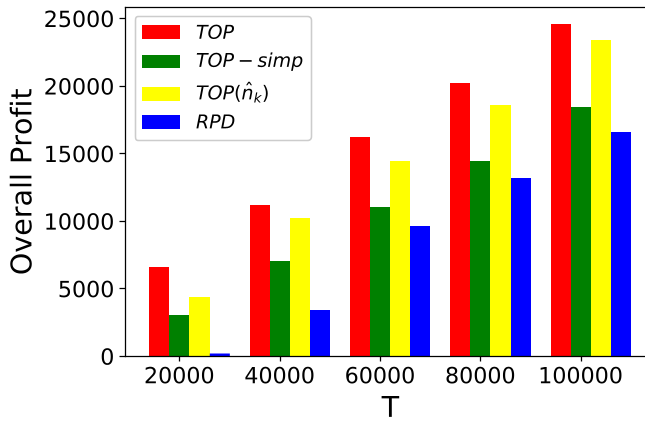 Fig 4: Performance comparison showing TOP outperforming standard RPD and simplified versions of itself.
Critical Insight: Why This Matters for the Future
The real takeaway here is the asymmetry of information. Individual users don't know how long their jobs will take, but the cloud provider—having seen thousands of similar ResNet or Transformer training runs—does.
By utilizing MAB-based online learning, providers can turn this information gap into a competitive advantage:
- For the User: Absolute budget certainty.
- For the Provider: Higher utilization and better profit margins by intelligently "binning" jobs based on their expected resource-time footprint.
Limitations
The model assumes that users aren't malicious. In a real-world scenario, a user might intentionally run an infinite loop if they paid a flat fee. The authors suggest outlier detection to mitigate this, but in a production environment, this would require strict "Fair Use" policies or hardware-level telemetry.
Conclusion
TOP represents a pivot from selling "raw time" to selling "completed tasks." As ML becomes an industrial utility, this occupation-oblivious pricing could become the standard for high-performance computing, making cloud costs as predictable as a monthly Netflix subscription.