
Turning Grades into Jobs: A Data-Driven Approach to Vocational Recommendation
Occupation recommendation based on student achievement mining in vocational skill training
This paper proposes an occupation recommendation system for vocational skill training based on student achievement mining. By utilizing correlation analysis and association rule mining (Apriori and FP-Growth), the approach identifies relationships between student grades and employment outcomes to provide personalized career suggestions.
TL;DR
Bridging the gap between vocational training and the job market, this paper introduces a system that analyzes student achievements across four dimensions—Professional, General, Practical, and Behavioral—to recommend specific occupations. By mining association rules from historical employment data, the system provides students with targeted career paths and "early warnings" for those at risk of unemployment.
Context & Motivation
In the volatile landscape of the global economy, vocational training is the lifeline for employment. However, most educational data mining (EDM) still focuses on "will this student pass the exam?" rather than "will this student get the job?". The authors recognize that vocational success isn't just about grades; it's about how specific skill sets align with the needs of diverse industry sectors. Their goal is to move from passive score reporting to active career guidance.
The Core Methodology: A Two-Pronged Mining Strategy
The researchers don't just jump into recommendation. They follow a rigorous analytical pipeline to ensure the data is "reasonable" before drawing conclusions.
1. Statistical Sanity Check: Correlation Analysis
Before recommending, they ask: Do grades actually matter for getting hired? They use the Left Measure, a correlation metric that compares joint probability against independent probability.
- Positive Correlation (Left > 1): Higher grades (A/B) in Behavioral Capacity strongly lead to employment.
- Negative Correlation (Left < 1): Low grades (D/E) are statistically linked to non-employment.
2. The Association Rule Engine
Once the correlation is validated, the system mines rules in the form of .
- Clustering: Because there are too many specific job titles, they use clustering to group occupations (e.g., "Software Development," "Technical Service").
- Mining Algorithms: Apriori is used to find frequent associations for recommendations, while FP-Growth identifies "Maximal Frequent Patterns" in unemployed student data to act as a warning system.
 Figure 1: The proposed architecture, from raw achievement data to recommendation and warning.
Specialized Recommendation Logic
Unlike standard collaborative filtering (used by Netflix), the authors propose three specific criteria for career recommendation:
- Diversity: If a student's profile matches multiple high-confidence rules, recommend all related occupations.
- Simplicity: If a general rule (e.g., "Good PK") leads to a job, don't use a more complex one (e.g., "Good PK + Good GK") unless it adds specific value.
- Downward Compatibility: If a rule exists for a "Grade B" student, a "Grade A" student should also be eligible for that recommendation.
Experimental Validation
The study analyzed a real-world dataset comprising Professional Knowledge (PK), General Knowledge (GK), Practice Skill (PS), and Behavioral Capacity (BC).
Key Findings in Data Consistency
The correlation charts below confirm that as scores decrease from "Optimal" to "Pass," the correlation with employment (ES=yes) drops significantly, while the correlation with non-employment (ES=no) rises.
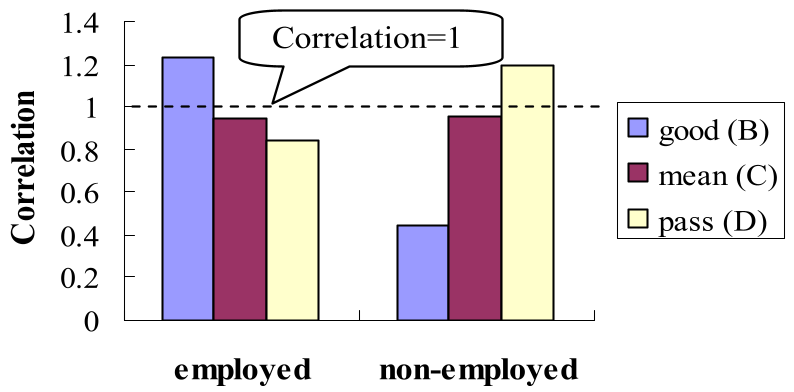 Figure 2: Practice Skill correlation shows a clear positive trend for high scorers and a negative trend for low scorers regarding employment.
A few discovered rules include:
- General Knowledge (Optimal) Software Development.
- Practice Skill (Good) + Behavioral Capacity (Optimal) Software Development.
- Professional Knowledge (Mean) Technical Service.
Critical Insight & Conclusion
While the paper is technically grounded in established algorithms like Apriori and FP-Growth, its strength lies in its Domain-Specific Logic. Vocational training requires a different Inductive Bias than traditional K-12 education; here, "Practical Skill" and "Behavioral Capacity" are often better predictors of employment than "Professional Knowledge" alone.
Limitations: The current model relies on static historical data. Future adaptations could benefit from Reinforcement Learning to update recommendations as market demands shift in real-time.
Final Takeaway: This approach provides a blueprint for vocational institutions to transform from "skills silos" into "career accelerators" by leveraging their most valuable asset: their historical student success data.