
Oil and Water Do Mix: Why the Future of Engineering Demands Social Science
Oil and Water do Mix: Social Science Meets Engineering Towards a Transdisciplinary Perspective on Cyberworlds
This paper proposes a transdisciplinary framework for Cyberworld research, merging Computer Science and Engineering with Social Sciences. It introduces a multi-layered matrix—ranging from Ontological to Political-Economic levels—to bridge the gap between technical design and sociocultural phenomena in virtual environments.
TL;DR
The study of Cyberworlds is often split between two silos: the "Hard Science" of coding and the "Soft Science" of sociology. This paper argues that this separation is a relic of the past. By introducing a transdisciplinary framework, the author demonstrates that technical features (like a GUI or an AI's behavior) are not just code—they are the DNA of virtual societies. From digital economies to virtual identity, the "oil" of engineering and the "water" of social science must finally mix.
The "Oil and Water" Problem: A Flawed Boundary
Historically, engineering conferences attract engineers, and psychology conferences attract psychologists. The author uses a striking metaphor: academia treats these disciplines like oil and water, which naturally repel each other.
While interdisciplinarity suggests we should bring these experts to the same table, the author pushes for transdisciplinarity. The difference is crucial:
- Interdisciplinary: Different experts look at the same problem from their own silos (like an emulsion that eventually separates).
- Transdisciplinary: Researchers cross the boundary, learning the language and logic of the opposite field to achieve a truly holistic understanding.
Methodology: The Six-Layer Framework
To bridge this gap, the paper introduces a systematic way to look at Cyberworlds across six specific levels. This matrix allows an engineer to see the social impact of their code and a sociologist to see the technical constraints of a society.
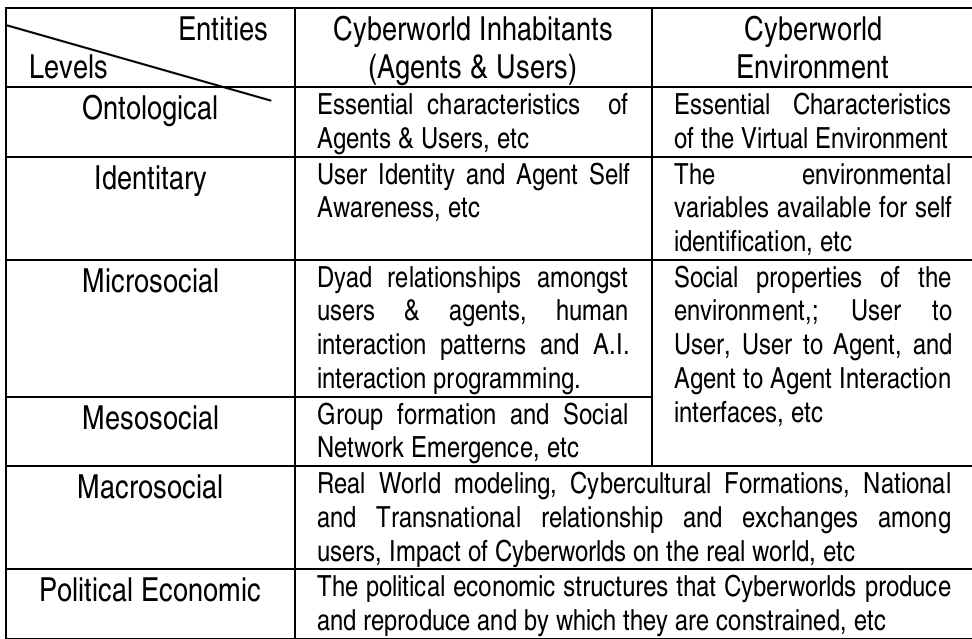
1. The Ontological Level (The "What")
What is a cyberworld? Is it a server, or is it a social space? Engineers often define it by its hardware/software specs, while social scientists see the "social fabric" shaped by user interactions.
2. The Identitary Level (The "Who")
This focuses on the Virtual Identity. Users don't just "log in"; they project their psyche into an "online persona" or avatar. Understanding "amenability" in AI agents (their self-awareness and learning) is a direct intersection point between psychology and agent programming.
3. The Micro & Mesosocial Levels (The "How")
- Microsocial: How two agents or users interact. A "failed" interface (like spam) ignores human social patterns, while a "successful" one (like text messaging) aligns with human social needs.
- Mesosocial: How groups form. These are complex, indivisible systems where user relationships create a web of norms and "critical mass."
4. Macrosocial & Political-Economic (The "Context")
Cyberworlds create their own cultures ("Cyberculture") and economies. They are not isolated bubbles; they exist within real-world legal frameworks and global market forces.
Case Study: The War Over Virtual Property
The most compelling evidence for this transdisciplinary approach is the crisis of Ownership in MMORPGs (like World of Warcraft).
A player spends thousands of hours "leveling up" a character and then sells it on eBay for $3,000.
- The Developer's View: "We own the code; we are providing a service. You are just renting space."
- The User's View: "I invested my time and labor. This identity belongs to me."
This is an Ontological conflict. It’s not just a legal bug—it’s a fundamental disagreement on what the virtual world is. An engineer who doesn't understand "social capital" or "labor theory" cannot fix the economic death-spirals caused by real-money trading in their game.
Critical Analysis & Conclusion
The author’s core contribution is the realization that design is a social act. When an engineer builds a communication tool, they are effectively writing the "Constitution" for that virtual world.
Takeaway
As we move toward more immersive "Cyberworlds" (Metaverses), the distinction between "Soft" and "Hard" science becomes a liability. The most successful developers of the future will be those who can navigate the technical rigors of AI and server architecture while simultaneously understanding the nuances of human identity and cultural formation.
Oil and water do mix—and the result is a more resilient, human-centric digital future.