
OSO: Redefining Real-Time Video Classification via Storyboard Super-Images
One-Shot Only Real-Time Video Classification: A Case Study in Facial Emotion Recognition
The paper introduces "One-Shot Only" (OSO), a novel real-time video classification framework that transforms video sequences into a single "storyboard" image. Using frame selection and clustering strategies, it enables standard 2D CNNs to perform spatio-temporal fusion, achieving SOTA results in facial emotion recognition on the AFEW 7.0 dataset.
TL;DR
The One-Shot Only (OSO) method simplifies video classification by packing representative frames into a single "storyboard" image. By doing so, it leverages the power of optimized 2D CNNs to capture spatio-temporal features, resulting in a 10x speedup and significantly higher accuracy (up to +13%) compared to traditional frame-averaging methods in facial emotion recognition.
Problem & Motivation: The Complexity of "Time"
Video classification is inherently difficult because it adds a temporal dimension to spatial data. Current approaches generally fall into two camps:
- Decision Fusion (2D CNNs): Treat frames as independent images and average the results. Problem: It ignores the chronological "story" of the video.
- 3D CNNs / RNNs: Process the volume of data directly. Problem: These models have massive parameter counts, are notoriously hard to train on small datasets (overfitting), and are too slow for real-time mobile or edge applications.
The authors' insight was simple yet profound: If a human can understand a story by looking at a comic strip (a storyboard), why can't a 2D CNN?
Methodology: Spatio-Temporal Information Fusion
The core innovation is the Storyboard Creating technique. Instead of feeding a 3D volume into a model, the system selects key frames and arranges them in a grid (e.g., 3x3, 4x4, or 5x5).
1. Frame Selection vs. Clustering
- Frame Selecting Approach: Uses Euclidean distance between frame feature vectors to find the most "distinct" frames, creating one master storyboard for the whole video.
- Frame Clustering Approach: Group frames into clusters (e.g., pre-emotion, peak emotion, post-emotion). A storyboard is made for each cluster, and an LSTM processes the sequence of these storyboards.
2. The Architecture
The OSO pipeline handles face detection, tracking, and alignment before building the storyboard. This grid-image is then resized to 224x224—the standard input for high-performance 2D CNNs like ResNet or VGG.
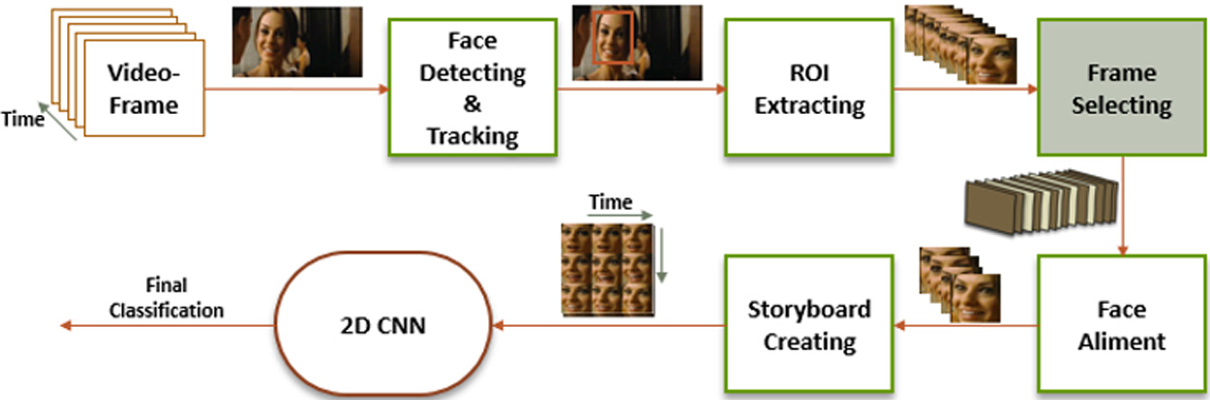 Figure 1: The OSO Pipeline: (A) Frame Selecting with direct 2D CNN prediction; (B) Frame Clustering with LSTM sequence modeling.
Experiments & Results: Speed Meets Accuracy
The researchers tested OSO on the AFEW 7.0 (Acted Facial Expressions in the Wild) dataset.
SOTA Comparison
OSO significantly outperformed winners of the EmotiW Challenge who used visual-only data.
- Accuracy: The OSO Frame Clustering (VGG16 + 4x4 grid) reached 55.6% accuracy, far surpassing the EmotiW baseline of 36.08%.
- Efficiency: Because the model only looks at one (or very few) composite images instead of 90+ individual frames, the runtime is roughly 10 times faster than traditional 2D CNN fusion.
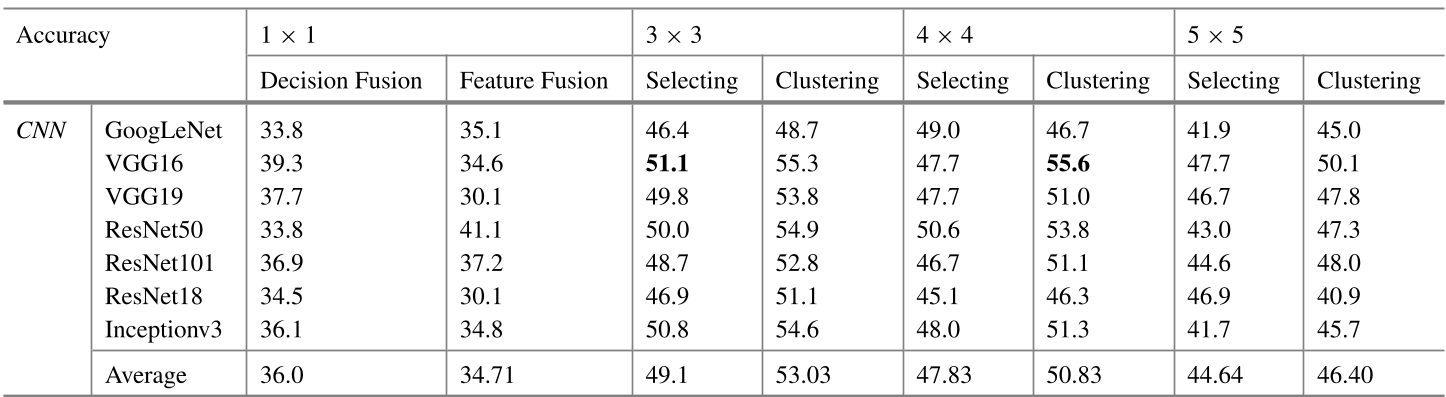 Table 1: Comparison of Accuracy across different 2D CNN backbones and storyboard sizes.
Key Insight: The "Goldilocks" Grid Size
The researchers found that a 3x3 or 4x4 grid usually performs best. Increasing the grid to 5x5 sometimes reduced accuracy. This suggests that shrinking too many frames into one image causes the 2D CNN to lose fine-grained spatial details (like the subtle curve of a lip during a "surprise" emotion).
Critical Analysis & Conclusion
Takeaway
OSO proves that we don't always need 3D convolutions for video. By cleverly rearranging data in 2D space, we can "trick" standard image models into understanding temporal flow. This is a massive win for Real-Time Human-Computer Interaction (HCI).
Limitations
- Resolution Loss: Shrinking many frames into one 224x224 image forces a trade-off between temporal resolution (more frames) and spatial resolution (clearness of each frame).
- Fixed Grid: The current method uses a preset grid size, which might not be optimal for very long videos compared to very short ones.
Future Work
The OSO framework could be extended to Action Recognition or Anomaly Detection in surveillance, where real-time processing is even more critical than in emotion recognition.