
Decoding the Signature of Community Management: Is Your Network "Designed" or Just Emergent?
Online community management as social network design: testing for the signature of management activities in online communities
This study investigates whether "onboarding"—a proactive community management policy—leaves a detectable structural signature in the social networks of online communities. By comparing empirical data from three communities and utilizing a generalized preferential attachment simulation, the authors demonstrate that successful management causes in-degree distributions to systematically deviate from the standard power-law form.
TL;DR
In the world of network science, we often assume that social networks grow "wild," following the "rich-get-richer" logic of preferential attachment. This paper challenges that by treating community managers as network designers. By analyzing both real-world communities and computer simulations, the authors prove that active management—specifically "onboarding"—leaves a distinct mathematical footprint: a deviation from the classic power-law degree distribution.
Background: The Myth of Pure Emergence
Traditional models like the Barabási-Albert model suggest that online communities should naturally evolve into scale-free networks where a few "superstars" (hubs) have most of the connections. But successful communities aren't just accidents of math; they are shaped by human agents who onboard newcomers, resolve conflicts, and direct attention.
The authors argue that if community management is effective, it must function as a form of Social Network Design. If you change the rules of how links are formed, the resulting "map" of the community should look fundamentally different.
The "Onboarding" Intervention
The study focuses on a policy called Onboarding. When a new member joins:
- A manager greets them (creating an incoming link).
- The manager suggests someone for them to talk to (encouraging the newcomer to create an outgoing link).
- The community responds (others link to the newcomer).
Methodology & The Simulation
To prove this leaves a "signature," the authors compared three communities:
- InnovatoriPA: No special management (the control).
- Edgeryders & Matera 2019: Active onboarding policies (the treatment).
They then built a simulation that pitted "Preferential Attachment" (natural growth) against "Onboarding" (designed growth).
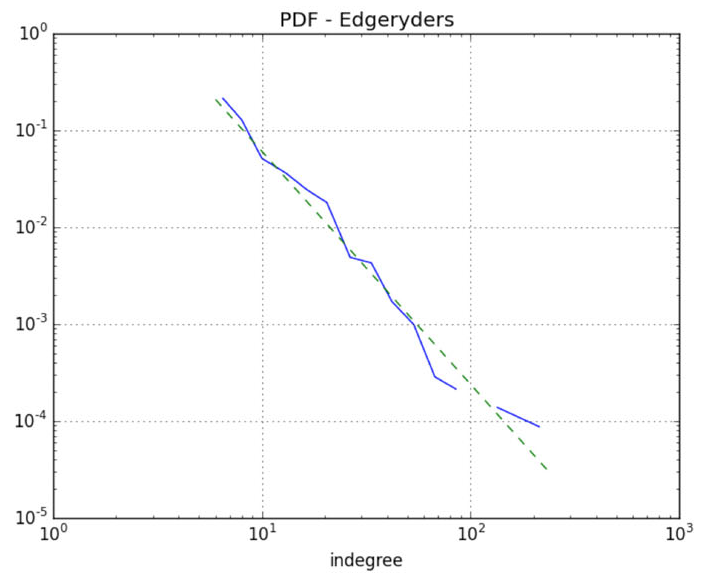 Figure: The log-log plot shows how simulated networks with onboarding (bottom right) mirror the "bent" distribution of real-world managed communities like Edgeryders (bottom left).
Key Insights from the Data
The researchers used a rigorous Goodness-of-Fit test to see if the networks followed a power law ().
- The "Kill" of the Power Law: In the unmanaged community (InnovatoriPA), the power law held true. In the managed communities, the power law was strongly rejected for the full range of users.
- The Tail Remains: Interestingly, for the "superstars" (the high-degree tail), the power law still works. This makes sense: managers focus on the "little guys" (newcomers). Once you become a power user, the "natural" laws of the internet take back over.
- The Signature: Onboarding creates a "bulge" in the lower end of the distribution. It forces links toward people who haven't "earned" them yet through sheer popularity.
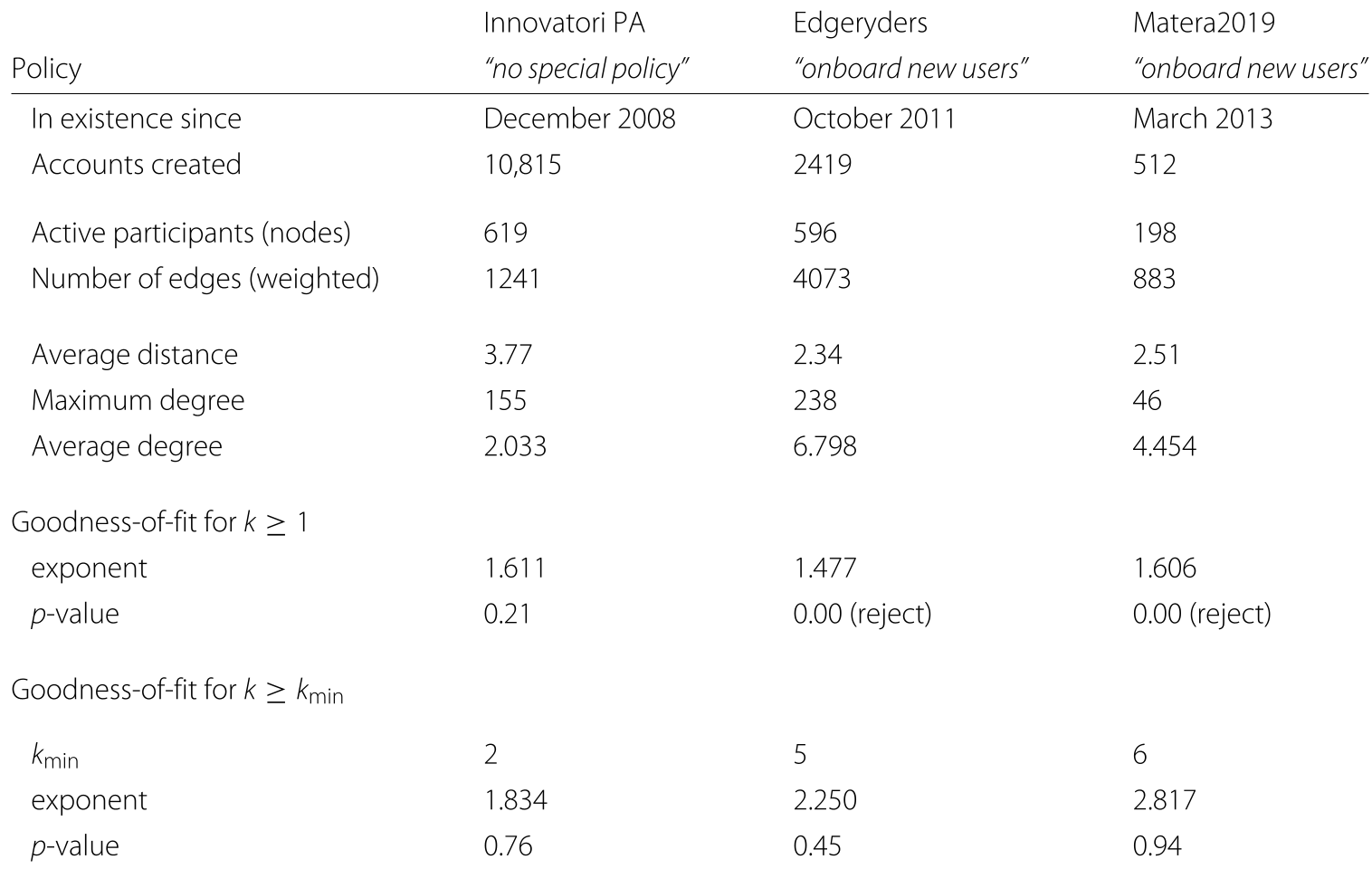 Table: Note the p-values. A p-value of 0.00 for Edgeryders and Matera 2019 means we can say with near certainty that they are NOT ordinary, unmanaged power-law networks.
Why This Matters for the Future
This research moves community management from an "art" to a "science."
- Performance Metrics: Instead of just counting "likes" or "posts," organizations can look at the topology of their network. If your degree distribution is a perfect power law, your community manager might not be doing much to help newcomers!
- Algorithmic Governance: As we move toward AI-moderated spaces, this gives us a way to "program" the desired social structure.
Limitations
The authors admit that while a "reject" on the power-law test suggests management is happening, it doesn't necessarily prove management is good. Other factors, like UI design or cultural quirks, could also cause these deviations. However, this remains a landmark attempt to find the "ghost in the machine"—the human hand guiding the growth of digital social structures.
Summary Takeaway
If you want to know if your community management is working, stop looking at the top users and start looking at the "shape" of the entry-level experience. A healthy, managed community should break the laws of physics—or at least, the laws of network science.