
Watchdog in the Pipeline: Real-Time Spectre Detection via Microarchitectural Traces
Online Detection of Spectre Attacks Using Microarchitectural Traces from Performance Counters
The paper introduces a real-time detection framework for Spectre attacks by monitoring microarchitectural hardware performance counters (HPC). Using a Multilayer Perceptron (MLP) classifier enhanced by a Weighted Moving Average (WMA) sliding window technique, the approach achieves a 0% false negative rate and 0.77% false positive rate.
TL;DR
Researchers from UC Irvine have developed an online detection system that catches Spectre attacks as they happen by monitoring the "heartbeat" of the CPU. By analyzing branch mispredictions and cache behavior through Hardware Performance Counters (HPC), their ML-powered detector achieves a perfect 0% False Negative rate, ensuring no attack goes unnoticed.
Background: The Invisible Threat
The discovery of Spectre sent shockwaves through the industry because it exploited a fundamental feature of modern CPUs: Speculative Execution. By guessing the path of a branch and executing instructions ahead of time, processors gain immense speed. However, if the guess is wrong, the "ghost" instructions leave traces in the cache.
Current software defenses are often like "whack-a-mole"—they fix specific instances but fail to address the underlying microarchitectural leakage. Furthermore, traditional antivirus tools are blind to these attacks because they occur at the hardware level, leaving no footprint in OS logs.
The Insight: Attackers Have a Hardware "Signature"
The authors realized that while Spectre hides from software, it is loud and Phoenix-like at the hardware level. To leak data, an attacker must:
- Maltrain the Branch Predictor: This creates distinct patterns in branch instructions.
- Flush and Reload the Cache: This inevitably spikes Last-Level Cache (LLC) misses.
By monitoring four specific metrics—LLC references, LLC misses, branch instructions retired, and branch mispredictions—the team could "see" the attack in the noise of everyday computing.
Methodology: From Raw Traces to Real-Time Decisions
The proposed system doesn't just look at a single moment; it analyzes the execution flow.
1. Data Collection
Using the Linux perf tool, the system samples CPU counters every 0.1 seconds. This provides a multi-dimensional time series of how the hardware is behaving.
2. Architecture & Smoothing
To prevent "jitter" (temporary spikes in activity) from causing false alarms, the authors implemented a Weighted Moving Average (WMA). This smooths the classifier's output over a Sliding Window.
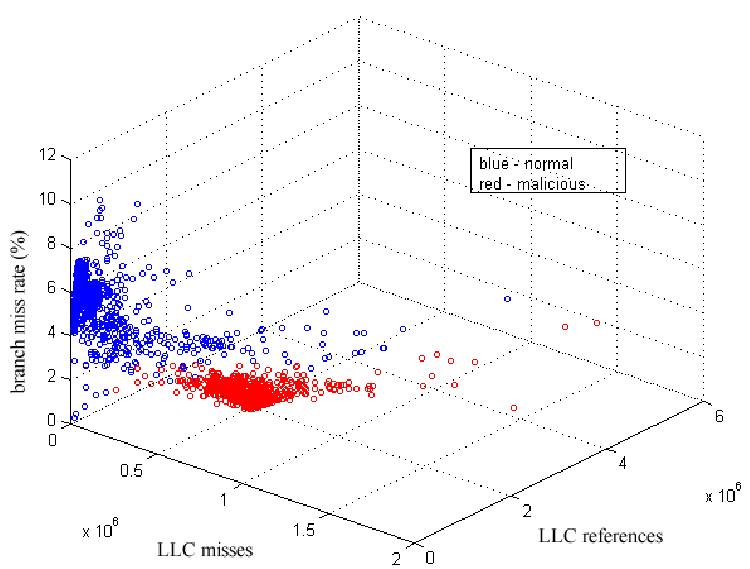 In the 3D feature space above, you can see a clear separation between "Clean" (normal) behavior and "Malicious" (Spectre) behavior.
Experiments & Performance
The researchers tested three main classifiers: Logistic Regression (LR), Support Vector Machines (SVM), and Multilayer Perceptrons (MLP/Neural Networks).
Key Results:
- MLP Accuracy: The Neural Network approach was the winner, reaching an Area Under Curve (AUC) of 0.9998.
- The "Zero Stealth" Achievement: It achieved 0% False Negatives. In security, this is crucial—it means the attack was never missed.
- Low Overhead: Because HPCs are built-in hardware features, the act of monitoring them adds almost no burden to the CPU's primary tasks.
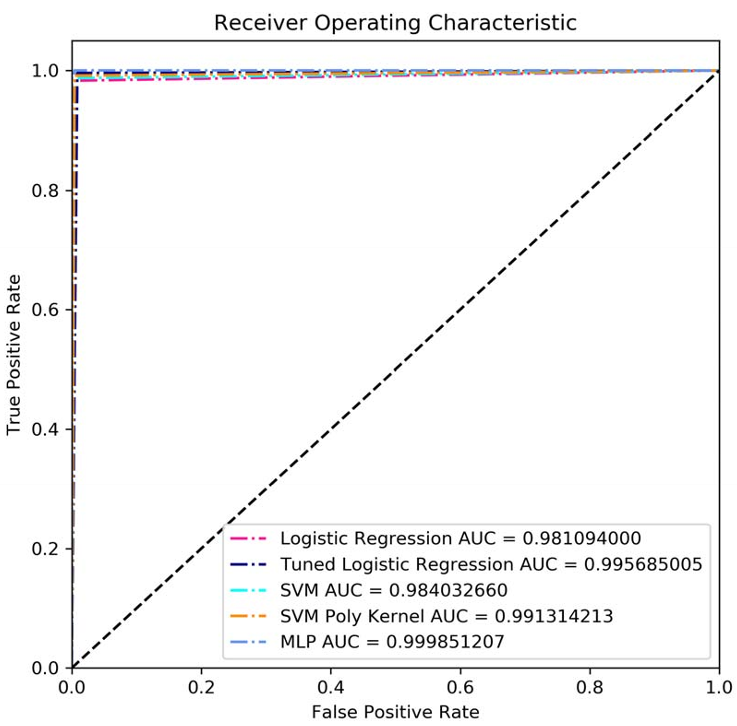 The ROC curves show that all models performed well, but the MLP (the curve closest to the top-left) offered the best trade-off between sensitivity and specificity.
Detailed Performance Table
| Classifier | AUC | False Positives (%) | False Negatives (%) | Training Time |
|---|---|---|---|---|
| Tuned LR | 0.995 | 1.15 | 2.43 | 0.04s |
| SVM (Poly) | 0.991 | 0.77 | 0.97 | 9.8s |
| MLP | 0.999 | 0.77 | 0 | 95s |
Critical Insight & Conclusion
While the MLP is the most accurate, it takes significantly longer to train (95s vs 0.04s for LR). However, for a security-critical system, this one-time "upfront cost" is well worth the 100% detection rate.
The true value of this work lies in its real-time nature. By using a sliding window, the system can trigger an alert or halt a process within seconds of a Spectre attack beginning, rather than analyzing the "post-mortem" logs after the data has already been stolen. As hardware vulnerabilities continue to emerge, this type of microarchitectural "immune system" may become a standard component of secure computing.