
Unveiling the Digital Mirror: Community Extraction and Behavioral Prediction via MCL and k-Means
Research on Online Digital Cultures - Community Extraction and Analysis by Markov and k-Means Clustering
The paper presents a framework for personal data analytics within a "Social Data Commons" to empower users by revealing insights from their digital footprints. It employs Markov Clustering (MCL) for Twitter community detection and k-Means for spatial clustering of mobile cell tower data, achieving high accuracy in predicting user behavioral routines.
TL;DR
In an era where personal data is often treated as "commercial fuel," King’s College London researchers have introduced a framework to return data sovereignty to the user. By combining the MobileMiner app with Markov Clustering (MCL) and k-Means, they demonstrate that coarse metadata—like cell tower IDs and Twitter followers—is sufficient to reconstruct intimate social circles and predict daily movements with nearly 100% accuracy.
Background: Escape from the Commercial Black Box
Most social media analytics are designed for brands to track "influencers" or "sentiment." For the average user, the data produced is a black box. This paper pivots the lens, focusing on the "Social Data Commons"—an environment where users participate in the development of tools to analyze their own digital traces. The researchers worked with young developers (Young Rewired State) to test if simple mathematical models could reveal the same insights as the opaque algorithms used by tech giants.
Why Markov Clustering (MCL) Beats Louvain for People
The study highlights a critical gap in social graph analysis. While the Louvain method is popular for maximizing modularity in large networks, it often fails at the "ego-network" level—the personal sphere of an individual.
The Intuition of MCL
MCL operates on the principle of Random Walks. It uses two alternating processes:
- Expansion: Squaring the adjacency matrix to see where a "random walker" might end up after two steps.
- Inflation: Raising values to a power to strengthen "busy" paths and weaken "rare" ones.
The logic is elegant: in a dense community, a person is more likely to stay within the group than leave it.
The Result: When applied to a researcher's Twitter feed, 20% of MCL clusters were immediately identifiable as specific conferences or research groups. In contrast, the Louvain method produced a 0% relevance rate for recognizable social context.
Trajectory Mining: Cell Towers as Life Markers
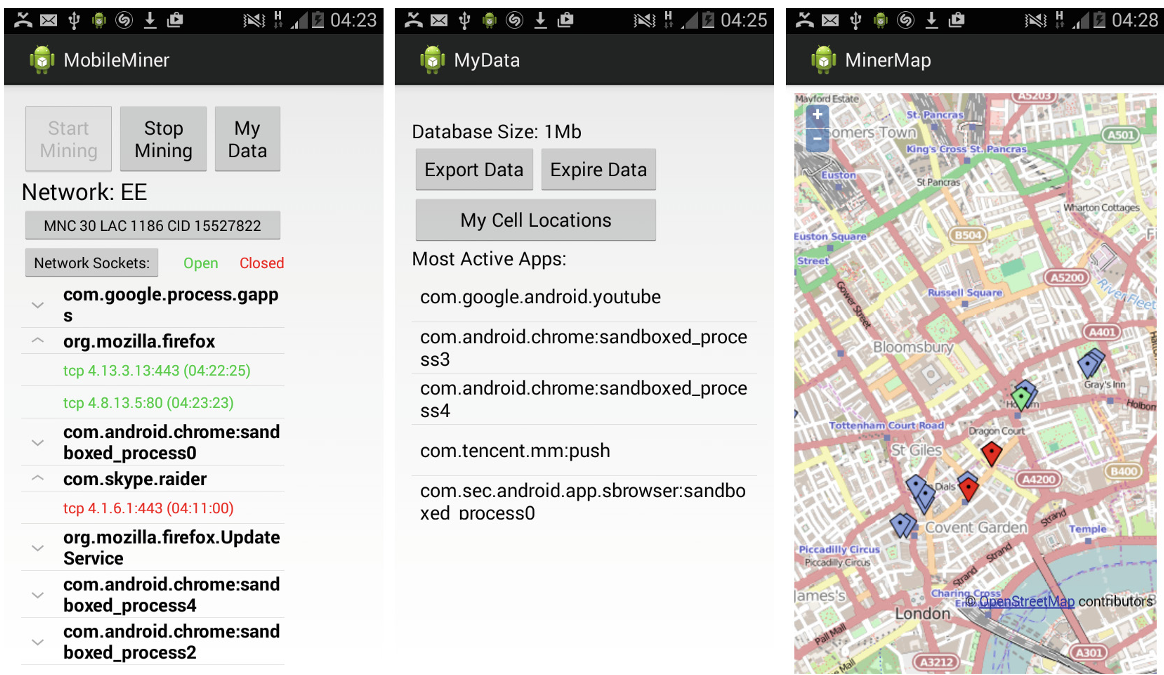
Instead of battery-draining GPS, the team used Cell Tower IDs. While less precise, they are ubiquitous and highly revealing.
Adding Velocity to k-Means
A standard k-Means cluster of locations often struggles with "journeys" (points that are close together because they were visited during a commute). To fix this, the authors used Feature Vectors containing both:
- Spatial Coordinates (Lat/Long)
- Estimated Velocity (Calculated via time intervals between tower switches)
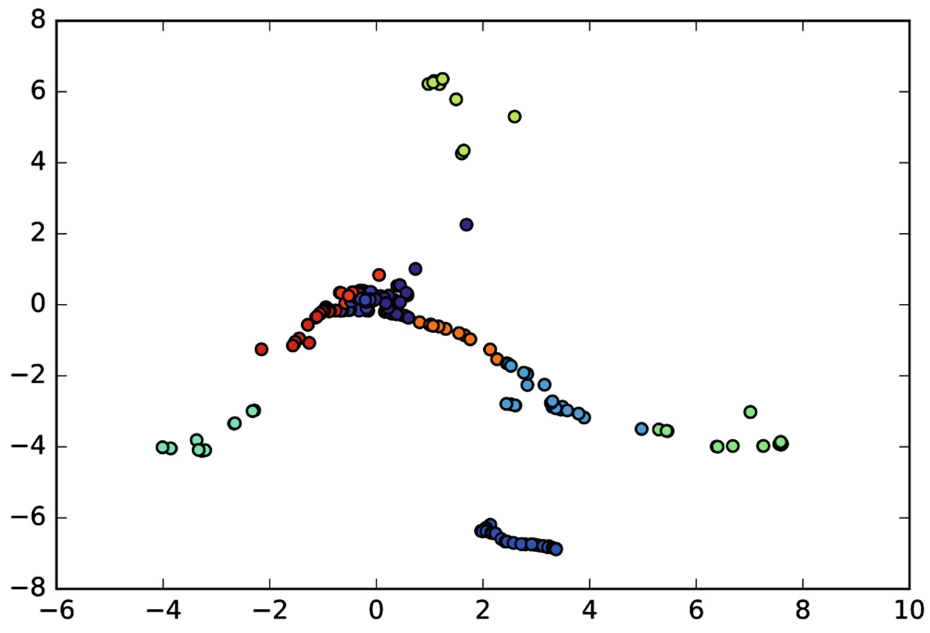
This allowed the algorithm to distinguish between a "place" (where the user stays put) and a "trip" (where the user moves at a consistent speed).
The "Scary" Accuracy of Random Forests
The highlight of the experiment was the predictive power of the processed data. By feeding the clustered "life places" and timestamps into a Random Forest classifier, the researchers could predict where a user would be at a given time and day with 99.9% accuracy.
| Metric | Multi-Class Prediction Accuracy |
|---|---|
| Dummy Classifier (Frequency based) | 50% |
| Naive Bayes | 75% |
| Random Forest (MCL + k-Means labels) | 99.9% |
This demonstrates that even without precise GPS, our routines are so rhythmic that "coarse data" is enough for a machine to learn our lives.
Deep Insights & Future Work
The study serves as a wake-up call for privacy and a toolkit for transparency.
- Insight: Social context (hashtags like #GE2015 or #Arduino) naturally aligns with the mathematical clusters found by MCL, proving that our network connections are deeply tied to our topical interests.
- Limitations: The 99.9% accuracy might suffer from "over-fitting" or the highly structured lifestyles of the young students in the study. Predicting the movements of a freelancer or a frequent traveler might yield lower scores.
- Takeaway: Transparency works. By co-developing the app with the subjects, the researchers successfully turned "surveillance data" into "educational insight."
Final Thought: If a simple random walk and a k-Means algorithm can map your life this effectively, imagine what the trillions of parameters in Big Tech's models are seeing.