
Can Online Participation Predict Performance? Decoding the "Source/Sink" Dynamics in Student Projects
Can Online Discussion Participation Predict Group Project Performance? Investigating the Roles of Linguistic Features and Participation Patterns
This study investigates whether online discussion behaviors can predict student performance in group programming projects. By applying machine learning to classify "Sink" (information-seeking) and "Source" (information-providing) roles alongside linguistic analysis, the researchers developed a predictive model where Source contributions and early participation significantly correlate with higher project grades.
Executive Summary
TL;DR: It’s not about how much you talk, but what you say and when you say it. This research demonstrates that students who act as "Sources" (providing answers) and those who engage early in the project lifecycle achieve significantly better grades. Conversely, simply asking questions ("Sinks") or using technical jargon does not guarantee success.
Background: Published in the International Artificial Intelligence in Education Society, this work bridges the gap between raw data mining and pedagogical insight. It moves beyond simple post-counting to treat discussion boards as a window into a student's cognitive engagement and time-management habits.
Problem & Motivation: The Vanity Metric Trap
Instructors often look at "message counts" as a proxy for engagement. However, the authors argue that this is a "vanity metric." A student could post 50 times asking for help (high quantity, low mastery) or 5 times providing definitive solutions (low quantity, high mastery).
The challenge lies in Automation vs. Nuance. Manual qualitative analysis of thousands of forum posts is impossible for a professor. The authors set out to build an automated pipeline that could "read" student dialogue and identify the behavior patterns that actually lead to an 'A' grade.
Methodology: The "Sink" and the "Source"
The core innovation lies in the classification of "Information Roles."
- Sink (Information Seeker): Messages requesting help or clarification.
- Source (Information Provider): Messages giving hints, answers, or troubleshooting steps.
1. The Architecture of Analysis
The authors built a pipeline involving:
- Noise Reduction: Stripping out C++ code blocks and normalizing informal speech (e.g., "shud" "should").
- SVM Classifiers: Built using Speech Act theory to distinguish between Sinks and Sources with over 90% accuracy.
- Linguistic & Temporal Tools: Using LIWC for emotion tracking and Coh-Metrix for text cohesion.
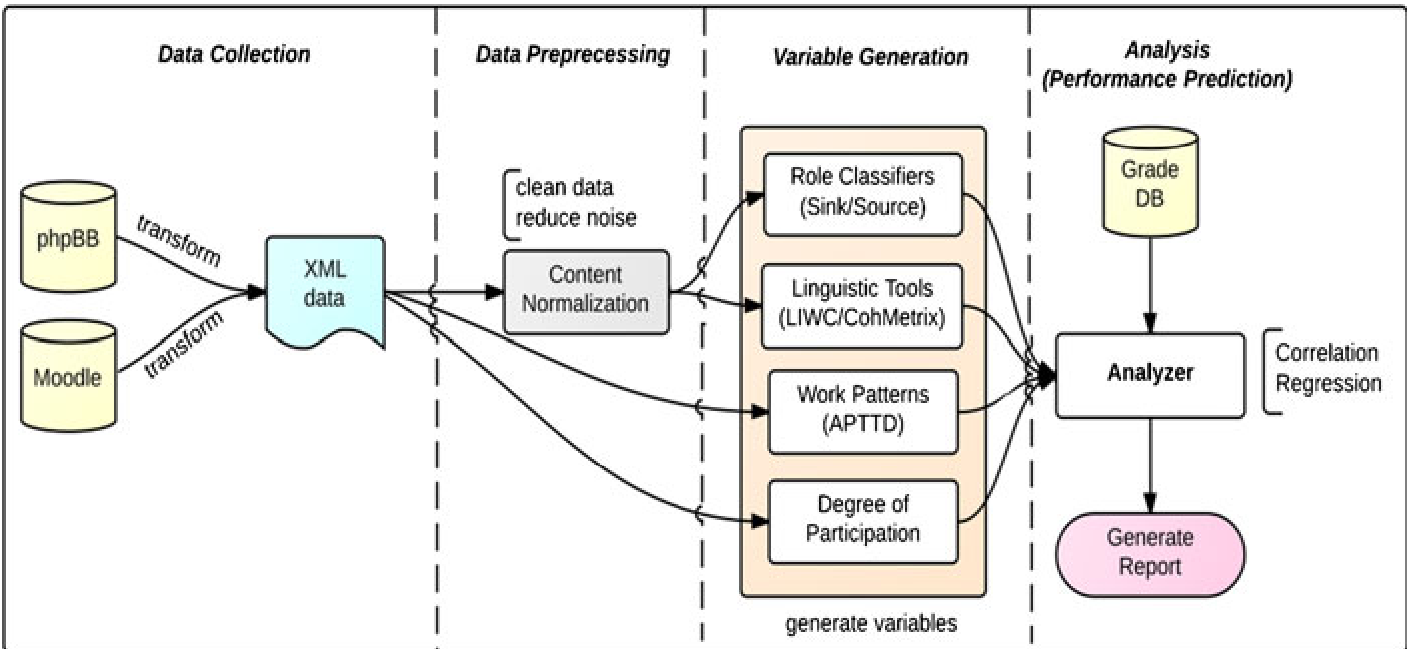 Figure 1: The study's procedural framework, showing the journey from raw Moodle/phpBB data to performance prediction.
2. Temporal Analysis (Procrastination vs. Pacing)
The researchers introduced APTTD (Average Posting Time To Deadline). By calculating how far a post is from the due date, they could mathematically identify "procrastinators" vs. "proactive workers."
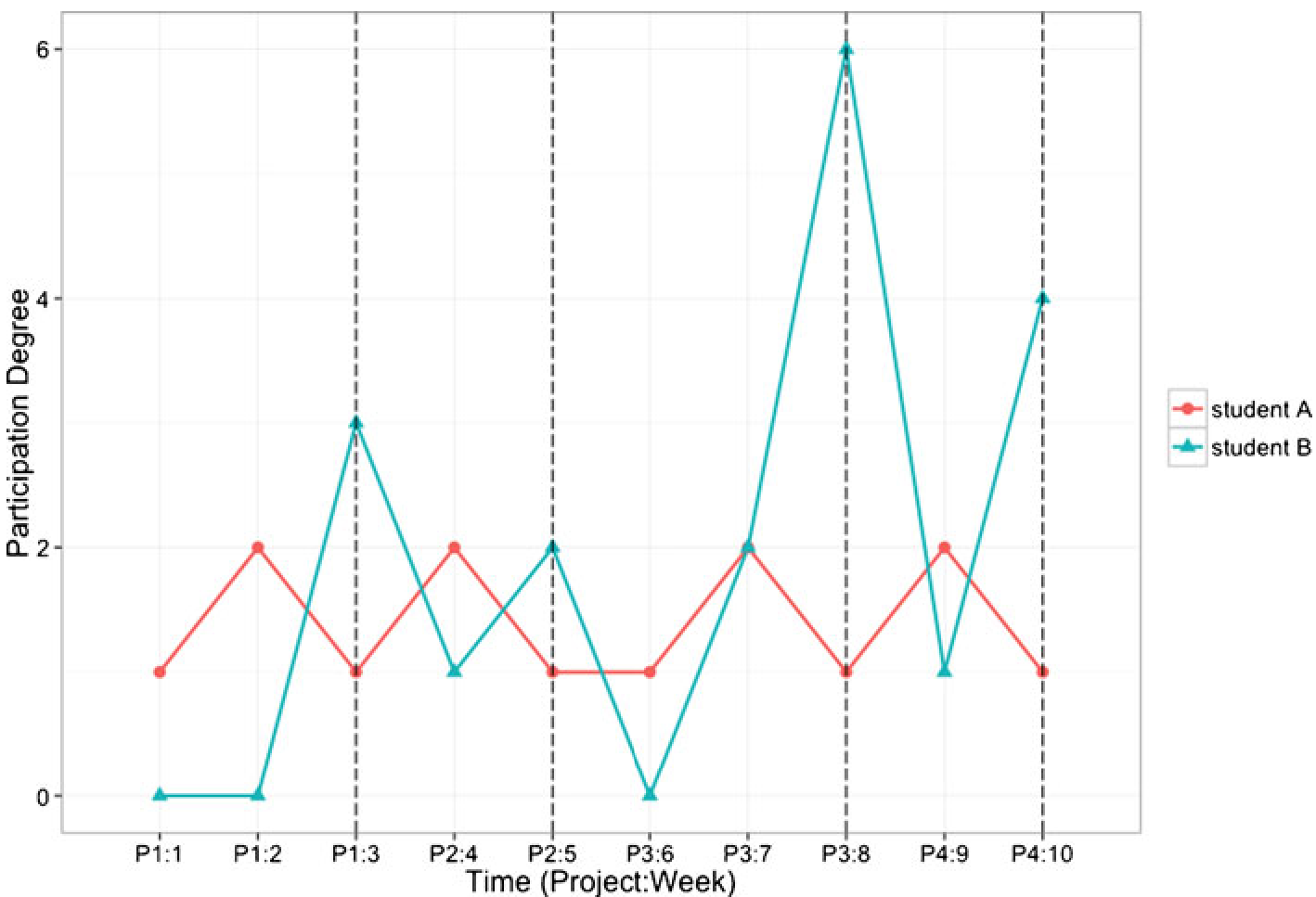 Figure 2: A visual contrast between Student A (early, consistent participation) and Student B (last-minute "deadline spikes").
Results: What Actually Matters for Grades?
The results from 173 student groups across eight semesters are revealing:
- Being the Teacher Helps: The "Source" role had the strongest correlation with high grades (). Explaining concepts to others reinforces the explainer's own understanding.
- Early Birds Win: APTTD was a significant predictor (). Groups that started discussions early had more time for the "iterative discovery" required in complex programming.
- Positive Vibes: "Positive Emotion" expressions (like thanking peers) were a minor but significant predictor, likely indicating a healthy, collaborative group environment.
The "Non-Predictors"
Surprisingly, several common metrics did not matter:
- Technical Term Density: Using more "fancy CS terms" didn't correlate with better grades.
- Text Cohesion/LSA: The complexity or flow of the writing itself was irrelevant to the technical success of the project.
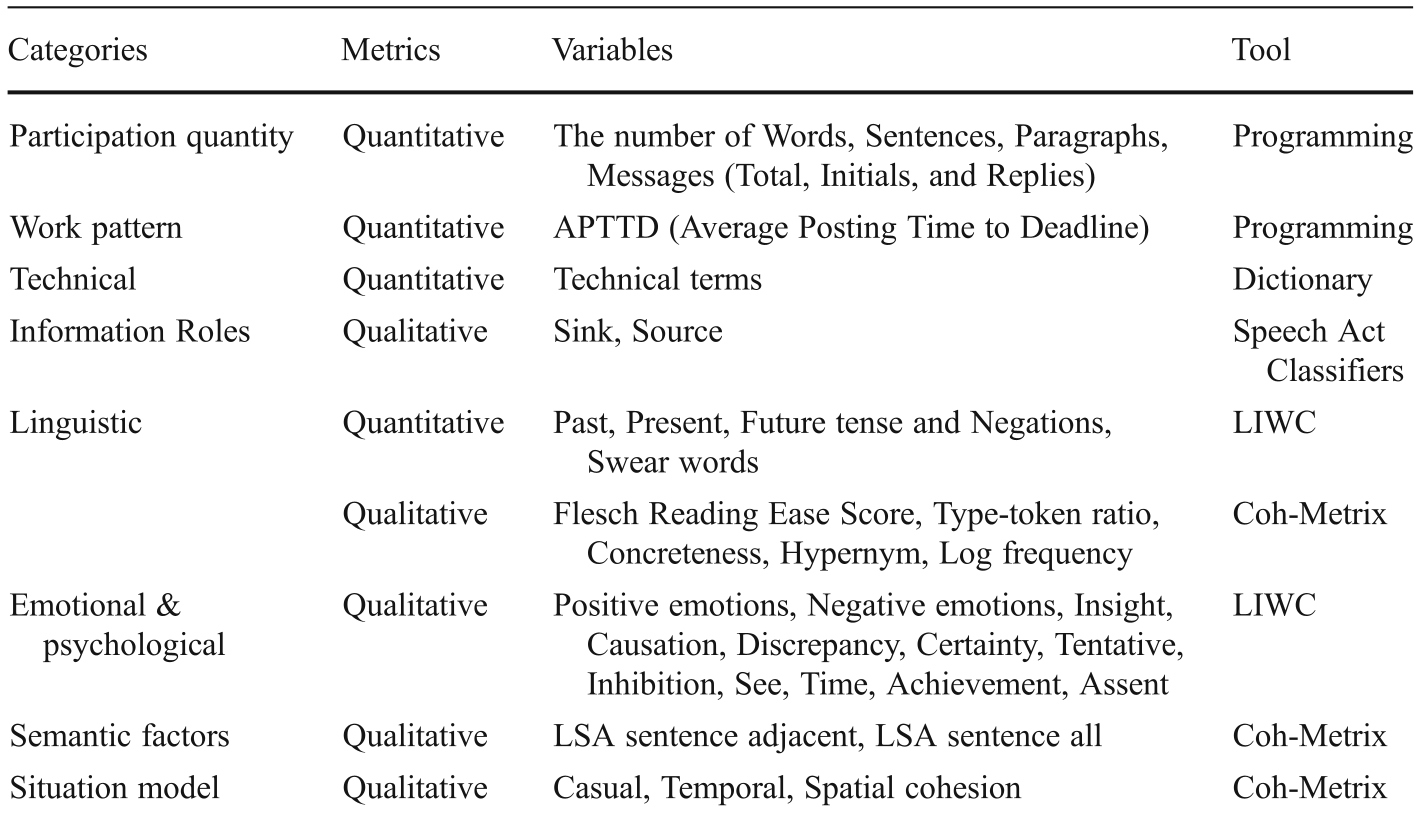 Figure 3: Summary of the predictive variables and their categories used in the regression model.
Critical Analysis & Conclusion
Takeaway: This paper provides a blueprint for "Just-in-Time" instructional interventions. Instead of waiting for a project to be failed, instructors can use these automated alerts to identify "Sink-only" groups or "Procrastinating" groups in week two of a project.
Limitations:
- Domain Specificity: The study is limited to Computer Science. In a Philosophy or Literature course, "Linguistic Cohesion" might become a top predictor.
- Representative Bias: In 27% of groups, one student acted as a "representative" for the whole team, potentially masking the performance indicators of their quieter teammates.
Future Outlook: With the advent of Large Language Models (LLMs), the "Sink/Source" classification could be made even more nuanced today, potentially identifying not just if help was given, but the pedagogical quality of that help.